How Next Panel Reviews Art, Writing, Pacing, and Characters
Quick Answer
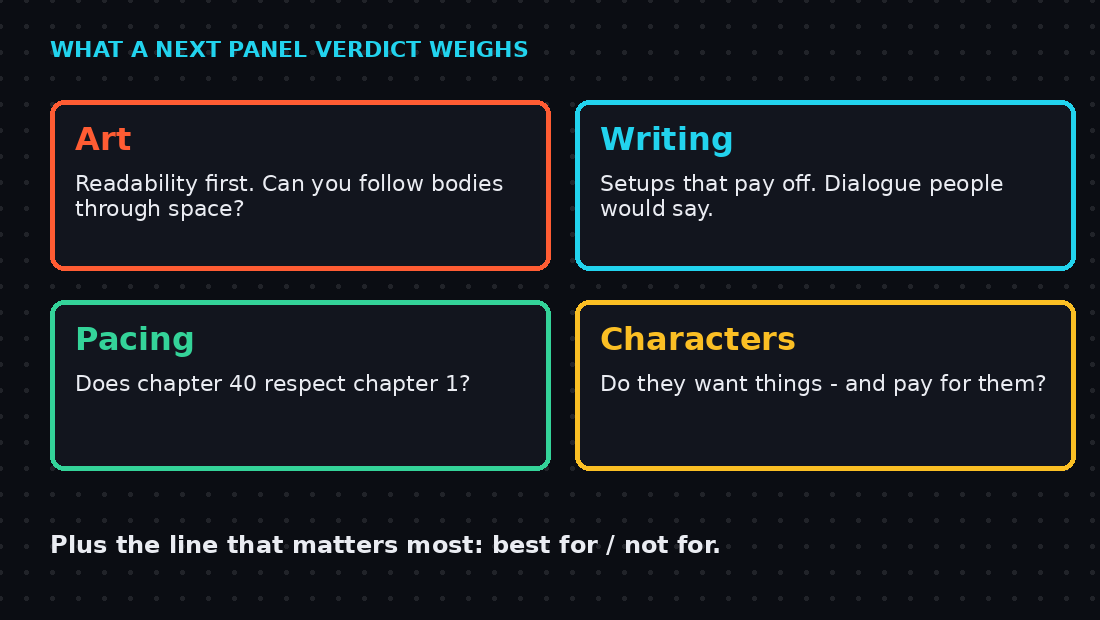
Next Panel reviews weigh four crafts separately - art (readability before beauty), writing (setups that pay off), pacing (does chapter 40 respect chapter 1), and characters (do they want things and pay for them) - then translate the verdict into best-for/not-for guidance rather than pretending one number fits all readers.
Trust in a review site comes from one place: knowing how the verdict got made before you read it. So here's our method, in public, specific enough to argue with. This is the page every review on Next Panel quietly points back to.
The question each review answers hasn't changed since we wrote it on the wall: should I read this, what is it like, and where can I read it officially. Four crafts get weighed to answer it.
Art: readability before beauty
"The art is good" is the least useful sentence in comics criticism, so we banned it. We grade things you can check. Readability: in an action sequence, can you follow bodies through space, or is it impressive noise? Control: does the artist decide your reading speed - holding you on a beat panel, sprinting you through a fight? Consistency: does chapter 80 look like chapter 8, or did the schedule eat the artist? Identity: would you recognize a page blind?
Beauty matters too - we're not robots - but beauty without readability reviews badly here, and workmanlike art that serves its story reviews better than you'd expect.
Writing: setups, payoffs, and people who talk like people
Plot summary isn't analysis, so our writing sections look at machinery instead. Do setups pay off, and were they visible in hindsight - the fair-play test. Does dialogue sound like people deciding things, or like exposition wearing a face? Does the story know what it's about, and does that survive success? (Many series have a thesis for twenty chapters and a content treadmill after.) Translation quality gets noted when it helps or hurts - official translations are usually solid, but voice is a craft of its own.
Pacing: the forty-chapter question
Pacing is where serialized comics live or die, and where reviews written off three chapters lie by accident. Our rule: a review weighs the run, not the audition. Does the story respect its own escalation, or does every arc reset the stakes to zero? Do quiet chapters earn their place (they should - the best ones are load-bearing)? For webtoon-format series we also weigh the scroll itself: episode rhythm, cliff discipline, whether the weekly shape would exhaust or sustain you.
Slow is not a defect. Unearned slow is. The review will always tell you which one you're walking into.
Characters: do they want things, and do they pay?
The fastest tell of a series that will collapse: a protagonist who is a camera. We look for wants with costs - characters whose desires create the plot rather than receiving it. Antagonists with their own arithmetic. Side casts that remember things. Growth that gets paid for instead of announced. When a review says the lead "avoids the blank-slate trap," this is the test it passed.
Then the verdict gets honest
The four crafts produce the rating; the useful part is the translation underneath. Best for / not for is the line we'd defend hardest in every review - because an 8 with the right reader beats a 9 with the wrong one, and pretending one number fits everyone is how review sites train readers to ignore them. Spoiler levels stay labeled, disclosure boxes appear wherever money could be suspected of leaning on a verdict (it doesn't - the editorial policy is blunt about this), and every review ends at an official reading link, because a verdict that strands you was never finished.
Disagree with a verdict? Genuinely - write in. Reviews get revisited when works change or when a reader's argument is better than ours. It has happened. It will happen again.
Frequently Asked Questions
What does the rating out of 10 actually mean?
9-10 is reserved for series we'd recommend to almost anyone; 8 is excellent with caveats; 7 is good for the right reader; below that, the review explains precisely why. The best-for line carries more information than the number.
How can you judge art objectively?
We don't claim to. We judge specific, checkable things: can you follow action through space, does the artist control your reading speed, does episode 80 look like episode 8. Beauty is taste; readability and consistency are craft.
Do panels appear in reviews?
In limited form, only to support specific commentary, always credited with a link to read the work officially - never as a way to read the work here. Our copyright policy covers the details.
What makes you change a published verdict?
The work changing. Ongoing series get revisited at milestones - a collapse in act three or a glow-up after a rough start both earn an updated review with the change noted.