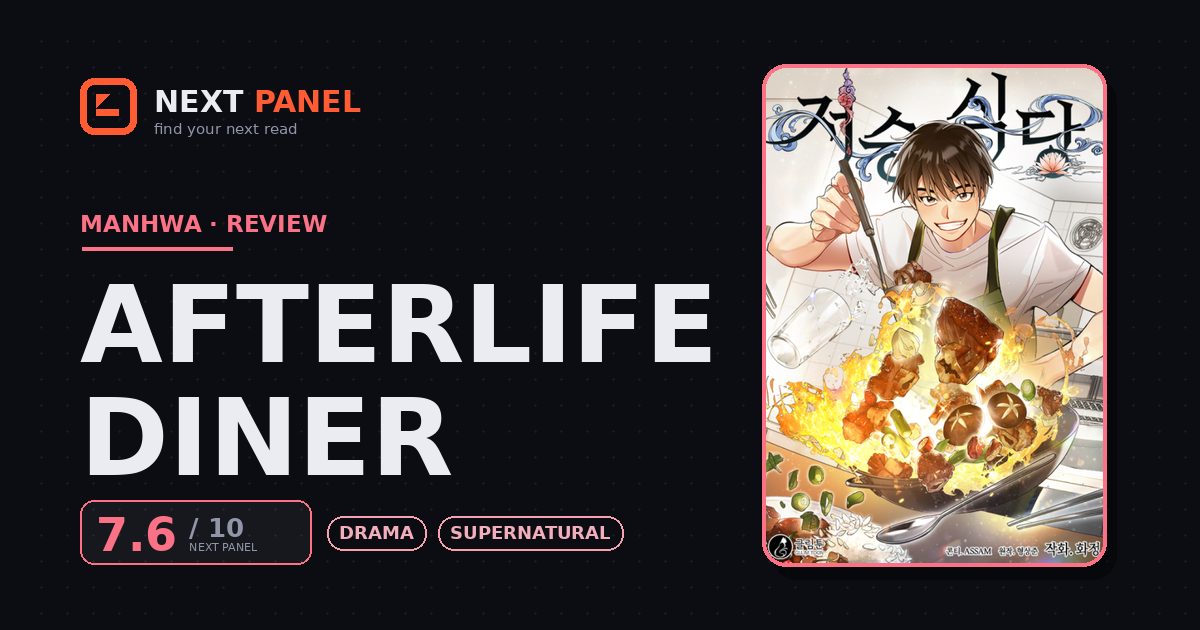
Is Afterlife Diner Worth Reading? Review & Where to Read
Quick Answer
If you want a supernatural slice-of-life built on food, grief, and quiet closure rather than horror or high stakes, yes — each ghost's story lands with real emotional weight.
Quick Verdict
“The ghosts who wander into Kang-Jin's diner aren't there to haunt anyone — they're there because a plate of the right food is the closest thing to unfinished business they have left, and that's what makes this manhwa work.”
Best for: Readers who want an episodic, food-centered supernatural drama that uses each ghost's story to explore grief, regret, and quiet comfort.
Not for: Readers who want the ghost premise to lean into horror or a driving overarching plot rather than standalone emotional stories.
- Type
- Manhwa
- Genres
- Drama, Slice of Life, Supernatural
- Status
- Ongoing
- This review
- Minor Spoilers
- Author
- ASSAM
- Artist
- Hwa-Jeong
- Publisher
- Tapas
- Platform
- Tapas
| Quick facts | |
|---|---|
| Format | Manhwa, 128 chapters |
| Run | 2023–present · ongoing |
| Community score | AniList 7.2 · MangaUpdates 7.3 |
| Where to read | Tapas — official |
Overview
Lee Kang-Jin inherits an entire building in Seoul's affluent Gangnam neighborhood — a life-changing windfall with one condition attached. He has to run the diner inside it for five years. What nobody tells him upfront is who the late-night customers actually are: between 11 p.m. and 1 a.m., ghosts carrying resentment from their old lives show up looking for the comfort food that reminds them of who they used to be. Kang-Jin's inheritance turns out to come with a job he never signed up for — cooking for the dead as much as the living.
What it does well
The choice to use food as the connective tissue between Kang-Jin and his ghostly customers gives this manhwa real emotional precision. A dish isn't just a dish here — it's tied to a specific memory, relationship, or regret, and that specificity keeps each ghost's story from blurring into generic supernatural sentimentality.
The five-year condition on the inheritance gives the series useful structure without forcing false urgency onto what's fundamentally a gentle, episodic format. It's a frame the story can return to without needing every chapter to escalate toward some bigger conflict.
Kang-Jin himself grows into the role in a way that matters. He's not simply serving food to strange customers — he has to actually engage with their grief and unfinished business, which keeps him an active presence in his own story rather than a passive host.
Where it falls short
The ghost-of-the-week structure means the overarching thread of Kang-Jin's five-year obligation advances slowly between individual stories, and readers looking for a stronger throughline may find the pacing meandering.
Not every ghost vignette lands with the same emotional weight — some stories hit harder than others, and the overall experience can feel a little uneven chapter to chapter.
And because the tone stays firmly on the side of comfort and closure, readers hoping for the supernatural premise to build toward mystery or real stakes may find the show content to stay small and personal instead.
Verdict
This is a quietly moving supernatural slice-of-life that uses food as a language for grief and closure. If you want an episodic manhwa where each chapter's ghost has something real to say about what they left unfinished, Afterlife Diner delivers that consistently, even if its overall plot moves at a gentle pace.
Strengths & Weaknesses
Strengths
- Using food as the bridge between the living and the dead gives the supernatural premise real emotional specificity — each ghost's request for a particular dish says something about who they were and what they left unresolved.
- The five-year condition on Kang-Jin's inheritance gives the story a clear structural frame without forcing an artificial sense of urgency into what's otherwise a gentle, episodic format.
- Kang-Jin's own growth as someone who has to genuinely listen to his customers' grief, rather than just cook for them, keeps him from being a passive audience surrogate.
Weaknesses
- The episodic, ghost-of-the-week structure means the overarching plot around Kang-Jin's five-year obligation moves slowly between individual stories.
- Some of the ghost vignettes lean harder on sentiment than others, and the emotional hit can vary from chapter to chapter.
- Readers wanting the supernatural elements to build toward larger stakes or mystery may find the show's comfort-first tone limits how far the ghost premise is pushed.
Similar Titles
Different premise, similar gentle emotional pacing for readers who want warmth over high stakes.
The Beloved Incompetent Stepmom
Shares a quiet, character-focused approach to found family and emotional healing.
Where to Read Officially
| Platform | Format | Pricing | Region notes | Link |
|---|---|---|---|---|
| Tapas | Digital chapters | Free + Paid | Region availability varies | Open |
Frequently Asked Questions
Are the ghosts dangerous?
No, they're portrayed as carrying unresolved resentment or grief rather than being hostile — the diner functions more as closure than confrontation.
Why does Kang-Jin have to run the diner for five years?
It's the condition attached to inheriting the building, and it's what puts him in contact with the ghosts in the first place.
Is this series finished?
No, it's ongoing, with new ghost stories and chapters still being released.