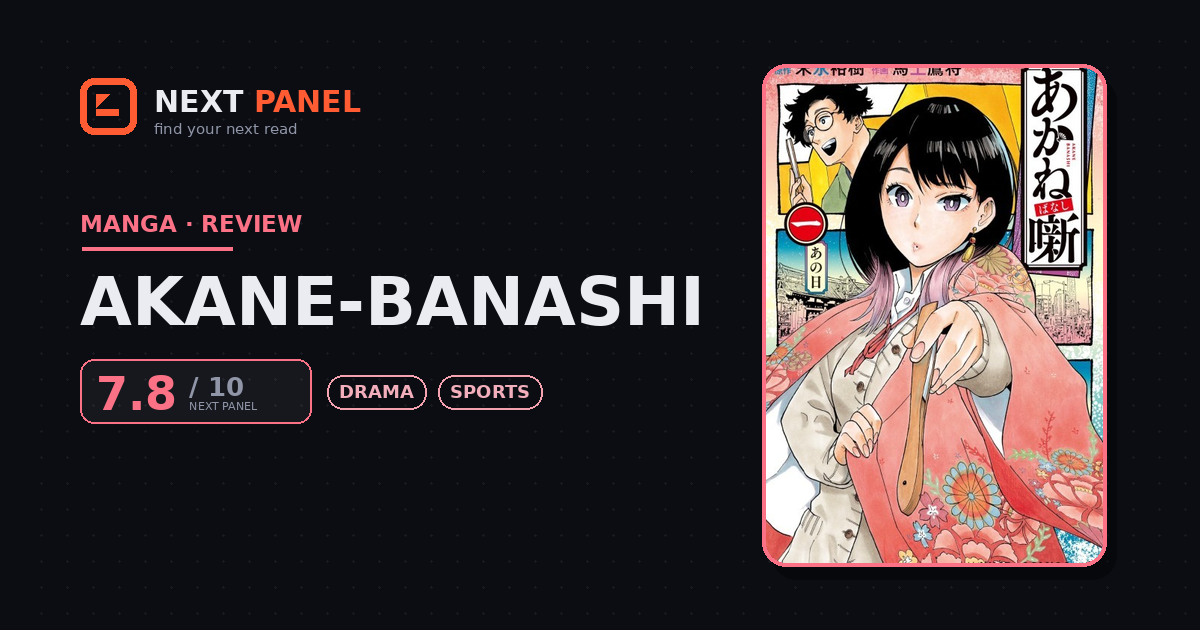
Is Akane-banashi Worth Reading? Review & Where to Read
Quick Answer
It does, and more easily than you'd expect. Akane-banashi treats a single performer sitting on a cushion telling a story as genuine competitive drama, and the craft on display makes the niche subject accessible fast.
Quick Verdict
“Watching one person tell a joke shouldn't be this tense, but Akane-banashi makes a centuries-old storytelling art feel like a real competition worth caring about.”
Best for: Readers who want a competitive, growth-driven shonen built around craft and performance rather than fighting or superpowers.
Not for: Readers who want constant plot momentum instead of scenes that slow down to let a single performance play out.
- Type
- Manga
- Genres
- Drama, Sports
- Status
- Ongoing
- This review
- Minor Spoilers
- Author
- Yuki Suenaga
- Artist
- Takamasa Moue
- Publisher
- Shueisha
- Platform
- VIZ / Shonen Jump
| Quick facts | |
|---|---|
| Format | Manga (shōnen), 20 volumes |
| Run | 2022–present · ongoing |
| Community score | AniList 8.1 · MangaUpdates 7.7 |
| Where to read | VIZ / Shonen Jump — official |
Overview
Akane Osaki wants to become a shin'uchi, the highest rank in rakugo — a centuries-old Japanese art where a single performer, seated on a cushion, acts out an entire comedic story alone, using nothing but voice, timing, and a fan or hand towel as props. Her father was a promising rakugo performer whose career was destroyed after a rival accused him of stealing material, and Akane's climb through the rakugo world's strict apprentice ranks is driven by the goal of proving he was framed. Written by Yuki Suenaga and illustrated by Takamasa Moue, Akane-banashi has run in Weekly Shonen Jump since February 2022 and is still ongoing.
What it does well
The core trick of Akane-banashi is making you care about a performance style that, on paper, sounds like the least "shonen" premise imaginable — one person, sitting still, telling a story. It works because the manga treats every rakugo routine as a real contest with real stakes: audience reaction, formal grading, career-making or career-ending consequences. Moue's art finds ways to dramatize a seated performer through framing, pacing, and reaction shots that make you feel the room's energy shift, which is a genuinely hard problem to solve in a medium with no sound.
The other strength is how specific Akane's motivation is. She's not chasing an abstract dream of being the best — she's trying to clear her father's name in an industry that ended his career over an accusation, and that grounds every rank-up and every performance in something concrete. Along the way, the manga doubles as a real introduction to rakugo as an art form: its ranks, its etiquette, the relationship between a performer and the classic stories they inherit and reinterpret. It never feels like a lecture, because the information always serves the next performance you're about to watch play out.
Where it falls short
The central challenge — showing why a performance is great when the medium can't convey voice or timing directly — doesn't always land. Some sequences lean on other characters' reactions to sell a routine's quality rather than fully making you feel it yourself, and that gap is more noticeable in quieter chapters.
The supporting cast of rival and veteran performers is large, and outside of their signature routines, several of them are hard to tell apart in terms of personality. The manga's occasional detours into rakugo association politics and rank-committee maneuvering are necessary world-building, but they move at a noticeably slower pace than the performance-driven chapters, and a few of these stretches feel like they're delaying the next actual showcase rather than building toward it.
Verdict
Akane-banashi takes one of the least obviously "shonen" premises possible and turns it into a genuinely tense, well-observed competitive drama. It won't hook you the same way a fight scene would, but if you give the first few chapters room to work, it's one of the more distinctive ongoing series in Weekly Shonen Jump right now.
Strengths & Weaknesses
Strengths
- The premise is genuinely fresh for Weekly Shonen Jump — turning rakugo, a centuries-old solo comedic storytelling art, into competitive shonen drama shouldn't work as well as it does.
- Takamasa Moue finds real visual ways to make a single seated performer holding an entire room feel dynamic, which is a hard trick to pull off in a static medium.
- Akane's drive comes from a specific, grounded wound — her father's career destroyed by a rival's accusation — instead of a generic 'become the best' motivation.
- The manga actually teaches you how rakugo works, from formal ranks to audience-reading technique, without the explanations turning into a lecture.
Weaknesses
- A lot of what makes a rakugo performance great is about vocal timing and delivery, and translating that to a purely visual medium means some scenes have to tell you a performance is great rather than fully show it.
- The supporting cast of performers can blur together once you're outside their signature routines.
- The behind-the-scenes rank politics and industry subplots move slower than the performance chapters and can feel like a detour from what the series does best.
Similar Titles
same interest in treating a niche discipline's craft and grind as real competitive drama
shares the quiet, character-first take on a traditional competitive art form
similar pressure-of-performance drama, with a young lead finding their voice under scrutiny
Where to Read Officially
| Platform | Format | Pricing | Region notes | Link |
|---|---|---|---|---|
| VIZ / Shonen Jump | Digital chapters | Print & digital volumes | Free + Paid | Region availability varies | Open |
Frequently Asked Questions
Is Akane-banashi finished?
No, it's ongoing — serialized in Weekly Shonen Jump since February 2022, with 22+ volumes collected as of mid-2026 and new chapters still releasing.
Do I need to know anything about rakugo going in?
No. The manga explains the ranks, etiquette, and technique of rakugo as Akane learns them, so no outside knowledge is required.
Is Akane-banashi a sports manga even though there's no sport?
It's structured like one — ranked competition, rivals, a clear path to the top — just applied to a solo storytelling art instead of an athletic one.