Is Akira Worth Reading? Review & Where to Read
Quick Answer
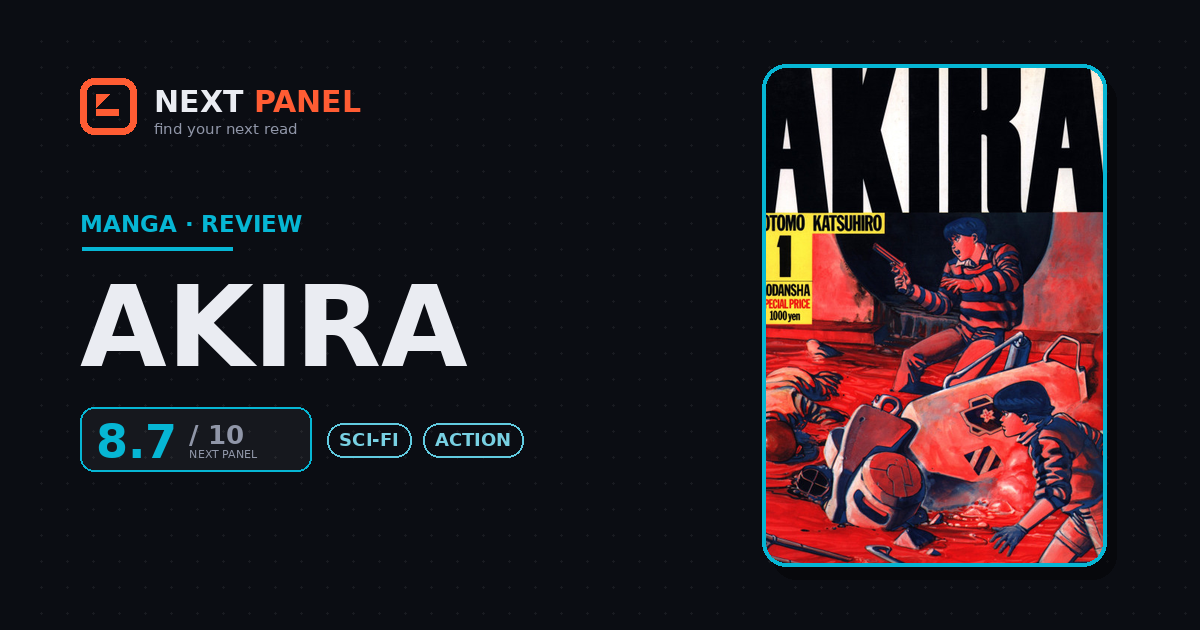
Yes, it's essential. Akira's art and worldbuilding are landmark, genre-defining work, and its influence is everywhere. Just know the plot gets chaotic in the later volumes and the characters are thin next to the spectacle.
Quick Verdict
“Some of the most staggering art ever drawn powers this landmark cyberpunk epic — essential and thrilling, even as the plot sprawls into chaos in its later volumes.”
Best for: Readers who want a landmark, spectacle-driven cyberpunk epic with revolutionary art.
Not for: Readers who want a tight, easy-to-follow plot or deep character work.
- Type
- Manga
- Genres
- Sci-Fi, Action
- Status
- Completed
- This review
- Minor Spoilers
- Author
- Katsuhiro Otomo
- Publisher
- Kodansha
- Platform
- Kodansha
| Quick facts | |
|---|---|
| Format | Manga (seinen), 120 chapters, 6 volumes |
| Run | 1982–1990 · completed |
| Community score | AniList 8.4 · MAL 8.7 · MangaUpdates 8.5 |
| Content | Violence, gore |
| Where to read | Kodansha — official |
Overview
Akira is one of the most influential comics ever made, full stop. Set in Neo-Tokyo, a sprawling, corrupt megacity rebuilt after a mysterious explosion leveled the original, it follows Kaneda, a cocky biker-gang leader, and his friend Tetsuo, whose latent psychic powers erupt after an accident and spiral violently out of his control. As Tetsuo's abilities grow monstrous, they pull in the military, a secret government program, and the looming mystery of "Akira." It's a massive, kinetic cyberpunk epic, and Katsuhiro Otomo's art reshaped what a lot of people thought the medium could even do.
What it does well
The art is the headline, and it earns it. Otomo draws with staggering detail and energy, and his action, motion, and large-scale destruction still look revolutionary decades on. The famous set-pieces, the bike chases, the city-shaking catastrophes, have a weight and clarity that countless artists have tried to copy since.
The worldbuilding is the other pillar. Neo-Tokyo is one of cyberpunk's defining settings, a grimy, neon-lit sprawl of gangs, protests, and rot, and the sheer density of it makes the world feel alive and lived-in. You can draw a straight line from Akira to a huge amount of the sci-fi that followed, in comics, film, and games alike.
It also moves. For all its scale, the momentum is relentless, and the spectacle is genuinely thrilling. Underneath the chaos run real themes about power, youth, decay, and the failures of authority, which give the carnage more meaning than pure action would. The early volumes in particular, before the scale explodes, are some of the tightest, most relentless comics you can read.
Where it falls short
The plot is the weak point. As it goes, the story sprawls and grows increasingly chaotic and abstract, especially in the later volumes, where the escalating psychic apocalypse can be genuinely hard to follow. It prioritizes scale and imagery over a clean, trackable narrative.
The characters are also fairly thin next to the spectacle, serving the epic more than driving it. And it's a dense, demanding read; the scope can overwhelm, and it asks more patience than its breakneck reputation suggests.
Verdict
Akira is essential, both as a landmark in manga history and as a still-stunning piece of work. The art alone justifies reading it, and its influence on cyberpunk and the medium is impossible to overstate. Go in for the spectacle, the world, and the craft rather than a tidy plot or deep characters, and brace for the later volumes getting chaotic. If you want a clean, easy story it will frustrate you, but as a monumental, genre-defining epic, little else compares, and it's complete.
Strengths & Weaknesses
Strengths
- Katsuhiro Otomo's art is staggering — detailed, kinetic, and full of destruction and motion that still looks revolutionary decades later.
- Its cyberpunk worldbuilding is hugely influential, and Neo-Tokyo is one of the genre's iconic settings.
- It has relentless momentum and spectacle, with action and set-pieces that are genuinely thrilling.
- There's real thematic weight underneath — power, youth, decay, and authority all run through it.
Weaknesses
- The plot sprawls and grows chaotic and abstract, especially in the later volumes, where it can be hard to follow.
- The characters are fairly thin next to the spectacle.
- It's dense and demanding, and the sheer scope can overwhelm.
Similar Titles
Another landmark sci-fi seinen with big ideas, though more restrained and character-focused.
Another influential sci-fi-horror manga from a similar era of bold ideas.
Another gritty, imaginative series with a wild world and standout art.
Where to Read Officially
| Platform | Format | Pricing | Region notes | Link |
|---|---|---|---|---|
| Kodansha | Print & digital volumes | Paid | Region availability varies | Open |
Frequently Asked Questions
Is the Akira manga different from the famous movie?
Yes, significantly. The 1988 film compresses and changes a lot; the manga is far longer and goes much further. If you only know the movie, the manga is a deeper, different experience.
Is it finished?
Yes, it's complete in six large volumes, so you can read the whole epic.
Is it hard to follow?
It can be, especially in the later volumes where the plot gets chaotic and abstract. The art and momentum carry you, but it's a dense, demanding read.