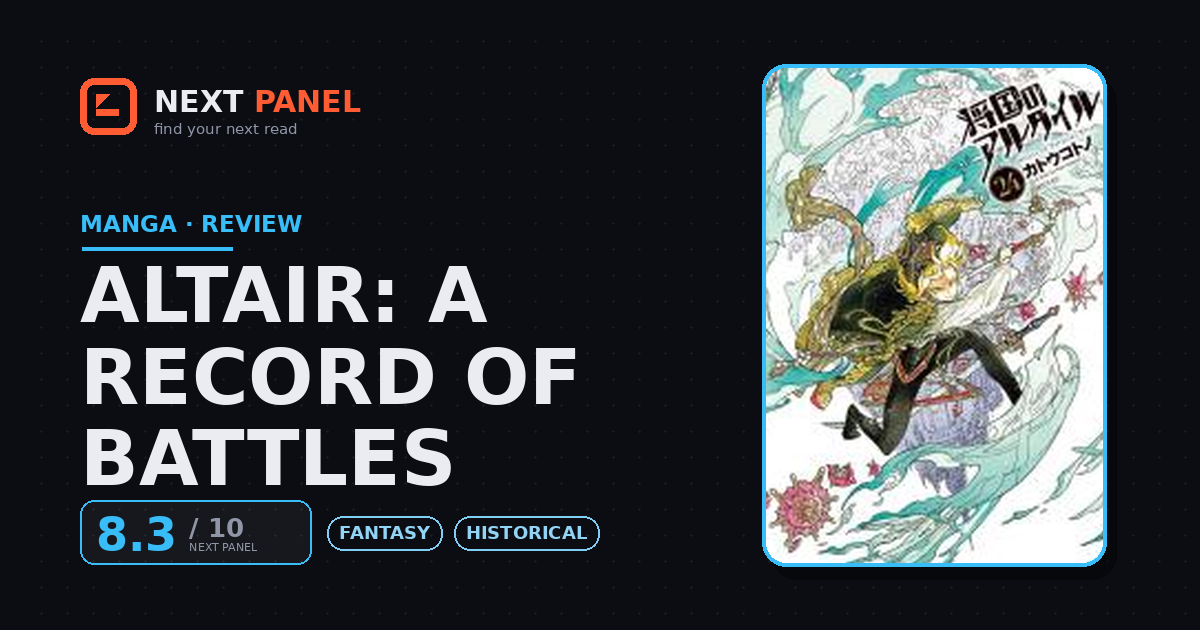
Is Altair: A Record of Battles Worth Reading? Review & Where to Read
Quick Answer
Yes, especially if you want political and military fantasy that treats diplomacy and strategy as seriously as combat. It's a slow-building, Ottoman-flavored war epic that rewards patience with real payoff.
Quick Verdict
“War manga usually gets there through the battlefield -- this one gets there through council chambers, treaties, and a teenage pasha who'd rather out-think his enemies than out-fight them.”
Best for: Readers who want political and military strategy manga in the vein of court intrigue and diplomacy-first storytelling, not just battlefield spectacle.
Not for: Readers looking for a fast-paced action series or immediate gratification -- this one builds its conflicts patiently over many volumes.
- Type
- Manga
- Genres
- Fantasy, Historical
- Status
- Completed
- This review
- Minor Spoilers
- Author
- Kotono Katou
- Publisher
- Kodansha
- Platform
- Kodansha USA (digital)
| Quick facts | |
|---|---|
| Format | Manga, 165 chapters, 27 volumes |
| Run | 2007–2023 · completed |
| Community score | AniList 7.6 |
| Where to read | Kodansha USA (digital) — official |
Overview
Mahmut is a young pasha serving in the council of Torqye, a fictional empire modeled loosely on the Ottomans, when the assassination of an Imperial minister threatens to ignite a war with the neighboring Balt-Rhein Empire. Altair: A Record of Battles follows Mahmut as he tries to uncover the truth behind the killing and steer his country away from a conflict that everyone around him seems eager to start.
What it does well
What sets Altair apart from most military fantasy is where it chooses to spend its time. Mahmut's real weapon isn't a sword -- it's information, negotiation, and a willingness to out-think opponents who assume war is inevitable. That makes for a lead who feels genuinely distinct in a genre crowded with characters who solve problems by charging at them, and it gives the series' quieter council-room scenes as much tension as any battlefield could.
The Ottoman-inspired setting does real work here too. Torqye and Balt-Rhein aren't generic fantasy kingdoms -- they're built with enough specific political and cultural texture that the rivalry between them feels historically grounded even though the story is fictional. That groundwork is part of why the manga earned the Kodansha Manga Award for Shounen in 2017: it commits fully to political complexity without losing sight of the human cost of the decisions being made. And because the story plays a long game, choices made early on ripple forward in ways that reward readers paying attention to the wider map rather than just the immediate scene.
Where it falls short
That same patience is a real barrier to entry. The pacing is deliberate, favoring councils and treaties over frequent combat, and the first several volumes ask a lot of readers before the political stakes fully click into place. The cast is large too -- ministers, rival pashas, and generals from two empires all need tracking, and it takes real investment before all the names and allegiances settle into a clear picture.
Verdict
Altair: A Record of Battles is a rare war story that trusts diplomacy and strategy to carry as much weight as combat. It asks for patience, but for readers willing to sit with its political chess game, it pays off as one of the more thoughtful military fantasy series out there.
Strengths & Weaknesses
Strengths
- Mahmut is a genuinely compelling lead precisely because his first instinct is negotiation and information-gathering, not the sword -- a rare take on a young military leader in a genre that usually skips straight to battle.
- The Ottoman-inspired setting (a fictionalized Torqye Pashalu facing off against a Balt-Rhein Empire modeled on the Holy Roman Empire) gives the political maneuvering real texture and stakes beyond generic fantasy kingdoms.
- The series won the Kodansha Manga Award for Shounen in 2017, recognition that reflects how well it balances complex political plotting with real emotional and moral weight.
- The story is patient about consequences -- decisions made early in council chambers pay off (or backfire) volumes later, which rewards readers willing to track the wider political picture.
Weaknesses
- The heavy focus on councils, treaties, and political maneuvering means the pacing is deliberately slow, and readers expecting frequent large-scale battles may find early volumes talk-heavy.
- The large cast of ministers, generals, and rival pashas across two empires takes real effort to track, especially in the first several volumes before the political map settles.
Similar Titles
Vinland Saga
Similar willingness to slow down and treat the cost and strategy of war as seriously as the fighting itself.
Legend of the Galactic Heroes
Same genre space of a young leader navigating war through strategy and political maneuvering rather than raw combat.
Where to Read Officially
| Platform | Format | Pricing | Region notes | Link |
|---|---|---|---|---|
| Kodansha USA (digital) | Digital | Paid | Region availability varies | Open |
Frequently Asked Questions
Is this a historical retelling of the real Ottoman Empire?
No -- it's a fictionalized fantasy world clearly inspired by Ottoman and Holy Roman Empire history and politics, not a direct historical account.
Is the series finished?
Yes, all 27 volumes are complete and fully available in English through Kodansha USA.
Is this more action-focused or politically focused?
Politically focused -- military conflict happens, but the manga spends most of its time on diplomacy, court intrigue, and strategic planning rather than battlefield action.