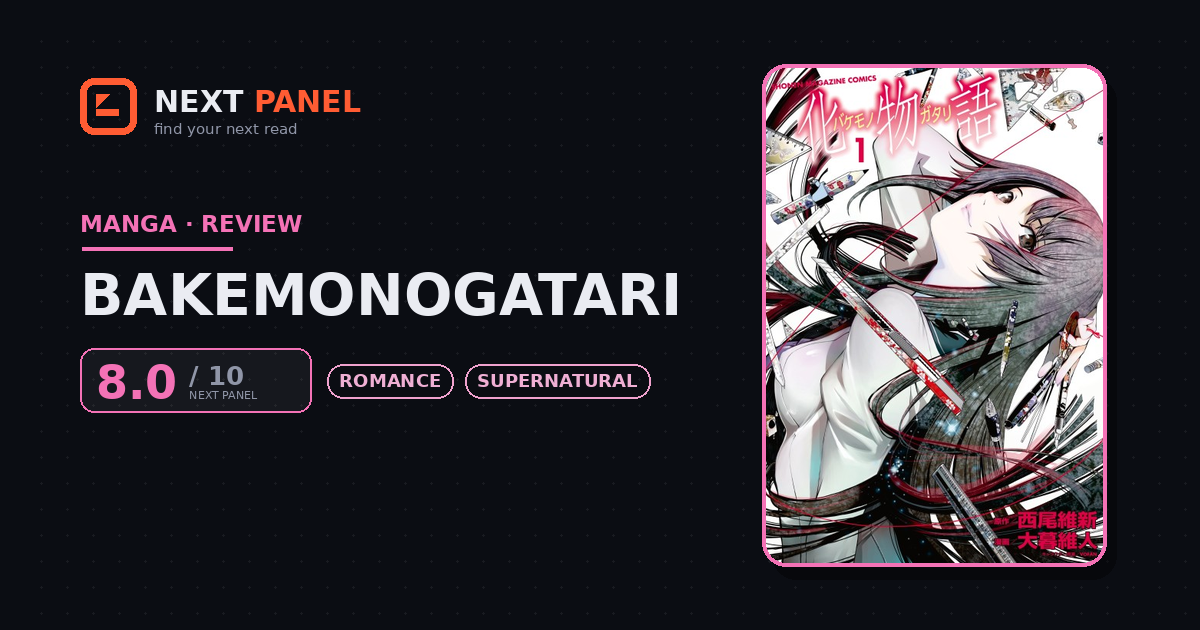
Is Bakemonogatari Worth Reading? Review & Where to Read
Quick Answer
Worth reading if you want a genre-defining, densely written supernatural mystery with stunning, showcase-level art.
Quick Verdict
“Worth it as one of the most influential supernatural manga of its era. It's talk-heavy and unapologetically fanservice-heavy, so go in knowing that's part of the package.”
Best for: Readers who want a genre-defining supernatural mystery with dense, wordplay-driven dialogue and some of the most striking, elaborate art in manga.
Not for: Readers who want fast-paced action or restrained fanservice. This series favors long philosophical exchanges over economical dialogue.
- Type
- Manga
- Genres
- Romance, Drama, Supernatural
- Status
- Completed
- Author
- NISIOISIN
- Artist
- Oh!Great
- Publisher
- Kodansha
- Platform
- Kodansha
| Quick facts | |
|---|---|
| Format | Manga, 193 chapters, 22 volumes |
| Run | 2018–2023 · completed |
| Community score | AniList 8.2 · MangaUpdates 7.9 |
| Where to read | Kodansha — official |
Overview
After surviving a vampire attack that left him mostly human but not entirely, high schooler Koyomi Araragi spends his final year of school running into girls whose personal struggles have quite literally taken monstrous form: a girl who weighs nothing after an encounter with a "crab," a lost child who can't find her way home no matter how hard she tries, a track star hiding a devil's monkey paw of a wish. Each arc pairs Araragi with a new heroine and a new "oddity" tied to something real she's hiding: grief, resentment, self-loathing, loneliness. It's less a monster-of-the-week story than an extended character study wearing supernatural clothing.
What it does well
The structure is the real achievement here: NISIOISIN uses the oddities as literal manifestations of psychological pain, so solving each "case" means actually confronting what's wrong with the person carrying it, and that gives every arc real emotional stakes underneath the mystery hook. The dialogue is the series' calling card, dense, digressive, funny, and genuinely unlike almost anything else in manga, characters banter through wordplay and philosophy in ways that reward paying close attention. And Oh!great's art is a legitimate showcase, panels twist, stretch, and reassemble themselves around the characters in ways few other artists attempt, giving even a purely conversational scene real visual energy. Backed by a strong, sustained reputation across its full 22-volume run and one of the most influential anime adaptations of its decade, this is a genre-defining work, not just a popular one.
Where it falls short
The dialogue-first structure means entire chapters can pass as two characters talk in circles before anything visibly happens, which will test the patience of readers who want momentum. More importantly, the series' persistent fanservice, including sexualized framing involving a character who's explicitly drawn and written as much younger than the rest of the cast, has drawn real and valid criticism from readers and critics alike, and it's worth knowing that going in rather than discovering it partway through. Oh!great's elaborate art can also tip into style-over-clarity territory in busier scenes. And even in a strong official localization, some of the wordplay and cultural specificity inevitably loses a little in translation.
Verdict
This is a genuinely influential, distinctively written supernatural series with showcase-level art, but it's also talk-heavy and carries real fanservice concerns that deserve a clear-eyed heads-up. If dense dialogue and psychological horror-lite mysteries sound appealing and you're comfortable with the fanservice, the complete run delivers on its reputation.
Strengths & Weaknesses
Strengths
- Genre-defining structure: each heroine's arc externalizes a real emotional wound as a supernatural "oddity"
- NISIOISIN's dialogue is genuinely distinctive, dense, witty, and unlike almost anything else in the medium
- Oh!great's art is a genuine showcase, dynamic, elaborate, and packed with visual invention
- Complete 22-volume run with a strong, consistent critical reputation across a full decade-plus
Weaknesses
- Extremely dialogue-heavy pacing; conversations often run for entire chapters before anything visibly happens
- Persistent fanservice, including sexualized framing around a character drawn much younger than the rest of the cast, has drawn real, valid reader criticism
- Oh!great's exaggerated art style and paneling can feel more showy than clear at times
- Dense wordplay and cultural references don't always translate cleanly, even in a strong official localization
Similar Titles
Same dialogue-driven, talk-your-way-through-the-case structure, without the supernatural or fanservice elements
Same moody, atmospheric Kodansha supernatural-romance tone, with a lighter, more restrained approach to fanservice
Where to Read Officially
| Platform | Format | Pricing | Region notes | Link |
|---|---|---|---|---|
| Kodansha | Digital chapters & print volumes (Kodansha) | Paid | Region availability varies | Open |
Frequently Asked Questions
Is there an official English translation?
Yes, Kodansha USA/Vertical publish the full 22-volume series digitally and in print through kodansha.us.
Do I need to read the light novels first?
No, this manga adapts the original Bakemonogatari novels directly and works as a self-contained entry point, though it's the first part of the larger Monogatari franchise.
Is the series finished?
Yes, the manga adaptation is complete at 22 volumes.
Is this connected to the anime?
Yes, it adapts the same source novels as Shaft's popular 2009 Bakemonogatari anime, though the manga and anime are separate adaptations.