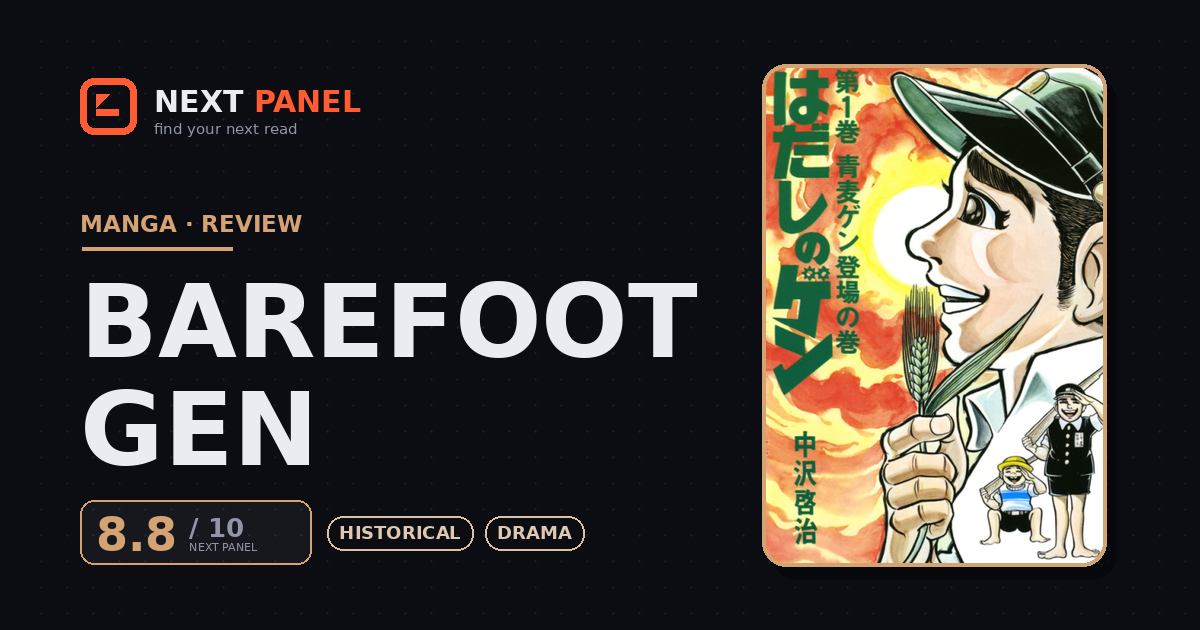
Is Barefoot Gen Worth Reading? Review & Where to Read
Quick Answer
Yes, if you can handle unflinching depictions of war and its aftermath. This isn't entertainment in the usual sense — it's a firsthand account that earns every bit of its reputation.
Quick Verdict
“There's no other manga quite like it, and there probably shouldn't be. Essential reading, but go in knowing exactly what you're signing up for.”
Best for: Readers who want historical fiction grounded in real survivor testimony and aren't looking away from hard subject matter.
Not for: Readers who want a comfortable read or who are sensitive to graphic depictions of war, injury, and death.
- Type
- Manga
- Genres
- Drama, Historical
- Status
- Completed
- This review
- Minor Spoilers
- Author
- Keiji Nakazawa
- Publisher
- Last Gasp
- Platform
- Last Gasp
| Quick facts | |
|---|---|
| Format | Manga (seinen), 54 chapters, 10 volumes |
| Run | 1973–1987 · completed |
| Community score | AniList 7.8 · MangaUpdates 8.0 |
| Content | Graphic violence, death, radiation sickness, war trauma |
| Where to read | Last Gasp — official |
Overview
Barefoot Gen follows Gen Nakaoka, a six-year-old boy in Hiroshima in August 1945, through the atomic bombing and its aftermath. Keiji Nakazawa was himself a survivor of the bombing at that age, and he wrote and drew this series as a direct account of what he lived through — his family, his city, and the years of hunger, sickness, and rebuilding that followed.
It's not subtle, and it isn't trying to be. The bombing itself is depicted in specific, physical detail, and the volumes that follow don't soften what survivors actually dealt with: radiation sickness, discrimination against hibakusha, and grinding poverty. This is one of the earliest and most influential examples of manga being used as serious historical testimony rather than entertainment.
What it does well
The single biggest strength is authenticity. Nakazawa isn't imagining what the bombing might have been like — he's drawing from memory, and it shows in small, specific details that a writer working from research alone wouldn't think to include: the exact way people talked about food shortages, the specific cruelty of neighbors toward burn victims, the strange numbness that sets in after enough loss.
Gen himself keeps the story from collapsing into pure misery. He's stubborn, sometimes selfish, and always looking for an angle to keep his family fed — a believable kid reacting to an unbelievable situation, not a saintly stand-in for suffering. That grounded characterization is what lets the story keep moving forward instead of just wallowing.
The series is also doing more than one thing at once. It's a bombing narrative, but it's also an account of how Japan treated its own survivors badly in the years after, and how a city and a family put itself back together with almost nothing. That wider scope gives the story weight beyond its most famous, most horrifying chapters.
Where it falls short
The art, especially early on, is a product of its era — some of the character designs and comic exaggeration feel dated and occasionally clash with the seriousness of what's being shown, which can be jarring for readers used to modern manga art. The pacing also loosens in the middle volumes, where the story shifts from the immediate bombing to years of postwar hardship; some chapters read more like a chronicle than a driven narrative.
This also isn't a series built for rereading or casual consumption. Its intensity is the point, but that means most readers will experience it once, deeply, rather than revisiting it the way they would a more conventional favorite.
Verdict
Barefoot Gen isn't comfortable, and it isn't meant to be. It's a firsthand account of one of the worst things a person can survive, told by someone who actually did, and that honesty is what makes it one of the most important works manga has produced. Read it when you're ready for it, not when you want something easy.
Strengths & Weaknesses
Strengths
- It's drawn from Nakazawa's own experience surviving the bombing at age six, and that firsthand knowledge shows in details no research alone could produce.
- The story doesn't turn tragedy into melodrama — it stays matter-of-fact about horror, which somehow makes it hit harder.
- Gen himself is a stubborn, resourceful kid rather than a passive victim, which keeps the back half of the story from feeling hopeless.
- It works as both personal memoir and a wider account of postwar Japan — food shortages, discrimination against survivors, and the slow rebuilding of a city.
Weaknesses
- The early art is rough and dated by modern standards, with some cartoonish exaggeration that can clash tonally with the subject matter.
- Pacing sags in a few of the later volumes as the story shifts from the bombing itself to the grind of postwar survival.
- This is not a rereadable comfort title — its intensity means most people will only go through it once.
Similar Titles
Grave of the Fireflies
Same territory of a child's-eye view of wartime Japan and its human cost, though that one is a novel/film rather than manga.
Shares an interest in guilt, trauma, and how people rebuild after harm, in a very different setting.
Another manga willing to depict violence honestly while ultimately arguing against it.
Where to Read Officially
| Platform | Format | Pricing | Region notes | Link |
|---|---|---|---|---|
| Last Gasp | Print volumes | Paid | Region availability varies | Open |
Frequently Asked Questions
Is Barefoot Gen based on a true story?
Yes. Keiji Nakazawa survived the atomic bombing of Hiroshima as a child and based Gen's experience directly on his own.
Is it appropriate for younger readers?
It's often assigned in schools for its historical value, but the imagery is graphic — parents and readers should know it depicts real violence and death in detail.
How long is the series?
It's complete at 10 volumes, originally serialized from 1973 to 1987, collecting Nakazawa's full account from the bombing through the postwar years.