Is Cells at Work! Worth Reading? Review & Where to Read
Quick Answer
Yes, especially if you want something breezy and educational without being dry. It's less a deep character drama and more a well-executed gimmick that never runs out of steam within its short run.
Quick Verdict
“The premise is the whole appeal, and it's a genuinely good one — this is the rare comic where you close a chapter having laughed and also learned something.”
Best for: Readers who want a light, funny series they can hand to a kid or a squeamish friend and still enjoy themselves.
Not for: Readers who want deep character arcs, ongoing romance, or a story that isn't structured around a new problem-of-the-week.
- Type
- Manga
- Genres
- Action, Comedy
- Status
- Completed
- This review
- Minor Spoilers
- Author
- Akane Shimizu
- Publisher
- Kodansha
- Platform
- Kodansha
| Quick facts | |
|---|---|
| Format | Manga (shōnen), 30 chapters, 6 volumes |
| Run | 2015–2021 · completed |
| Community score | AniList 7.5 |
| Content | Cartoon violence, some body horror imagery |
| Where to read | Kodansha — official |
Overview
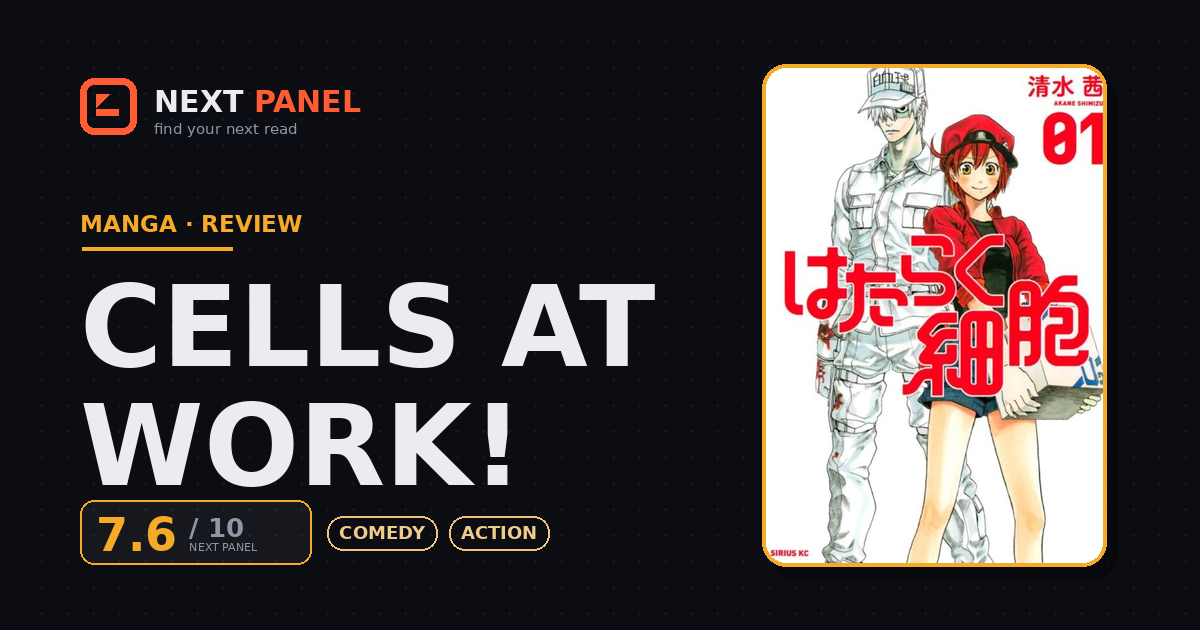
Cells at Work! takes the single dumbest-sounding pitch imaginable — what if your red and white blood cells were anime characters with jobs — and plays it completely straight. Red Blood Cell AE3803 is a rookie constantly getting lost on her oxygen-delivery runs. White Blood Cell U-1146 is the guy who shows up to stab germs whenever the body gets infected. Around them, platelets build blood clots, killer T cells patrol for cancer, and various bacteria and viruses show up as legitimate threats. It sounds like a gimmick because it is one, but it's a gimmick that's been thought through.
What it does well
The best thing Cells at Work! does is make biology entertaining without dumbing it down. A chapter about a scraped knee becomes a full action sequence about clotting. A cold becomes an invasion story. Anaphylactic shock becomes a genuine crisis with real tension. You come away from most chapters having picked up a fact about how your own body works, and you don't feel like you were assigned homework to get there — the information rides along with a comedy-action plot instead of replacing it.
Red Blood Cell and White Blood Cell carry the series well as a duo. She's earnest and easily flustered; he's terse, competent, and quietly protective in a way the manga never overplays. Their dynamic gives the book a throughline even though most chapters are self-contained. The art helps a lot here too — Akane Shimizu makes trillions of near-identical cells visually distinct through simple costume and expression choices, so even a packed battle panel against a wave of bacteria stays easy to follow.
And the series isn't afraid to get serious. Arcs dealing with cancer, heatstroke, or a major injury shift tone noticeably, and the stakes register even though the characters are still designed like a shonen cast. That willingness to let the body's actual dangers feel dangerous is part of what keeps the concept from wearing thin as fast as it could.
Where it falls short
The structure is also the series' biggest limitation. Nearly every chapter follows the same shape: something goes wrong in the body, the relevant cells respond, the threat gets neutralized, roll credits. Once you clock the pattern, later volumes start to feel like variations on a theme rather than a story building toward something. The supporting cast of platelets, killer T cells, and macrophages are fun in small doses but mostly stay one-note mascots rather than characters who grow.
Because each chapter is basically its own case file, the manga reads more like a well-made anthology than a serialized story. That's fine if you're reading it in short bursts, but marathoning several volumes back to back can make the formula more obvious than it is picking the series up occasionally.
Verdict
Cells at Work! is exactly what it looks like: a smart, funny, occasionally moving series built on a single great idea. It doesn't try to be more than that, and within its short six-volume run it never really overstays its welcome. If you want something you can recommend to almost anyone — a kid curious about the body, a friend who doesn't usually read manga, or just yourself on a slow afternoon — this clears the bar easily. Just don't expect the plot to go much deeper than the premise promises.
Strengths & Weaknesses
Strengths
- The core concept — your body as a walking, talking workplace — is explained clearly enough that you actually absorb the biology without feeling lectured at.
- Red Blood Cell and White Blood Cell make a solid comedy duo: her cheerful cluelessness against his blunt, sword-swinging professionalism gives every chapter an easy rhythm.
- The art finds a nice trick of making cells and germs instantly readable as characters — you always know who's who even in a crowded action panel.
- It doesn't shy away from real stakes. Chapters on serious illness or injury land with more weight than the cute art style suggests they will.
Weaknesses
- The structure repeats: a threat shows up, the immune system mobilizes, the threat gets cleared. Once you've read a handful of chapters you can predict the shape of the next one.
- Side characters among the trillions of platelets and cells mostly exist to be cute mascots rather than people with their own arcs.
- Because each chapter is built around one bodily function or illness, pacing across a whole volume can feel more like an anthology than a single story.
Similar Titles
Another science-forward series that turns real facts into an entertaining hook.
Same short, punchy comedy-chapter structure with a strong single gimmick.
Where to Read Officially
| Platform | Format | Pricing | Region notes | Link |
|---|---|---|---|---|
| Kodansha | Print & digital volumes | Paid | Region availability varies | Open |
Frequently Asked Questions
Do I need to know biology to enjoy Cells at Work!?
No. The manga explains each concept as it goes, and the story works fine even if you forget it all the moment you close the book.
Is it appropriate for kids?
Mostly yes — it's playful and educational, though a few arcs about serious illness or injury get more intense than the cute designs suggest.
Are there spinoffs worth reading?
Cells at Work! CODE BLACK (a grittier, adult-body version) and Cells at Work! Bacteria! are the two most notable spinoffs, but the original is the best starting point.