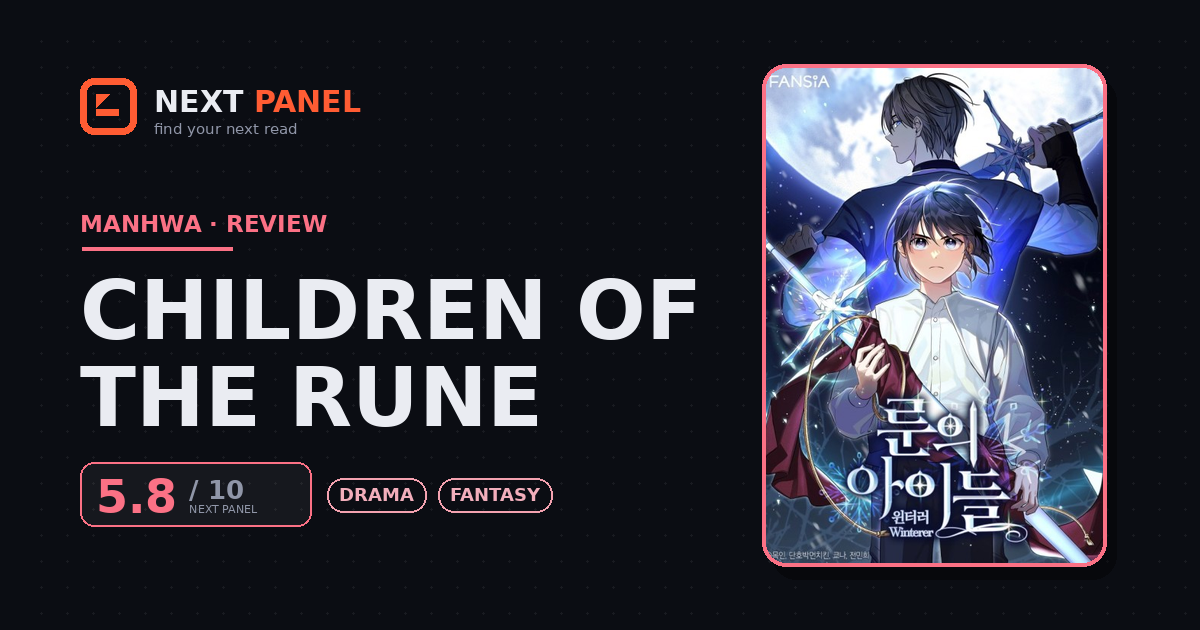
Is Children of the Rune Worth Reading? Review & Where to Read
Quick Answer
Only if you're specifically drawn to slow, non-linear trauma narratives — the ambition is real, but the execution divides readers hard enough that it's a genuine gamble.
Quick Verdict
“Reaches for something more psychologically serious than most dark fantasy in this genre and doesn't fully land it, though the attempt itself sets it apart.”
Best for: Readers who want slow, character-focused dark fantasy told from a traumatized child's confused point of view, and who don't need every plot beat to be immediately clear.
Not for: Readers who want a brisk pace, a likable cast, and events that resolve cleanly rather than sitting in ambiguity for chapters.
- Type
- Manhwa
- Genres
- Drama, Fantasy
- Status
- Ongoing
- This review
- Minor Spoilers
- Author
- Jeon Min-hee
- Artist
- Kyona
- Publisher
- Kakao
- Platform
- Tapas
| Quick facts | |
|---|---|
| Format | Manhwa (shounen), 74 chapters |
| Run | 2024–present · ongoing |
| Community score | AniList 6.0 · MangaUpdates 6.3 |
| Content | Family abuse and neglect, death of a sibling, psychological trauma |
| Where to read | Tapas — official |
Overview
Children of the Rune is an ongoing Korean manhwa written by Jeon Min-hee and illustrated by Kyona, adapting the novel series also known as Winterer, published in English on Tapas. Twelve-year-old Boris Jineman's world collapses in a single night when a family feud forces him and his older brother to flee, leaving Boris with nothing but Winterer, the family's legendary and fiercely coveted sword. When his brother sacrifices himself to protect him, Boris becomes the blade's sole guardian in a world full of people who want it — and him — gone.
What sets this apart from a typical dark-fantasy premise is the choice to tell almost everything from Boris's own confused, traumatized point of view, which is also exactly where the series generates its most passionate defenders and its harshest critics.
What it does well
The strongest material here comes from taking Boris's perspective seriously as a narrative device rather than a gimmick. His brother's death, in particular, is handled with a restraint that a lot of manhwa in this genre don't bother with, and it lands with real weight. The family conflict driving the plot avoids an easy villain-versus-hero shape — Boris's father is weak and complicit rather than outright monstrous, which makes the household feel uncomfortably plausible instead of like generic noble-court scheming. Winterer itself works well as more than a plot device; it's an inherited burden Boris didn't ask for, and the story treats it that way rather than as a simple power-up.
When the non-linear structure clicks, it does real work mirroring dissociation and trauma — readers experiencing the same confusion and delayed understanding that Boris does, rather than being spoon-fed context he doesn't have either.
Where it falls short
That same structural ambition is also the series' biggest liability. Pacing is a genuine, widely-flagged problem — one extended illusion arc in particular drags on long enough that even sympathetic readers report losing track of what's real, and less patient readers describe entire stretches as close to unreadable. The line between intentional disorientation and simply unclear plotting isn't always easy to find, and a fair number of readers land on the side of "confusing" rather than "thoughtfully ambiguous." Several adult characters, particularly within Boris's own family, are written with so little redeeming complexity that the intended tragedy can read as frustration instead — it's hard to feel devastated by choices that mostly look like plain bad writing rather than earned dysfunction.
Verdict
This is a manhwa that's genuinely trying to do something more psychologically serious than most of its genre, and when it connects, it connects hard. But the execution is inconsistent enough — in pacing, clarity, and character writing — that it's a real gamble rather than a safe recommendation. Worth trying if slow, trauma-focused storytelling appeals to you specifically; skip it if you want your dark fantasy briskly paced.
Strengths & Weaknesses
Strengths
- Telling the story through Boris's confused, twelve-year-old point of view is a genuine risk that pays off in a few key scenes — his brother's death in particular is written with enough restraint to land as genuinely affecting rather than manipulative.
- The family conflict at the center avoids simple villains; Boris's father is written as weak and complicit rather than cartoonishly evil, which makes the household's dysfunction feel more uncomfortably real than the genre's usual scheming-noble setup.
- The non-linear structure, when it works, mirrors trauma and dissociation in a way that's more thoughtful than most manhwa in this space bother to attempt.
- Winterer, the family's coveted sword, functions as a real symbol of inherited burden rather than just a plot-convenient power source.
Weaknesses
- The pacing is a serious problem — entire arcs, including one extended illusion sequence, drag on long enough that even readers who like the premise report losing track of what's actually happening versus what's imagined.
- The non-linear, confusion-as-a-feature approach doesn't always read as intentional; several stretches feel genuinely unclear rather than purposefully disorienting.
- A number of the adult characters, especially within Boris's own family, are written as so thoroughly unlikeable and poorly reasoned that some readers find the family drama frustrating rather than tragic.
Similar Titles
Similar interest in a traumatized young protagonist processing violence and loss slowly, over a long, patient run.
The Boy and the Beast
Shares the found-family-versus-broken-blood-family theme, though told with a much gentler tone.
Where to Read Officially
| Platform | Format | Pricing | Region notes | Link |
|---|---|---|---|---|
| Tapas | Digital chapters (free with wait, or unlocked with Ink) | Free + Paid | Region availability varies | Open |
Frequently Asked Questions
Is Children of the Rune based on a novel?
Yes — it adapts the Korean novel series of the same name (also known as Winterer), which has its own dedicated following independent of the manhwa.
Why do reviews for this series seem so split?
The slow pacing and non-linear, trauma-focused storytelling genuinely divide readers — some find it a rare, thoughtful approach to a child protagonist's psychology, others find long stretches confusing or frustrating.
Is this a heavy, dark story?
Yes. It deals directly with family abuse, grief, and psychological trauma, and doesn't soften those themes for a younger audience despite the young protagonist.