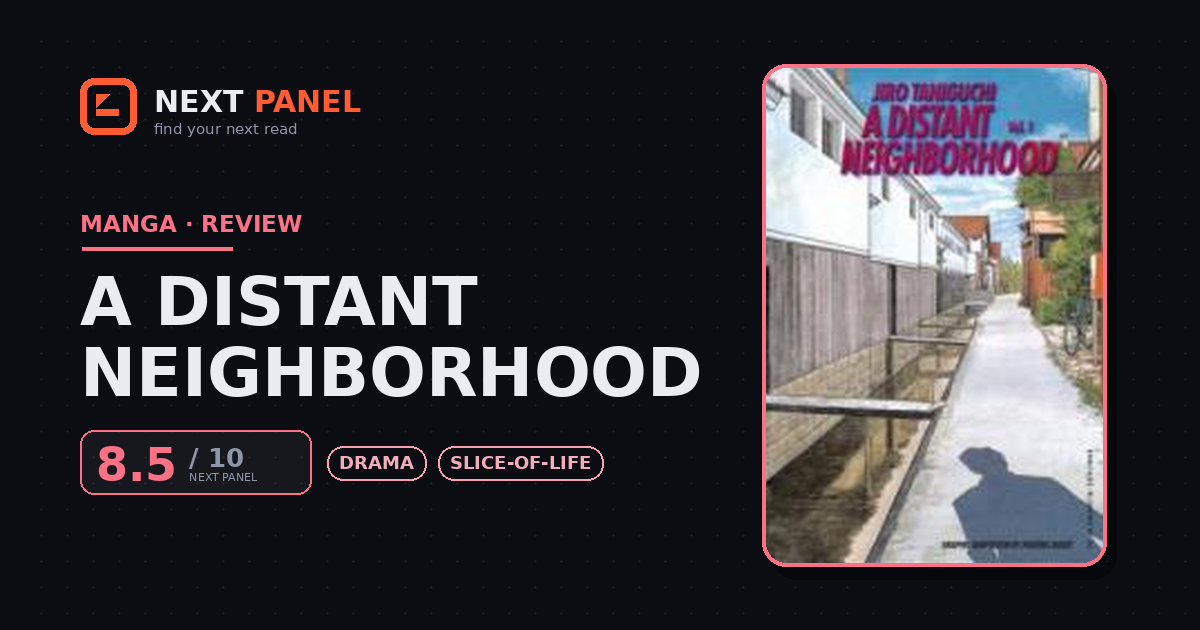
Is A Distant Neighborhood Worth Reading? Review & Where to Read
Quick Answer
Yes, if you want quiet, adult literary fiction about family, regret, and what you'd actually do differently if you got a second chance at being a teenager. It's short, dense, and stays with you.
Quick Verdict
“This isn't a fantasy about fixing your life -- it's a much harder question about whether you'd even want to, once you remember exactly why things went the way they did.”
Best for: Readers who want quiet, literary drama about family and regret, told with real restraint instead of melodrama.
Not for: Readers who want a fast plot, genre thrills, or a time-travel story focused on changing the past rather than understanding it.
- Type
- Manga
- Genres
- Drama, Slice of Life
- Status
- Completed
- This review
- Minor Spoilers
- Author
- Jiro Taniguchi
- Publisher
- Shogakukan
- Platform
- Ponent Mon
| Quick facts | |
|---|---|
| Format | Manga, 16 chapters, 2 volumes |
| Run | 1998–1999 · completed |
| Community score | AniList 7.8 |
| Where to read | Ponent Mon — official |
Overview
Hiroshi Nakahara is 48 years old, has a wife, two daughters, and a job, and is on a train back from a business trip when he impulsively gets off at the wrong stop -- the town where he grew up. Walking to visit his mother's grave, something shifts, and he finds himself standing in his own childhood body at 14, with every adult memory he's ever had fully intact. A Distant Neighborhood follows what he does with that impossible second chance: not fixing his life, exactly, but finally understanding the year his father walked out and never came back.
What it does well
Jiro Taniguchi's art is doing quiet, exact work throughout -- there's no visual spectacle here, just careful, unhurried linework on ordinary streets, classrooms, and dinner tables, and that restraint is exactly right for a story about a man reckoning with his own past rather than escaping it. The premise itself generates a specific, understated kind of tension: Hiroshi knows what's coming for his family, and the book is far more interested in what he chooses to do with that foreknowledge than in any mechanical time-travel logic.
What elevates it past a simple 'what if I could redo my life' fantasy is its refusal to make the central mystery -- why his father disappeared -- into something simple. The manga treats his father's choice with real empathy rather than turning him into a clean villain to be understood and forgiven in one dramatic beat. That patience pays off in an ending that earns its emotional weight instead of manufacturing it. And for a story this compact -- two volumes, collected into one English omnibus -- it's remarkably dense; it's the kind of book you can read in an afternoon and then immediately want to start again.
Where it falls short
The deliberate, internal pacing won't work for every reader. If you're drawn in by the time-slip hook expecting plot mechanics, twists, or real stakes tied to changing the timeline, you'll find the manga has almost no interest in any of that -- it's a vehicle for reflection, full stop. The supporting cast around Hiroshi's teenage years -- friends, teachers, classmates -- also gets comparatively thin treatment, since the book keeps its focus locked tightly on the father-son relationship at its center.
Verdict
A Distant Neighborhood is a quiet, deeply adult piece of literary fiction disguised as a time-slip story, and it's more interested in understanding a painful family history than in rewriting it. It's slow and narrowly focused by design, but for readers open to that mode, it's a genuinely moving, precisely drawn piece of work that more than earns its reputation.
Strengths & Weaknesses
Strengths
- Taniguchi's linework is quiet and precise -- ordinary rooms, streets, and faces carry the emotional weight instead of dramatic staging, which suits the story's restrained tone perfectly.
- Hiroshi's adult perspective inside his teenage body creates constant, understated tension: he knows what's coming, and watching him decide what to do with that knowledge is more compelling than any twist could be.
- The book resists the easy fantasy of 'fixing everything' -- it's genuinely interested in why his father left, and it treats that mystery with empathy rather than turning it into a villain reveal.
- It's short enough to read in one sitting but dense enough that it rewards a second one -- rare for a two-volume story to earn that.
Weaknesses
- The pacing is deliberately slow and internal -- readers who want the time-slip premise to drive plot mechanics or stakes will find it's mostly a vehicle for reflection instead.
- Some of the supporting cast (Hiroshi's teenage friends and teachers) get comparatively little development, since the book stays tightly focused on the father-son thread.
Similar Titles
The Walking Man
Same Taniguchi interest in quiet, unglamorous adult introspection told through careful, patient linework.
Similar commitment to slow, detail-driven visual storytelling over plot momentum, if you want more of that mode.
Same grounded, adult approach to regret and the choices that got you where you are.
Where to Read Officially
| Platform | Format | Pricing | Region notes | Link |
|---|---|---|---|---|
| Ponent Mon | Print omnibus | Paid | Region availability varies | Open |
Frequently Asked Questions
Is this a time-travel story?
It uses a time-slip premise, but the focus is entirely on reflection and family history rather than time-travel mechanics or paradoxes.
How long is it?
It's compact -- originally two volumes in Japan, collected into a single English omnibus by Ponent Mon.
Is there a film adaptation?
Yes, a 2010 French-Belgian-Japanese animated film adapts the story, though the manga is the original and more widely referenced version.