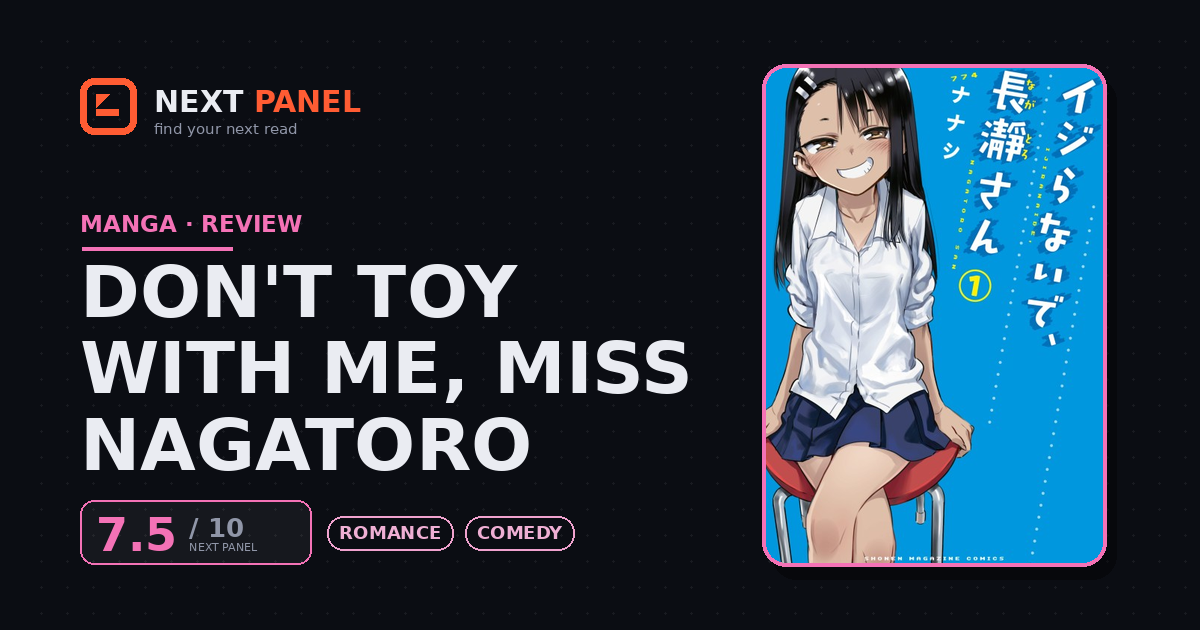
Is Don't Toy with Me, Miss Nagatoro Worth Reading? Review & Where to Read
Quick Answer
If you can get past a teasing-heavy start that flirts with outright bullying, Nagatoro turns into one of the warmer high-school romcoms out there. The dynamic actually grows, the art sells every reaction, and the payoff is genuinely sweet — but the romance takes its sweet time.
Quick Verdict
“Mean-girl teasing slowly becomes one of the sweeter romcoms around — if the early ribbing doesn't put you off, it earns its warmth.”
Best for: Readers who want a slow-burn high-school romance built on banter and don't mind a prickly start.
Not for: Readers who want a fast-moving romance and humor that isn't built around constant teasing.
- Type
- Manga
- Genres
- Romance, Comedy
- Status
- Completed
- This review
- Minor Spoilers
- Author
- Nanashi
- Publisher
- Vertical
- Platform
- Vertical
| Quick facts | |
|---|---|
| Format | Manga (shōnen), 188 chapters, 20 volumes |
| Run | 2017–2024 · completed |
| Community score | AniList 7.4 · MAL 7.6 · MangaUpdates 7.5 |
| Content | Mild fanservice |
| Where to read | Vertical — official |
Overview
Don't Toy with Me, Miss Nagatoro has a premise that makes a lot of people wary before they start: a sharp-tongued first-year girl, Nagatoro, latches onto a shy, art-loving upperclassman — "Senpai" — and spends her days needling him. She teases, she provokes, she makes him squirm. Put that way, it sounds insufferable. What the manga actually becomes over its run is something a lot warmer: a slow, sweet romance about two awkward people who don't know how to say what they feel, so they poke at each other instead.
What it does well
The key to the whole thing is that the relationship moves. If Nagatoro just bullied Senpai for twenty volumes, it'd be unbearable. Instead, the teasing slowly turns into a two-way street. Senpai starts pushing back, finding his own spine, and Nagatoro — who clearly likes him long before she'll admit it — gets flustered just as often as she dishes it out. By the middle of the series the cruelty has mostly burned off, replaced by a genuinely tender, often funny back-and-forth between two kids growing up.
Nagatoro herself is the reason it works. The smirking tease is a front, and the manga is smart about peeling it back: she's insecure, a little lonely, and far more invested than she lets on. Watching her wrestle with feelings she has no idea how to handle is the emotional core, and it makes her easy to root for even when she's being a brat.
Nanashi's art does a lot of the heavy lifting. The linework is clean and hugely expressive, especially with faces — every blush, every sly grin, every panicked Senpai reaction reads instantly. Comedy this dependent on reactions lives or dies on the cartooning, and here it consistently lands. The supporting cast helps too; once the art club and Nagatoro's friends get involved, the humor broadens out and the world feels fuller and friendlier.
Where it falls short
The honest warning is the start. The first stretch leans hard on teasing that can read as straight-up bullying, and not everyone will want to wait for the tone to soften. If that kind of humor rubs you the wrong way, the early chapters will be a slog rather than a hook. The romance is also a true slow burn — the will-they-won't-they stretches across the entire series, and readers who want momentum may get impatient. And like a lot of long romcoms, it has go-to beats it returns to often: the fanservice and the recurring "flustered Senpai" gag can feel repetitive when you read several volumes back to back.
Verdict
Don't Toy with Me, Miss Nagatoro is better than its premise has any right to be. Push past the prickly opening and it becomes a charming, heartfelt coming-of-age romance with a lead who's much more than her smirk. It's not fast and it's not deep, but it nails the cozy, blushy thing it's going for. If a teasing-to-tender slow burn sounds appealing, it's an easy recommendation — just know what the first few chapters are like going in.
Strengths & Weaknesses
Strengths
- The central dynamic genuinely evolves — what begins as one-sided teasing grows into something mutual and surprisingly tender.
- Nagatoro is more layered than the premise suggests: insecure and earnest under the smirk, which keeps her likable.
- Nanashi's expressive art is great at faces, selling every blush, smirk, and flustered reaction.
- Once the art club and the side cast arrive, the comedy gets warmer and less one-note.
Weaknesses
- The early chapters lean hard on teasing that can read as plain bullying, and some readers won't push past it.
- The will-they-won't-they drags out for a long time; the romance moves at a crawl.
- The fanservice and the repeated 'Senpai gets flustered' beat can feel formulaic when read in bulk.
Similar Titles
The gentler cousin — the same teasing-as-affection setup with none of the early edge.
Another comedy about two stubborn people circling romance through mind games.
A high-school romance where a shared hobby pulls two opposites together.
Where to Read Officially
| Platform | Format | Pricing | Region notes | Link |
|---|---|---|---|---|
| Vertical | Print & digital volumes | Paid | Region availability varies | Open |
Frequently Asked Questions
Is the teasing just bullying?
It starts close to it — the early chapters are spiky. But the manga gradually reframes the dynamic as two insecure kids working each other out, and the meanness fades as genuine affection takes over.
Is it finished?
Yes. It ran from 2017 to 2024 and is complete in 20 volumes.
Where can I read it in English?
Vertical, Kodansha's imprint, publishes the official English edition in print and digital.