Is Doubt Worth Reading?
Quick Answer
Doubt is worth reading for a tight, fast-moving killing-game mystery that doesn't pad its short page count.
Quick Verdict
“Tight, fast-moving psychological thriller that does a lot with a small cast and a short page count.”
Best for: Readers who want a quick, tense killing-game mystery without a long-term commitment.
Not for: Readers who want deep characterization, or who want a large, long-running cast and world.
- Type
- Manga
- Genres
- Horror, Thriller
- Status
- Completed
- Author
- Yoshiki Tonogai
- Publisher
- Yen Press
- Platform
- Yen Press
| Quick facts | |
|---|---|
| Format | Manga, 21 chapters, 4 volumes |
| Run | 2007–2009 · completed |
| Community score | AniList 6.3 · MangaUpdates 6.9 |
| Content | Violence, death |
| Where to read | Yen Press — official |
Overview
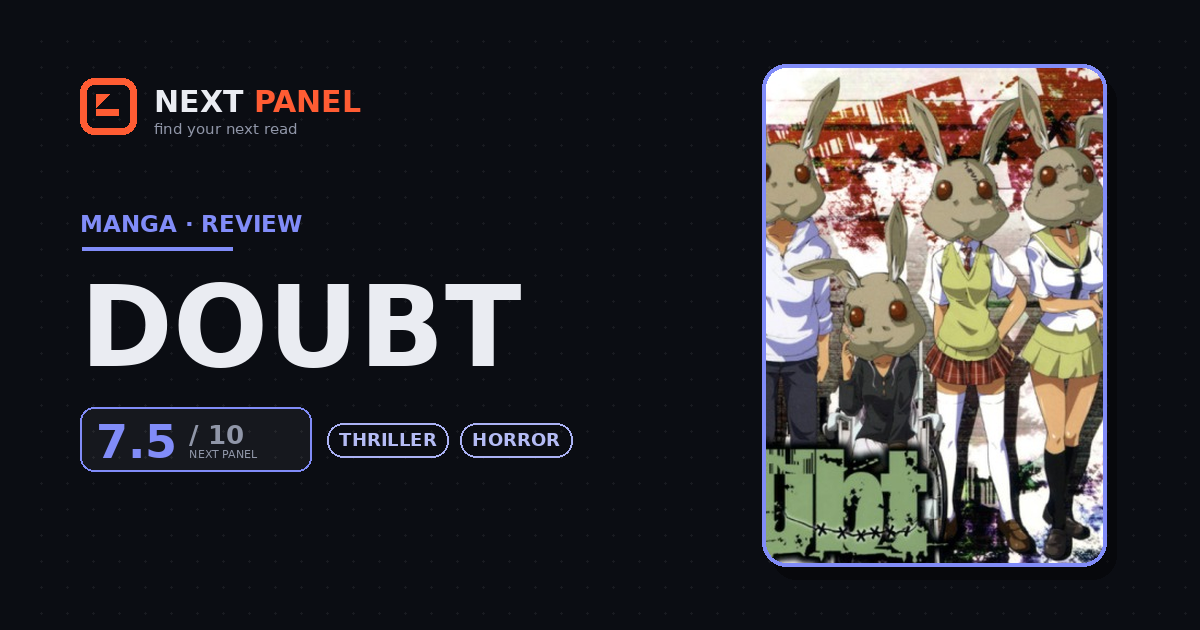
Doubt starts from a hit mobile game called Rabbit Doubt, a mystery where a hidden wolf picks off rabbits one by one until the survivors either catch the killer or die trying. When a group of teenage players meets up in person after connecting through the game, they wake up trapped in an abandoned building with barcode tattoos on their necks and a corpse already in the room, forced to play the game for real. Yoshiki Tonogai runs the whole story as a tight, claustrophobic whodunit: no one knows who the wolf is, trust breaks down fast, and the body count keeps rising until an answer forces itself out. Every accusation the group makes carries real weight, since guessing wrong doesn't just cost time, it costs lives.
What it does well
The premise is lean and Tonogai doesn't pad it. At four volumes, Doubt moves fast, cycling through suspicion, alliance, and betrayal without spending pages on filler, and the central mystery is fairly clued for readers who want to guess along rather than just be told. The cast is thin by design, closer to a locked-room mystery's small suspect pool than a sprawling ensemble, which keeps tension high since every death meaningfully changes the odds and dynamics for whoever's left. Tonogai's art favors sharp, off-kilter expressions during the interrogation scenes, giving the paranoia a visual language instead of leaning entirely on dialogue.
Where it falls short
The characters are thin outside their function in the mystery. This is a plot-and-tension delivery machine more than a character study, and readers who want real interiority from the cast will find most of them defined by a single trait or role. The resolution, once it lands, leans on some contrivance to make the pieces fit, a common weak point for the killing-game subgenre, and a couple of the personality-based deductions ask you to take the characters' read on each other at face value rather than earning it on the page. It's also a small, self-contained story with a fixed, low page count; if you want a big cast or a long-running world to sink into, this isn't it.
Verdict
A tight, fast-moving psychological thriller that does a lot with a small cast and a short page count, even if the characters stay mostly functional. Worth it for readers who want a quick, tense mystery rather than a big commitment, and Tonogai has more in the same vein if this one clicks.
Strengths & Weaknesses
Strengths
- A lean, fast-moving mystery that doesn't pad its four-volume length with filler.
- A small cast that keeps tension high, since every death meaningfully shifts the group's dynamics.
- Fairly clued for readers who want to guess the wolf's identity rather than just be told.
- Sharp, off-kilter art during interrogation scenes that gives the paranoia real visual weight.
Weaknesses
- Characters are thin outside their function in the mystery, defined mostly by a single trait or role.
- The resolution leans on some contrivance to make the pieces fit, a common killing-game subgenre weak point.
- A small, self-contained story for readers who want a bigger cast or a long-running world.
Similar Titles
Tonogai's own follow-up in the same killing-game subgenre, with a similar tight cast and mystery structure.
A different flavor of survival game, more action-driven than mystery-driven.
A more stylized, higher-energy take on the same trapped-and-forced-to-kill mystery structure.
Where to Read Officially
| Platform | Format | Pricing | Region notes | Link |
|---|---|---|---|---|
| Yen Press | Digital & Print | Paid | Region availability varies | Open |
Frequently Asked Questions
Is Doubt finished?
Yes. It's complete at four volumes, collected into two English omnibus editions, and was fully released by Yen Press in 2013.
Does Doubt connect to Tonogai's other manga?
Not directly as a sequel, but Judge and Secret are spiritual successors in the same killing-game subgenre.
Is Doubt very graphic?
It has on-page violence and death typical of the killing-game subgenre, though it's more focused on tension and deduction than gore.