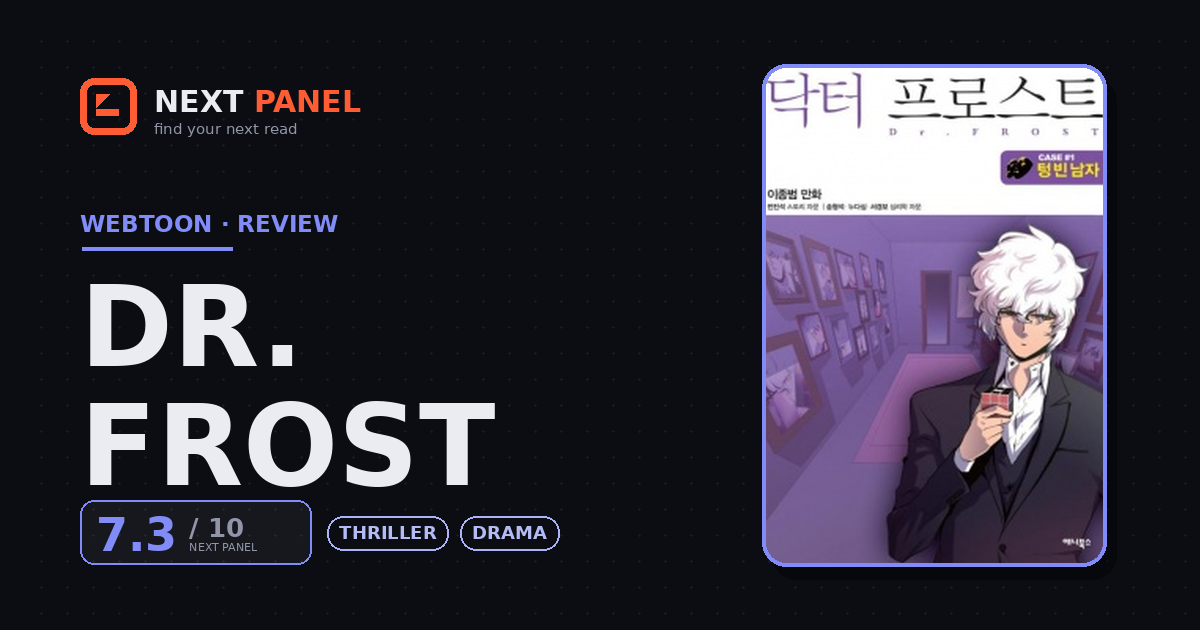
Is Dr. Frost Worth Reading? Review & Where to Read
Quick Answer
Yes, if you like case-driven psychological mysteries. It leans more on behavior and motive than shock twists, and it holds that approach for its entire run without running dry.
Quick Verdict
“Smarter than most "detective reads your mind" comics, and it stays that way for a genuinely long run.”
Best for: Readers who like procedural mysteries built around motive and psychology rather than action or gore.
Not for: Readers who want fast pacing and visually striking action rather than long, dialogue-heavy scenes.
- Type
- Webtoon
- Genres
- Drama, Thriller
- Status
- Completed
- This review
- Minor Spoilers
- Author
- Lee Jong-beom
- Publisher
- Naver Webtoon
- Platform
- WEBTOON
| Quick facts | |
|---|---|
| Format | Webtoon, 264 chapters, 18 volumes |
| Run | 2011–2021 · completed |
| Community score | AniList 7.7 · MangaUpdates 8.2 |
| Content | Psychological distress, mild violence, depictions of trauma |
| Where to read | WEBTOON — official |
Overview
Dr. Frost is built around a simple hook: Frost is a brilliant psychology professor who, due to a rare condition, doesn't experience most emotions the way other people do. What he does have is an encyclopedic understanding of how everyone else's emotions work, and he uses it to solve cases that range from workplace manipulation to cult indoctrination to violent crime. His student and eventual assistant, Yoon Seong-ah, acts as the reader's way into a story that could otherwise feel cold — she reacts to cases the way a normal person would, while Frost dissects them like a puzzle.
What it does well
The strongest thing about Dr. Frost is how seriously it treats its own subject. Each case is grounded in an actual psychological concept, and the comic takes the time to walk through why a person did what they did rather than just revealing a twist and moving on. That gives the mysteries a different kind of payoff than a typical whodunit — you're not just finding out who committed a crime, you're understanding the exact mechanism of thought that led there. It's the kind of series where the resolution genuinely teaches you something about how people behave under pressure, grief, or manipulation.
Frost as a character earns his premise instead of coasting on it. His lack of typical emotional response isn't played as a superpower with no cost — it isolates him, confuses the people around him, and occasionally makes him bad at the exact human moments the story needs him to get right. That tension carries the book more than any individual case does. Yoon Seong-ah's arc across the series is also worth noting: she starts as a fairly generic wide-eyed assistant and becomes someone with her own read on people, which keeps the cast from feeling static over such a long run.
The variety of cases helps too. Corporate gaslighting, cult recruitment tactics, criminal profiling, and interpersonal manipulation all get their own arcs, and each one draws on a different corner of psychology rather than repeating the same trick with new names attached.
Where it falls short
This is a talky comic, and it stays talky. Most chapters are built around conversation, internal monologue, and slow-burn reveals rather than action or visual spectacle, so readers looking for momentum between big moments may find long stretches drag. The art supports the story well enough but is rarely a highlight on its own — panels exist to deliver dialogue clearly, not to impress.
A handful of later arcs also push harder into melodrama than the earlier, more clinical cases did, which can feel like a tonal shift from what made the first half of the series distinct. It doesn't derail the book, but it's a noticeably different register.
Verdict
Dr. Frost is a smart, patient psychological mystery that trusts its readers to sit with real explanations instead of cheap twists, and it sustains that approach across a genuinely long run without running out of ideas. If you like your mysteries built on motive and behavior rather than action, this is one of the more substantial options out there — just go in ready for a dialogue-heavy comic, not a fast one.
Strengths & Weaknesses
Strengths
- Cases are built on real psychological concepts — cognitive bias, trauma response, group dynamics — explained through the plot instead of dumped in exposition boxes.
- Frost himself is a compelling lead precisely because he isn't a warm, likable genius; his inability to read emotion the normal way is treated as both a gift and a real limitation.
- The mystery structure varies enough between arcs — corporate manipulation, cult psychology, criminal profiling — that it doesn't feel like the same case reskinned each time.
- Supporting cast members, especially his assistant, get real growth across the run instead of staying static sounding boards for the lead.
Weaknesses
- Dialogue-heavy panels dominate most chapters, so readers who want visual momentum or action beats will find long stretches feel talky.
- Some later arcs lean on melodrama to raise the stakes, which sits awkwardly next to the series' otherwise clinical tone.
- The art is functional rather than striking — it gets the job done for a dialogue-driven series but won't wow anyone on its own.
Similar Titles
Same pleasure of watching a brilliant, emotionally detached lead out-think everyone around him.
Another series where psychological manipulation, not physical conflict, drives every confrontation.
Where to Read Officially
| Platform | Format | Pricing | Region notes | Link |
|---|---|---|---|---|
| WEBTOON | Digital chapters | Free | Region availability varies | Open |
Frequently Asked Questions
Is Dr. Frost finished?
Yes. The series ran from 2011 to 2021 and is complete, with the official English translation also fully released on WEBTOON.
Is there a live-action adaptation?
Yes, a Korean TV drama adaptation aired, though the webtoon tells a longer, more detailed version of the story.
Do I need psychology knowledge to follow it?
No. The comic explains the relevant concepts as each case unfolds, so no background is required going in.