Is Epic of Gilgamesh Worth Reading? Review & Where to Read
Quick Answer
Yes, but push through the opening chapters. Gilgamesh spends its first stretch on a fairly ordinary fantasy setup before revealing just how much loss, regret, and world-scale stakes are underneath it. Readers who stick around get one of the more emotionally complete fantasy webtoons of its era.
Quick Verdict
“Slow to start, then genuinely devastating once it commits to what it's actually about — a rare fantasy series willing to let its ending cost something.”
Best for: Readers who want a fantasy adventure that earns its emotional weight over a long arc and don't mind a patient, sometimes melancholy build.
Not for: Readers who want fast pacing from chapter one or a story guaranteed to end happily for everyone in it.
- Type
- Webtoon
- Genres
- Drama, Fantasy
- Status
- Completed
- This review
- Minor Spoilers
- Author
- Hwan Daeng
- Publisher
- Lezhin Comics
- Platform
- Lezhin Comics
| Quick facts | |
|---|---|
| Format | Webtoon, 173 chapters, 6 volumes |
| Run | 2015–2019 · completed |
| Community score | AniList 7.4 |
| Where to read | Lezhin Comics — official |
Overview
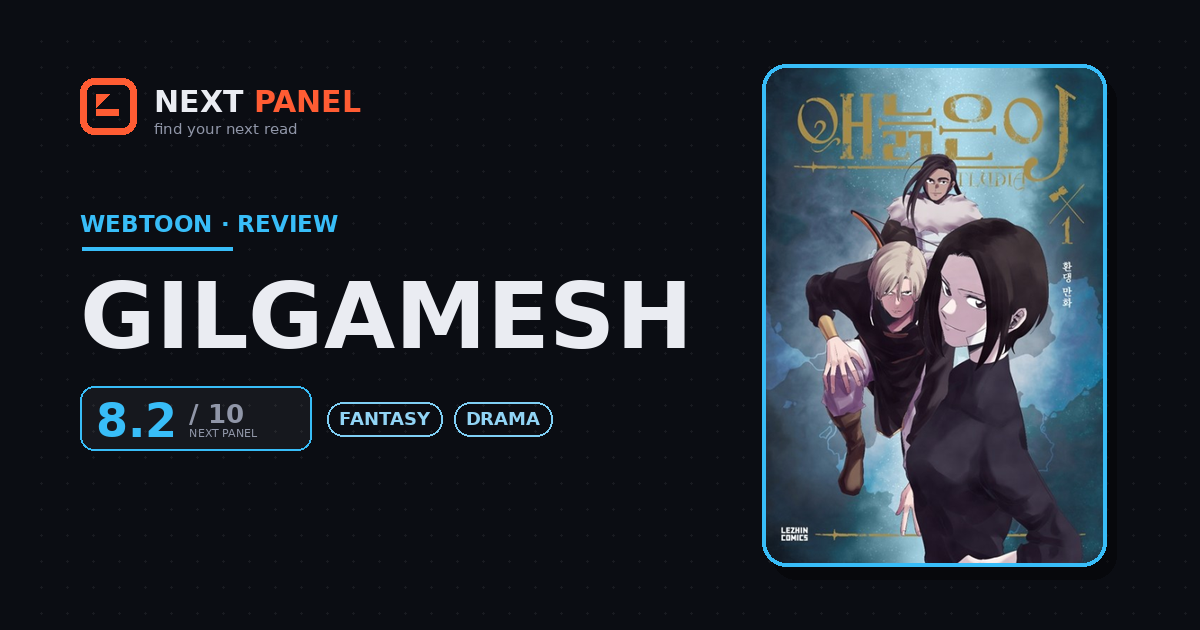
Tludia gets kicked out of her knight order for breaking too many weapons and eating too much, which sounds like the setup for a comedy. It isn't, not for long. On her way out, she tries to save an old man from robbers, only to find out he doesn't need saving — he's Ram, a man who's lived for thousands of years and lost nearly everyone he's ever cared about. Tludia, on the other hand, is dying: cursed with an illness that will kill her young. Ram offers to find a cure, less out of hope than habit. What starts as an odd-couple fantasy quest slowly turns into something much bigger and much sadder, as the story widens out to cover centuries of regret, war, and the specific loneliness of outliving everyone you love.
What it does well
The pairing at the center is what makes Gilgamesh work. Tludia isn't just a damsel for Ram to rescue — she's stubborn and alive in a way that genuinely unsettles him, and watching that unsettle him is more interesting than a typical mentor-student dynamic. Ram, for his part, isn't written as a wise, serene immortal; he's exhausted, occasionally cruel, and visibly out of practice at caring about anything, which makes his slow re-engagement with the world feel real instead of scripted.
The story also isn't afraid to let things go wrong. Characters lose fights they should win, relationships don't get resolved neatly, and the plot treats death as something with actual weight rather than a temporary setback. That willingness to let the story cost something is rare in fantasy webtoons, and it's the reason Gilgamesh sticks with readers after they finish it. The action, once the series settles in, backs this up with genuinely detailed, well-staged fight choreography that gives the quieter chapters somewhere to land.
Where it falls short
The first stretch of chapters is a real hurdle. It plays like a fairly standard fantasy-adventure opener — cursed girl, mysterious old man, vague quest — and doesn't yet hint at the scale or heaviness the story is building toward. Readers who bounce off the first ten chapters are missing the point where it actually starts working.
The art is also uneven. Some sequences, especially early on, look noticeably simpler than the detailed, atmospheric action scenes later in the run, and the jump between the two styles can be jarring if you're not expecting it. And the tonal shift from an odd-couple fantasy quest into a much darker story about loss and mortality isn't gentle — it's a deliberate gut-punch, not a gradual slope, which won't work for every reader.
Verdict
Gilgamesh asks for patience through a slow, fairly ordinary-looking opening, then spends the rest of its run proving that patience was worth it. Once it reveals what it's actually about — mortality, loss, and what it costs to keep choosing to live — it becomes one of the more emotionally honest long-runners in the genre, with an ending that doesn't let anyone, including the reader, off easy.
Strengths & Weaknesses
Strengths
- The central pairing of Tludia, a dying ex-knight-in-training, and Ram, a man who's lived for millennia and stopped caring about his own survival, gives the story real emotional stakes on both sides instead of just one character needing to be saved.
- The worldbuilding expands steadily rather than all at once, so by the later chapters the scope feels earned rather than tacked on.
- The plot is willing to hurt its characters and let consequences actually stick, which makes the twists land harder than in most fantasy webtoons built around a save-everyone premise.
- The action sequences, once the story picks up, are detailed and well-choreographed, giving the quieter emotional chapters real contrast.
Weaknesses
- The opening chapters are noticeably slower than the rest of the series and read like a fairly generic fantasy setup before the story reveals what it's actually building toward.
- The art is inconsistent — some stretches look simple compared to the detailed action scenes elsewhere, which can be distracting if you're reading in one sitting.
- The tone shifts into much heavier territory than the early chapters suggest, so readers expecting a lighter adventure may find the back stretch tonally jarring.
Similar Titles
Another Lezhin series willing to let its plot get genuinely dark and costly rather than protecting its cast.
Shares the interest in a long life weighed down by loss, and what it costs a character to keep choosing to live.
To Your Eternity
A similar emotional register — mortality, loss, and a central relationship that isn't guaranteed a happy outcome.
Where to Read Officially
| Platform | Format | Pricing | Region notes | Link |
|---|---|---|---|---|
| Lezhin Comics | Digital chapters | Free + Paid | Region availability varies | Open |
Frequently Asked Questions
Why is it called Gilgamesh if it's not the Mesopotamian epic?
The title is a reference, not an adaptation — Ram's arc echoes the original epic's themes of immortality, loss, and searching for peace, but the story and setting are entirely original to Hwan Daeng.
Is Gilgamesh finished?
Yes. It ran on Lezhin Comics from 2015 to 2019, with 127 main-story chapters followed by 45 side-story chapters, and it's fully completed.
Does the story get better after a slow start?
Considerably. Readers consistently note that the first several chapters undersell what the series becomes — the emotional and plot stakes escalate a lot once the setup is out of the way.