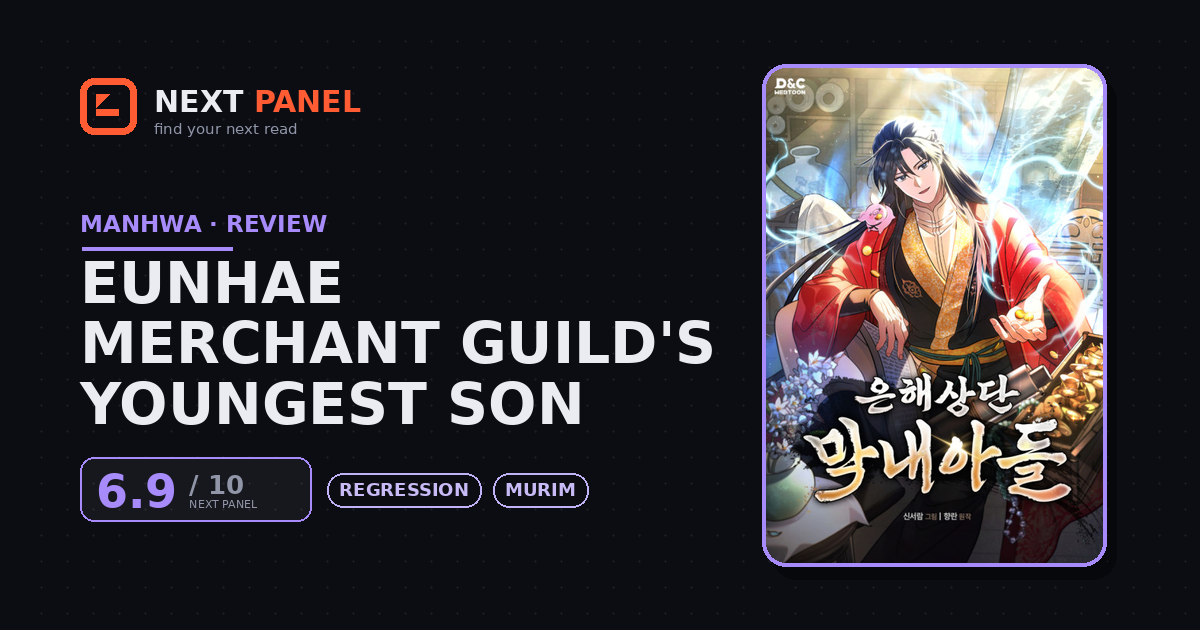
Is Eunhae Merchant Guild's Youngest Son Worth Reading? Review & Where to Read
Quick Answer
Worth reading if you want a regression story that channels its second-chance premise into commerce and guild politics rather than combat, with a genuinely satisfying underdog-to-mogul arc.
Quick Verdict
“Rebuilding a merchant empire through smarter trades and better-read contracts turns out to be just as tense as any sword fight once you know exactly how much Seoho has already lost by trusting the wrong people.”
Best for: Readers who want a regression revenge story built on business strategy and historical trade politics rather than combat.
Not for: Readers who want fantasy elements or action-driven pacing rather than a slower, commerce-focused historical drama.
- Type
- Manhwa
- Genres
- Regression, Drama, Murim
- Status
- Ongoing
- This review
- Minor Spoilers
- Author
- Hyang-Ran
- Artist
- Shin Seo-Ram
- Publisher
- Kakao
- Platform
- Tapas
| Quick facts | |
|---|---|
| Format | Manhwa (unknown), 69 chapters |
| Run | 2025–present · ongoing |
| Community score | AniList 6.6 · MangaUpdates 6.6 |
| Content | None significant |
| Where to read | Tapas — official |
Overview
Seoho Eun was born with an unmatched talent for business, but that gift wasn't enough to save him from being murdered by a rival head merchant. He wakes up decades earlier in his younger body, still learning the ropes of his family's Eunhae Merchant Guild, now armed with the full knowledge of every mistake, betrayal, and market shift that's coming. Determined not to repeat the choices that got him killed, Seoho sets out to rebuild the guild, protect the people he lost, and settle accounts with the rival who ended his first life. Written by Hyang-Ran with art by Shin Seo-Ram, Eunhae Merchant Guild's Youngest Son is an ongoing historical drama manhwa, published in English by Tapas Entertainment.
What it does well
The series distinguishes itself by pointing its regression premise at commerce instead of combat. Rather than gaining a sword skill or magic system, Seoho's advantage is purely knowledge -- of markets, of people's true loyalties, of the exact deals and mistakes that led to his downfall -- and watching him apply that knowledge to out-negotiate and out-maneuver rivals gives the story real tension without needing a single fight scene. That specificity matters: because Seoho knows precisely which decisions destroyed him the first time, every business move in his second life carries the weight of lived consequence rather than generic strategic savvy.
The historical merchant-guild setting also gets real texture -- rival houses, contract disputes, market maneuvering -- which makes the commerce itself feel genuinely high-stakes rather than a backdrop for a more conventional plot. And underneath the business strategy, Seoho's motivation to protect the specific people he lost the first time gives the story real emotional stakes beyond simply accumulating wealth and power.
Where it falls short
Readers drawn to regression manhwa for combat or fantasy spectacle should know upfront that neither is really present here -- the conflict stays almost entirely commercial and interpersonal, which is either the appeal or a dealbreaker depending on what you're looking for. The second-chance revenge structure, while well executed, is also a familiar shape for the genre once its initial hook is established. And since the story is still ongoing, the full scope of Seoho's rebuilt empire and its rivalries hasn't fully played out yet.
Verdict
This is a well-constructed regression drama that channels its second-chance premise into merchant-guild politics and business strategy, giving it real distinction within a crowded genre. It's a strong pick for readers who want their second chance played out in boardrooms and trade routes rather than battlefields.
Strengths & Weaknesses
Strengths
- Channeling the regression premise into merchant-guild politics and trade strategy instead of combat gives the story a distinct identity within a genre dominated by sword-and-magic power fantasies.
- Seoho's specific, hard-won knowledge of exactly which decisions and people led to his downfall gives every business move real dramatic weight rather than generic strategic cleverness.
- The historical trade-guild setting is rendered with enough texture -- rival merchant houses, contracts, market maneuvering -- to make the commerce feel genuinely high-stakes.
- Watching Seoho's second chance let him protect people he lost the first time around gives the story real emotional stakes beyond simple wealth accumulation.
Weaknesses
- Readers looking for combat, fantasy elements, or fast-paced action won't find much of it here -- the tension is almost entirely commercial and interpersonal.
- The regression-revenge structure, while well executed, follows a familiar genre shape once the initial setup is established.
- As an ongoing series, the full arc of Seoho's rebuilt guild and its rivalries is still being played out.
Similar Titles
Genius Grandson of the Loan Shark King
Shares the same second-chance, business-focused approach to a regression revenge story.
The Fable of a Failed Genius
Another regression story built on strategic, non-combat cleverness rather than raw power.
For readers who want a more traditional martial-world take on the second-chance formula, if a slower commerce-focused story isn't quite the hook they're after.
Where to Read Officially
| Platform | Format | Pricing | Region notes | Link |
|---|---|---|---|---|
| Tapas | Free chapters with paid early access via Tapas | Free + Paid | Region availability varies | Open |
Frequently Asked Questions
Is Eunhae Merchant Guild's Youngest Son free to read?
Yes -- it's available on Tapas with free chapters and paid early-access options.
Is the series finished?
No, it's still ongoing.
Is this a martial-arts (murim) story?
It's set in a broader murim-adjacent world -- Seoho was killed by the Murim Alliance in his first life -- but the story itself stays focused on his business and guild-building strategy rather than martial arts combat.