Is Exorcism Records: Journey to the West Worth Reading? Review & Where to Read
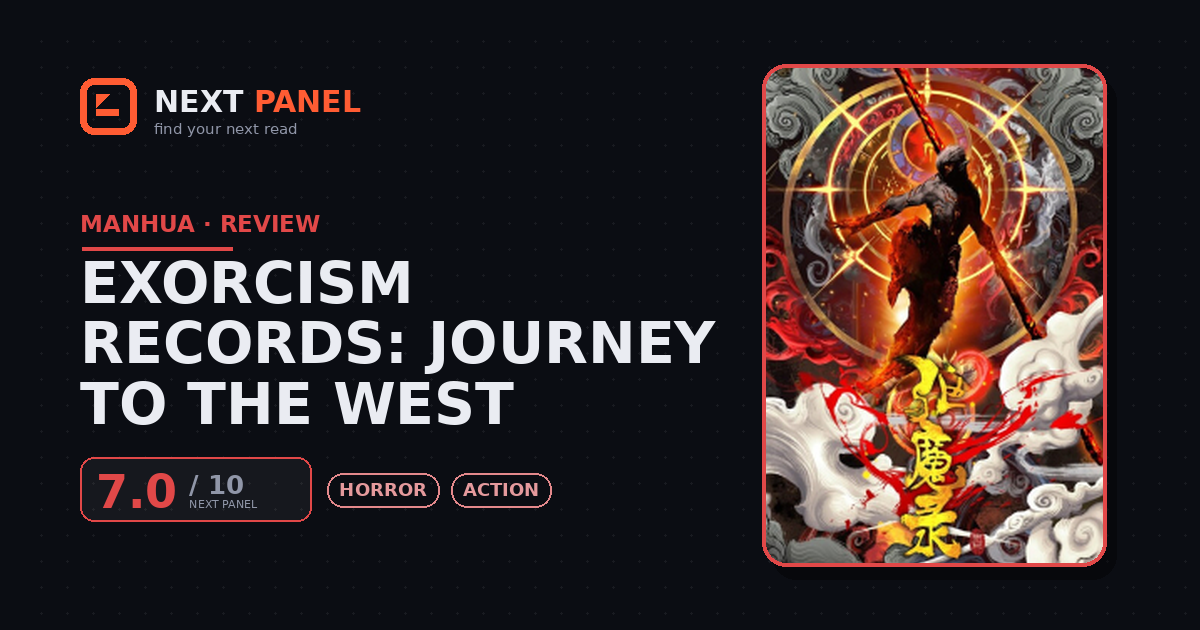
Quick Answer
Yes, if you like a classic story told from a different angle. Swapping the scripture quest for an exorcism mandate turns Journey to the West's familiar demon encounters into something closer to horror-adventure, and the change of framing makes even well-known monsters feel a little fresher.
Quick Verdict
“Clever angle on very old material — treat the demons as the point instead of the obstacle, and a familiar story gets a genuine reason to feel new again.”
Best for: Readers who enjoy Journey to the West retellings or monster-hunting horror-adventure with episodic structure and classic Chinese folklore roots.
Not for: Readers who want a single tight plot arc rather than a story built mostly around individual demon encounters, or who need the source material's Buddhist framing kept intact.
- Type
- Manhua
- Genres
- Horror, Action
- Status
- Ongoing
- This review
- Minor Spoilers
- Author
- Dengang
- Publisher
- Bilibili Comics
- Platform
- Bilibili Comics
| Quick facts | |
|---|---|
| Format | Manhua, 323 chapters |
| Run | ongoing |
Overview
Journey to the West has been retold more times than almost any story in Chinese literature, and Exorcism Records finds a genuinely different angle into it: what if the four travelers heading west weren't seeking sacred scriptures at all, but hunting demons? Jiang Liu'er and his three disciples still walk the same road and run into many of the same monsters — the White Bone Demon, the Nine-Headed Worm, and other figures pulled straight from the original folklore — but their reason for fighting them has changed completely. Where the original story treats these encounters as trials on the way to enlightenment, here they're the entire point. Jiang Liu'er sums up the shift himself when he tells the Buddha he's "just a freelance monk" — his path and the original pilgrim's path have quietly diverged.
What it does well
The core premise swap is smart because it doesn't need to invent new mythology to feel fresh — it just changes what the existing mythology is for. Readers who know the source material get the pleasure of watching familiar demons and set pieces get repurposed with a different stake attached, while the exorcism framing gives the story a slightly darker, more horror-adjacent texture than most Journey to the West adaptations lean into.
That tonal shift suits episodic structure well. Each arc functions like its own self-contained horror-adventure story built around a specific demon, which makes the series easy to read in pieces without needing to track a dense ongoing plot. The four-disciple dynamic — justice-driven, willing to sidestep the Buddha's larger cosmic plan in favor of smaller, tangible wins — gives the cast a clear, consistent identity that holds the individual arcs together even when the connecting plot threads are thin.
Where it falls short
That same episodic structure is also the story's biggest limitation. Because so much of the series is built around one demon encounter after another, the connective plot between arcs can feel secondary, and momentum dips in the gaps between the stronger individual stories. Readers who prefer a single driving plot over a monster-of-the-arc format may find themselves waiting for a throughline that takes a while to assert itself.
The reinterpretation also leans on familiarity with the source material more than it might first appear. Without knowing what the original Journey to the West does with these characters and demons, some of the changes here read as generic fantasy-horror beats rather than the pointed twists they're meant to be. And as of now, there's no official English license, so access depends on unofficial translations until that changes.
Verdict
Exorcism Records takes one of the most retold stories in Chinese fiction and finds a real angle into it by asking what happens when the obstacles become the mission. It's more satisfying arc by arc than as a single continuous read, but for anyone who enjoys Journey to the West retellings or episodic monster-hunting horror, the premise alone makes it worth checking out.
Strengths & Weaknesses
Strengths
- The core swap — exorcists instead of scripture-seekers — gives a story everyone already half-knows a real reason to feel different, since the demons stop being obstacles on the way to something else and become the actual point.
- Using recognizable Journey to the West monsters like the White Bone Demon and the Nine-Headed Worm gives each arc a built-in mythological hook without requiring the story to invent its horror from scratch.
- Jiang Liu'er's line to the Buddha — that he's 'just a freelance monk' — sums up the series' whole angle in one moment: justice and small, tangible wins over the abstract, distant goal of enlightenment.
- The episodic structure makes it easy to pick up and read in chunks without losing track of an overarching plot you have to keep memorizing.
Weaknesses
- The demon-of-the-arc structure means the story leans more on individual encounters than a single driving plot, so momentum can dip between arcs.
- Readers unfamiliar with Journey to the West's original cast and cosmology will miss some of the reinterpretation's punch, since a lot of what makes each twist land depends on knowing what's being changed.
- There's currently no official English licensed release, so availability depends on unofficial scanlation until that changes.
Similar Titles
Another Chinese folklore figure getting a modern action-adventure retelling, with a similar mix of mythology and monster-fighting.
The Legend of Nao Zhi
Shares the interest in taking a well-known cultural myth and restructuring it around a different core cast dynamic.
A different mythological base, but a similar blend of episodic supernatural encounters and Chinese folklore roots.
Frequently Asked Questions
Do I need to know the original Journey to the West to follow this?
Not strictly, but it helps. Familiarity with the original pilgrims and demons makes the reinterpretation's changes land harder, since a lot of the appeal is seeing familiar figures given a different purpose.
Is there an official English release?
Not yet as of this review — it's officially serialized in Chinese, with English versions currently only available through unofficial scanlation. Check back as licensing can change.
Is this connected to the anime 'Exorcism Chronicles: The Beginning'?
They share source material and demon-hunting framing from Journey to the West folklore, but this manhua and that donghua are separate adaptations — check each work's own credits before assuming a direct tie-in.