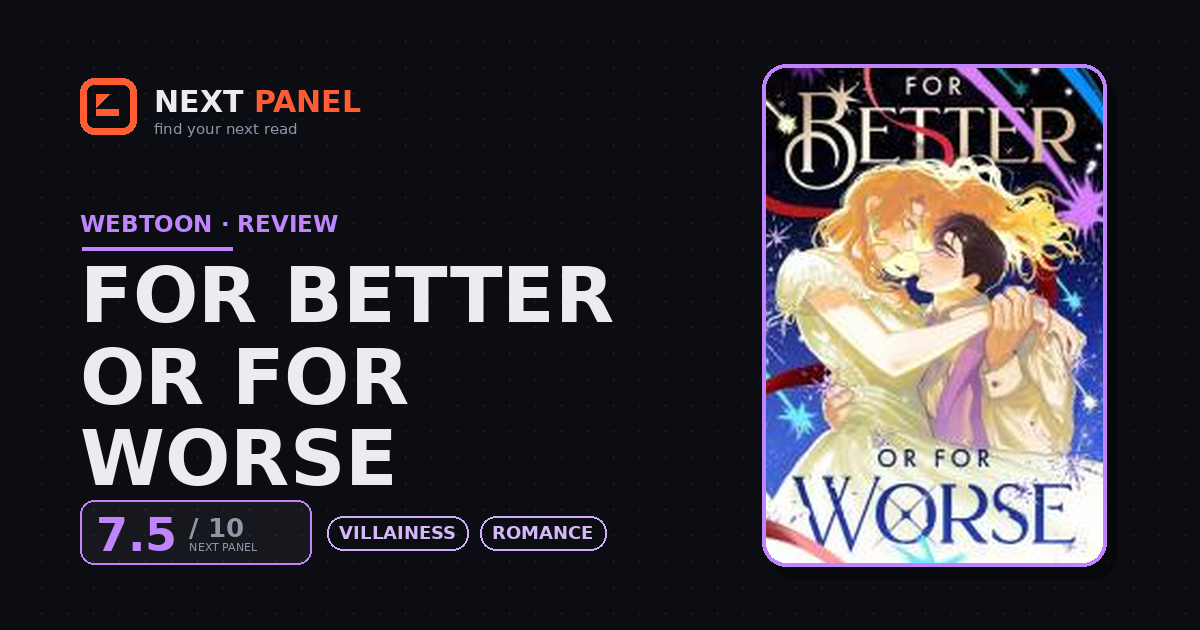
Is For Better or for Worse Worth Reading? Review & Where to Read
Quick Answer
If you want a well-drawn, character-driven villainess romance with a genuinely clever female lead, this delivers for most of its run — just brace for a rushed final stretch.
Quick Verdict
“Ninety percent of a great slow-burn romance, undercut by an ending that clearly ran out of room.”
Best for: Readers who want a villainess-genre romance carried by strong character writing rather than power fantasy or revenge.
Not for: Readers who need a story to stick its landing — the ending compresses plot threads that deserved more space.
- Type
- Webtoon
- Genres
- Villainess, Romance
- Status
- Completed
- This review
- Minor Spoilers
- Author
- No Heeda
- Artist
- Eunren
- Publisher
- Kakaopage
- Platform
- Tapas
| Quick facts | |
|---|---|
| Format | Webtoon (shōjo), 133 chapters |
| Run | completed |
| Community score | MangaUpdates 8.3 |
| Where to read | Tapas — official |
Overview
Lady Dillon doesn't realize she's living inside a romance novel until she runs into Marquess Cedric and the plot comes flooding back to her: in the story she remembers, her beloved younger sister marries Cedric and dies in childbirth. Determined to change that outcome, Dillon marries Cedric herself instead, fully aware that the novel's plot says he's supposed to fall in love with someone else entirely. For Better or for Worse spends its runtime on that marriage of convenience, and on what happens when two people who married for the wrong reasons start caring about each other anyway.
No Heeda and artist Eunren build this as a slow-burn romance dressed in villainess-genre clothing, more interested in Dillon and Cedric actually getting to know each other than in power fantasy or revenge plotting.
What it does well
Dillon is the clear draw. She's clever, self-possessed, and solves problems by outmaneuvering people rather than waiting to be rescued, which makes her a refreshing lead even within a genre that's produced a lot of capable heroines lately. Her dynamic with Cedric earns its slow burn — their early scenes are all friction and mutual suspicion, and the story takes real time letting that soften into something else, rather than rushing the payoff.
The supporting cast benefits from the same care. Dillon's friends and allies are written as people with their own concerns, not just sounding boards for the central romance, which gives the world around the two leads some real texture. And the art holds up its end throughout — expressive, well-composed, and it keeps getting better as the series goes, never becoming a reason to put the book down.
Where it falls short
The middle stretch tests patience. Some sequences — a single ball spans multiple chapters — spend a lot of time on dialogue and social maneuvering that doesn't always earn its length, and the pacing sags noticeably compared to the tighter opening and closing arcs.
A late twist is also divisive: it recontextualizes some of what came before in a way that several longtime readers feel undercuts the relationship growth the story spent so long building. And after all that patient pacing, the ending rushes to close out multiple plot threads at once, leaving the resolution feeling compressed next to everything that led up to it.
Verdict
For Better or for Worse is a well-drawn, character-first villainess romance carried by a genuinely sharp female lead and a slow burn that mostly earns its patience. The dragging middle and rushed ending keep it from being a clean 8, but the central relationship is worth the ride.
Strengths & Weaknesses
Strengths
- Dillon is a genuinely sharp, capable lead who solves problems with wit rather than passively waiting for the plot to save her.
- The marriage-of-convenience setup gives Dillon and Cedric's slow-burn chemistry real texture — their arguments and small truces feel like two specific people, not genre shorthand.
- The art is polished and expressive, and it noticeably improves as the series progresses without ever being a weak point.
- The supporting cast, including Dillon's female friends, get real personalities instead of existing purely to prop up the central romance.
Weaknesses
- The story drags in its middle stretch, with long dialogue-heavy sequences (an entire ball spans several chapters) that slow momentum without adding much.
- A late plot twist reframes earlier developments in a way that several readers find undercuts the relationship progress built up to that point.
- The ending compresses multiple threads and resolves the central conflict much faster than the patient pacing everywhere else in the series.
Similar Titles
A darker, more thriller-flavored slow burn if you want the patient pacing without the fantasy court setting.
A different genre entirely, but similar in centering a clever female lead navigating a relationship she didn't choose.
A more grounded, less fantastical romance-drama if the villainess trappings here aren't the draw.
Where to Read Officially
| Platform | Format | Pricing | Region notes | Link |
|---|---|---|---|---|
| Tapas | Webtoon (vertical scroll) | Free + Paid | Region availability varies | Open |
Frequently Asked Questions
Is For Better or for Worse finished?
Yes, it's complete at 133 chapters plus a prologue, and it's officially translated in English on Tapas.
Does Dillon actually become the story's villainess?
No — she uses her knowledge of the novel's plot to steer events away from the tragedy she remembers, which is the engine of the story rather than her becoming genuinely villainous.
Is this more comedy or drama?
Both, roughly in balance for most of the run — expect witty bickering and court intrigue alongside real emotional stakes, though the finale leans harder into drama than the rest of the story.