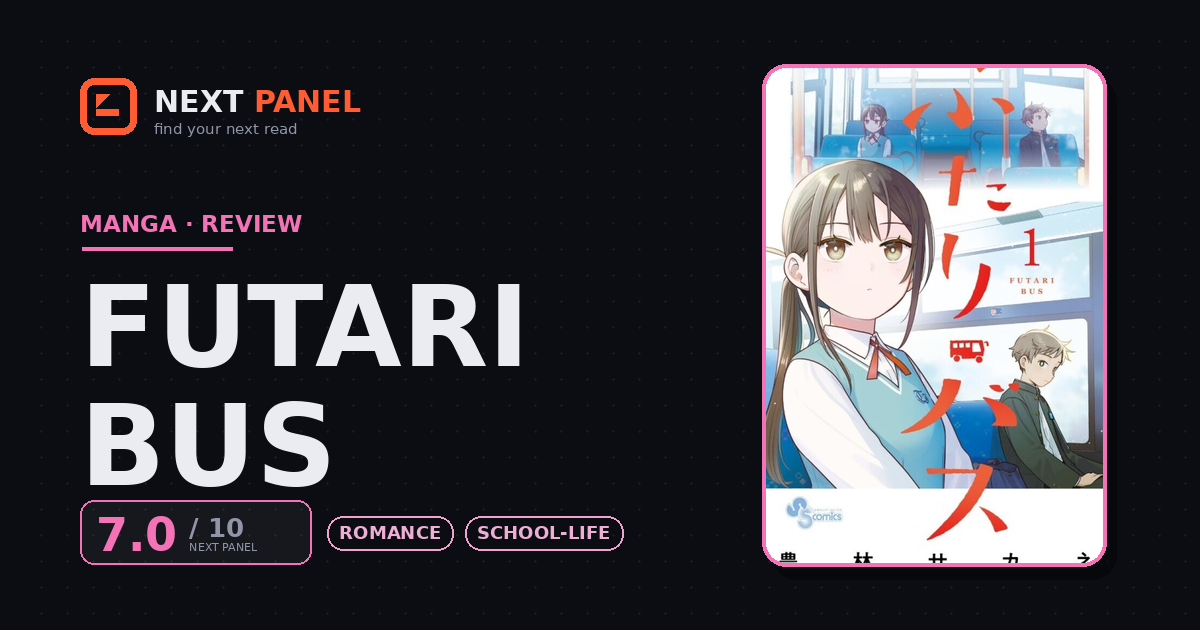
Is Futari Bus Worth Reading? Review & Where to Read
Quick Answer
Yes, with the caveat that it's brand new — only two volumes in as of this review. If you want a low-key, believable middle-school romance that isn't in a rush, this is worth starting now while it's still easy to catch up.
Quick Verdict
“Two volumes in, this is already better at quiet, believable teenage awkwardness than most rom-coms manage in twenty.”
Best for: Readers who want a slow, believable middle-school romance without over-the-top drama or a harem.
Not for: Readers who want fast romantic progress or a lot of plot happening around the couple.
- Type
- Manga
- Genres
- School Life, Romance
- Status
- Ongoing
- This review
- Minor Spoilers
- Author
- Sakane Toyobayashi
- Publisher
- Shogakukan
| Quick facts | |
|---|---|
| Format | Manga (shōnen), 2 volumes |
| Run | 2025–present · ongoing |
| Community score | AniList 7.5 · MangaUpdates 7.1 |
Overview
Shunpei Hinoki and An Takayagawa used to be close, back when they were in the same elementary school in a small town of around 3,000 people. Now they go to different schools, and their only regular contact is riding the same bus, sitting apart, not really talking. Futari Bus, written and drawn by Sakane Toyobayashi, starts small: the vending machine they used to pass on the route disappears, and that's reason enough for the two of them to actually speak again. Two volumes in, that's still basically the whole story — two kids slowly remembering how to be around each other.
What it does well
The character writing is the reason to read this. Shunpei and An act like actual young teenagers: awkward, a little too careful with what they say, prone to overthinking a two-sentence conversation. Neither of them is written as unusually mature or witty for their age, which is rarer than it should be in school-set romance manga, and it makes their scenes together feel observed rather than performed.
The bus itself is a smart structural choice. It gives the manga a reason for the two of them to be in the same place regularly without needing constant contrived run-ins, and it keeps the scale small — most of the manga happens in short windows, waiting at a stop or sitting a few seats apart, which suits the low-key tone.
The manga also leans on specific, small details instead of big swings. A missing vending machine, a half-remembered joke from years ago, the particular awkwardness of sitting near someone you used to talk to every day — these are the beats the story is actually interested in, and they land because the manga doesn't rush past them to get to a bigger romantic moment.
Pacing-wise, nothing here feels like it's stalling for the sake of stalling. It's slow because the relationship is genuinely early, and the manga seems comfortable letting it stay early for now.
Where it falls short
Two volumes is not a lot to judge a series by, and that's the honest limitation here. There's no way yet to know if Toyobayashi can sustain this tone once the story needs to introduce more plot, more supporting characters, or an actual turning point in the relationship. Right now it's proof of concept, not proof of a full series.
The cast outside Shunpei and An barely exists yet. Family, classmates, and other side characters show up, but nobody besides the two leads has gotten real definition so far, which is fine for a two-hander this early but worth knowing going in.
And if you don't like slow-burn romance, there's genuinely very little to hold onto yet — no love triangle, no big misunderstanding arc, just two kids talking a little more each chapter.
Verdict
This is an easy manga to catch up on right now, since there's only two volumes, and an easy one to recommend if quiet, age-appropriate teenage romance is what you're after. It hasn't proven it can go the distance yet, but what's here is unusually well-observed for how early it is. Worth starting now, with the understanding that you're getting in on the ground floor.
Strengths & Weaknesses
Strengths
- Shunpei and An actually read as their age — awkward, a little guarded, not wise-beyond-their-years like a lot of manga teens.
- The bus setting gives the manga a built-in, recurring reason for the two of them to keep running into each other without forcing constant coincidences.
- Small, specific details, like a missing vending machine or a half-remembered inside joke, carry more weight than big romantic gestures.
- Nothing about the pacing feels rushed toward a confession or a kiss — it's comfortable being early.
Weaknesses
- It's only two volumes in, so there's not much series shape yet — no telling how or whether the manga sustains this past the initial spark.
- The supporting cast outside the two leads barely registers so far; this is a two-hander for now.
- If slow-burn isn't your thing, there's genuinely very little romantic progress to point to this early.
Similar Titles
Another understated, believably-paced school romance if you want more of the same low-key tone.
A different tone (heavier subject matter), but a similar commitment to quiet, specific character writing over big gestures.
Frequently Asked Questions
Is Futari Bus licensed in English yet?
Not as of this review. It only started serialization in Japan in November 2025, so there's no official English release yet — worth checking back as it's still very new.
How many volumes are out?
Two, as of this review, with the series still actively serializing in Weekly Shonen Sunday.
Is this a slow-burn romance?
Very much so — this is early-stage, low-drama reconnection, not a fast-moving couple story.