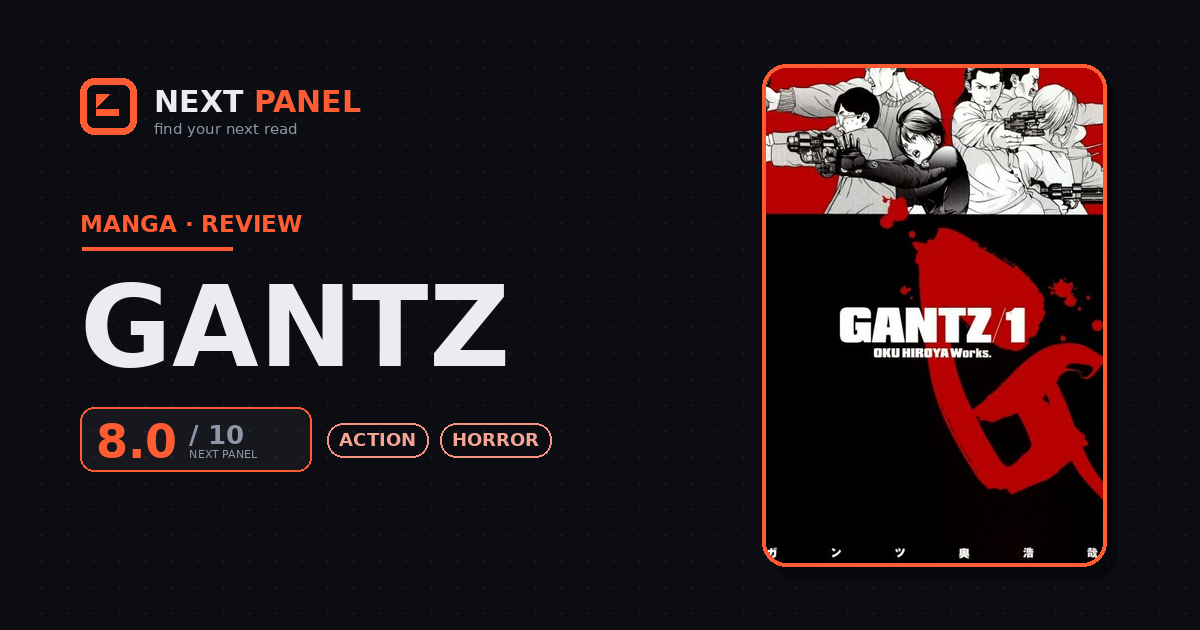
Is Gantz Worth Reading? Review & Where to Read
Quick Answer
Yes, if you want one of the most relentless, shock-driven action manga ever made and can stomach heavy violence and gratuitous nudity. It's less essential if you want a clean, consistent story from start to finish.
Quick Verdict
“Brutal, unpredictable, and drawn with real kinetic force — it just never figures out what to do with all the nudity it keeps shoving in the frame.”
Best for: Readers who want ultra-violent, unpredictable survival horror with genuine stakes and don't mind graphic content.
Not for: Readers who want a tightly plotted story with a consistent tone from beginning to end.
- Type
- Manga
- Genres
- Horror, Action
- Status
- Completed
- This review
- Minor Spoilers
- Author
- Hiroya Oku
- Publisher
- Shueisha
- Platform
- Dark Horse Digital
| Quick facts | |
|---|---|
| Format | Manga (seinen), 383 chapters, 37 volumes |
| Run | 2000–2013 · completed |
| Community score | AniList 7.7 · MangaUpdates 8.1 |
| Content | Extreme violence, gore, sexual content and nudity |
| Where to read | Dark Horse Digital — official |
Overview
Kei Kurono and his old classmate Masaru Kato die together on a subway platform, saving a homeless man from an oncoming train. Instead of staying dead, they wake up in an apartment with a group of strangers and a black sphere that calls itself Gantz. From there, it's simple and horrible: Gantz sends them out on missions to hunt aliens hiding in Tokyo, hands them absurdly powerful suits and weapons, and scores every kill. Miss your quota, die on the job, or just get unlucky, and you're gone for good. Survive enough missions and you're free. It's a premise built for maximum tension, and Oku wrings every bit of it out.
What it does well
The missions are where Gantz earns its reputation. Oku doesn't protect his cast. Named characters you've spent volumes with die mid-sentence, and the show-don't-tell violence, exploded torsos, snapped limbs, bodies caving in, lands with a physical weight a lot of action manga never bother to draw convincingly. That unpredictability keeps every mission genuinely tense instead of a foregone conclusion.
Kurono himself is a smarter build than he first looks. He starts as a checked-out, selfish teenager who mostly cares about looking cool and getting the girl. Watching him slowly turn into someone who actually steps in front of danger for other people, without the story making a big speech out of it, is one of the more quietly effective long-form arcs in the genre. Kato, the moral center of the early volumes, gives the whole thing a conscience to bounce off of.
The scope also keeps expanding in ways that genuinely surprise. Just when the formula of arrive, fight monster, survive or don't threatens to get stale, Oku pivots the story somewhere bigger and stranger, and the alien designs stay creative and unsettling well past the point where most series would start repeating themselves.
Where it falls short
The elephant in the room is the nudity. It shows up constantly, in mission briefings, in the apartment between fights, in scenes that have nothing to do with tension or character, and it rarely does anything the story actually needs. It's the single biggest reason Gantz reads as dated now rather than just violent.
The pacing also takes a real hit once the story shifts from tight, self-contained survival missions into a sprawling alien-invasion arc. That stretch drags, repeats beats from earlier volumes, and loses some of the claustrophobic tension that made the early chapters work. And the tone can whiplash hard, cutting from a genuinely grim death to broad, juvenile comedy in the same chapter, which undercuts scenes that should hit harder.
Verdict
Gantz is a genuinely important, influential piece of 2000s seinen action, and large stretches of it are still some of the most tense, well-drawn violence in manga. But it's not a clean recommendation. The gratuitous content and the sag in the middle stretch mean it works best for readers who already know they want something this unfiltered and are willing to push through the parts that haven't aged well to get to the parts that still land.
Strengths & Weaknesses
Strengths
- The art sells the violence: Oku draws bodies breaking apart with a clarity and weight most action manga don't bother with.
- The core hook, ordinary people forced into a death game with no explanation, stays tense because nobody's survival is guaranteed, named characters included.
- Kei Kurono's arc from a selfish, checked-out teenager into someone who actually tries to protect people is handled with more patience than the shock-value reputation suggests.
- The mission structure keeps escalating in genuinely surprising directions instead of settling into a formula.
Weaknesses
- The nudity and sexual content show up constantly and rarely serve the story, and it's the main thing that ages the series badly.
- The pacing sags hard once the story moves from body-count survival horror into a bigger alien-invasion plot, and some of that stretch feels like stalling.
- Tone swings from grim horror to juvenile comedy within the same chapter, and it doesn't always land.
Similar Titles
Same forced-death-game setup with a similarly unflinching approach to violence.
Another body-horror survival story about ordinary people facing monstrous threats they never asked for.
Shares Gantz's taste for grotesque creature design and squad-based body count.
Where to Read Officially
| Platform | Format | Pricing | Region notes | Link |
|---|---|---|---|---|
| Dark Horse Digital | Print & digital volumes | Paid | Region availability varies | Open |
Frequently Asked Questions
Is Gantz finished?
Yes. It ran in Weekly Young Jump from 2000 to 2013 and is complete across 37 volumes.
How graphic is Gantz?
Very. Expect frequent extreme violence, gore, and nudity throughout, not just in isolated arcs.
Where can I read Gantz legally?
Dark Horse Comics holds the English print and digital rights; volumes are sold as individual books and omnibus editions.