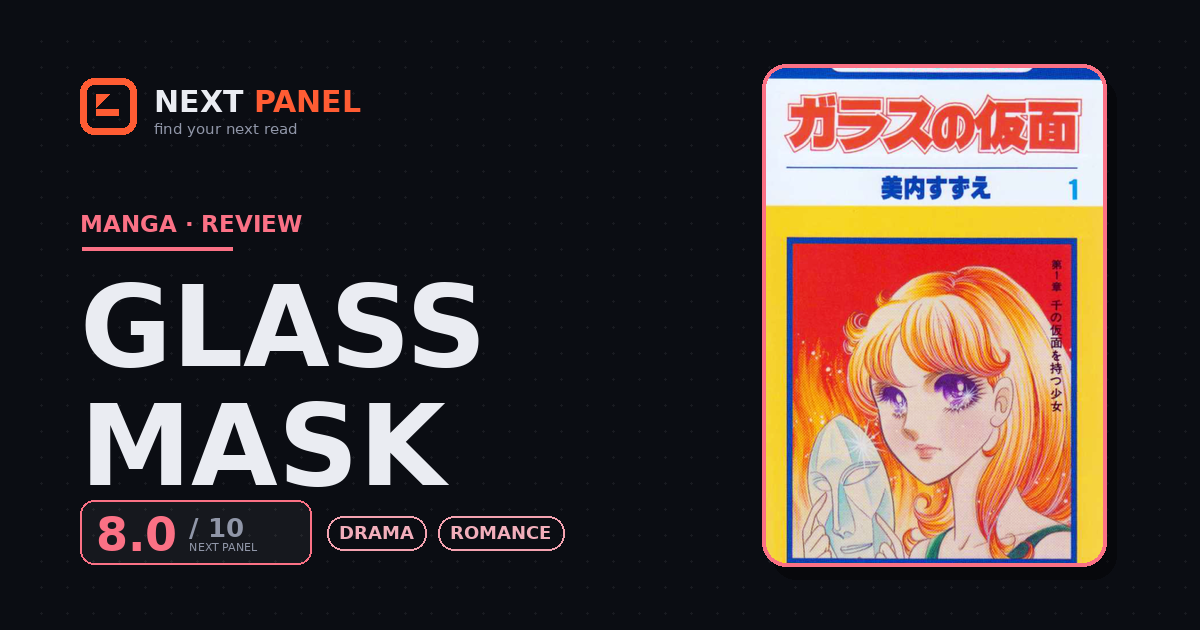
Is Glass Mask Worth Reading? Review & Where to Read
Quick Answer
Yes, if you want one of the most influential and purely passionate shoujo dramas ever drawn, and you're okay reading a story that's still, decades later, unfinished. The rivalry and the performances are worth it on their own.
Quick Verdict
“Few manga sell raw, obsessive ambition as convincingly as this one does — the tragedy is that you may finish every available chapter without ever finding out how it ends.”
Best for: Readers who want an intensely dramatic, character-driven story about ambition and rivalry and don't mind an open-ended, possibly permanent hiatus.
Not for: Readers who want a complete story with a clear ending and a lighter, more restrained emotional tone.
- Type
- Manga
- Genres
- Romance, Drama
- Status
- On Hiatus
- This review
- Minor Spoilers
- Author
- Suzue Miuchi
- Publisher
- Hakusensha
| Quick facts | |
|---|---|
| Format | Manga (shōjo), 2 volumes |
| Run | on hiatus |
| Community score | MangaUpdates 6.6 |
Overview
Maya Kitajima is a poor, unremarkable-looking teenager with a part-time job and no formal training in anything — until reclusive, legendary former actress Chigusa Tsukikage spots something in her that no one else can see. Tsukikage has spent years searching for someone capable of playing the lead in "The Crimson Goddess," a legendary play so demanding that only one actress a generation is considered worthy of attempting it. Maya's biggest obstacle isn't her poverty or her inexperience — it's Ayumi Himekawa, a wealthy, classically trained actress who becomes both her fiercest rival and, over time, someone she genuinely respects.
Suzue Miuchi started this series in Hana to Yume in 1976, and it became one of the best-selling and most influential shoujo manga ever made, shaping how the genre handles ambition, rivalry, and performance for decades afterward.
What it does well
Maya's relationship to acting is the whole engine of the story, and it's genuinely unusual: she doesn't just perform well, she disappears into a role so completely that it frightens the professionals around her. Watching other characters realize what she's capable of, chapter after chapter, is one of the most consistently effective hooks in the genre.
The rivalry with Ayumi is the other pillar, and it's handled with real maturity for a story this melodramatic. Neither woman is the villain. Both want to win because they respect the craft and respect each other, and that mutual respect under fierce competition gives the series a backbone that outlasts any individual arc.
Miuchi's play-within-the-story structure is also a highlight — entire theatrical productions get staged on the page, panel by panel, and those sequences are where the manga's emotional intensity peaks. And that intensity is everywhere: this is unapologetic, full-volume melodrama, drawn and written with total conviction, and that commitment is exactly what makes it work instead of feeling silly.
Where it falls short
The unavoidable issue is length and status. Glass Mask has been running, on and off, since 1976, and has sat on hiatus since 2012 with no confirmed date for a return. Reading it today means accepting the very real possibility that the central question — who finally plays the Crimson Goddess — may never get answered on the page.
Even setting the hiatus aside, nearly 50 volumes is a lot of story, and the later chapters slow down and occasionally repeat their own rhythms: a new obstacle appears, Maya struggles, Maya triumphs. The melodrama, while part of the appeal, is heavy even by shoujo standards and won't land for readers who prefer a lighter touch.
Verdict
Glass Mask earns its reputation as one of the defining shoujo dramas for a reason — the central rivalry and Maya's relationship to performance are as compelling now as they clearly were in 1976. Go in for the journey rather than a guaranteed destination, and it's an easy, rewarding read; go in needing a finished story, and the hiatus is a real dealbreaker worth knowing about upfront.
Strengths & Weaknesses
Strengths
- Maya's total, almost frightening commitment to acting — she disappears into a role in a way that unsettles the people around her — is a genuinely unique hook for a coming-of-age story.
- The rivalry with Ayumi Himekawa is one of the best in shoujo manga: both women respect each other, want to win on merit, and never get reduced to a simple villain-and-hero dynamic.
- The play-within-the-story structure lets Miuchi stage entire dramas inside the drama, and those performance arcs are where the manga is at its most purely thrilling.
- Miuchi commits fully to big, old-school melodrama without apologizing for it, which gives the whole series an emotional intensity a more restrained story wouldn't have.
Weaknesses
- The series has been on hiatus since 2012 with no confirmed resumption, so committing to it means accepting you may never see how the central rivalry resolves.
- At nearly 50 volumes and counting, the pace slows considerably in places, and some later arcs repeat the same obstacle-then-triumph rhythm as earlier ones.
- The melodrama is heavy even by shoujo standards, and readers who prefer understated writing may find some scenes overwrought.
Similar Titles
A more modern, faster-paced showbiz story with a similarly driven heroine clawing her way up from nothing.
A different medium (music instead of theater) but the same core idea of a young talent consumed by their art.
Another slow, character-first drama about obsessive dedication to a craft, this time shogi instead of the stage.
Frequently Asked Questions
Is Glass Mask finished?
No. It's been serialized since 1976 and remains on hiatus as of this review, with the story still unresolved. Author Suzue Miuchi has said she intends to finish it, but there's no confirmed timeline.
Is there an official English translation?
No. Miuchi has not signed off on an official English release, so there's no legal way to read it in English yet — worth re-checking down the line in case that changes.
Do I need to watch the anime first?
No. The manga is the original, definitive version, and the anime adaptations only cover portions of the much longer manga story.