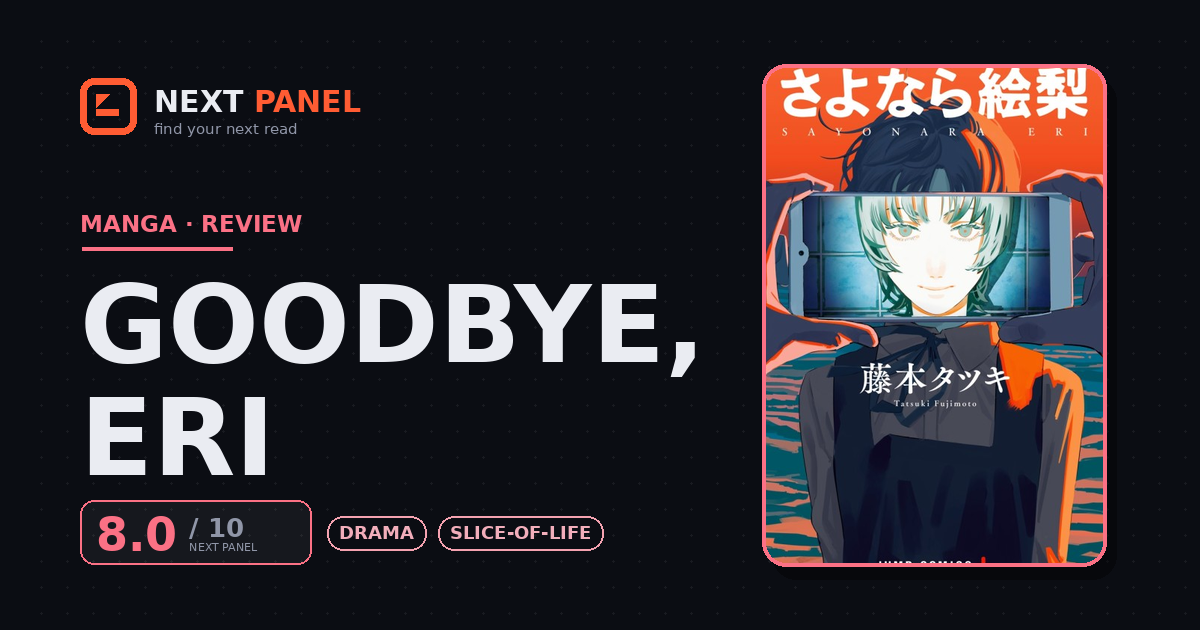
Is Goodbye, Eri Worth Reading? Review & Where to Read
Quick Answer
Yes, if you like inventive, thoughtful comics. Goodbye, Eri is a clever, moving one-shot about film, memory, and grief, and you can read it in one sitting. Just know its meta, ambiguous ending divides people.
Quick Verdict
“Inventive and moving, this one-shot about film, memory, and grief from Tatsuki Fujimoto is clever and layered — though its meta ambiguity will divide readers.”
Best for: Readers who want an inventive and moving short comic about art, memory, and grief.
Not for: Readers who want a long story, clear answers, or a conventional format.
- Type
- Manga
- Genres
- Drama, Slice of Life
- Status
- Completed
- This review
- Minor Spoilers
- Author
- Tatsuki Fujimoto
- Publisher
- VIZ Media
- Platform
- VIZ
| Quick facts | |
|---|---|
| Format | Manga (shōnen), 1 chapters, 1 volumes |
| Run | 2022–2022 · completed |
| Community score | AniList 8.5 · MAL 8.6 · MangaUpdates 8.4 |
| Content | Illness, grief |
| Where to read | VIZ — official |
Overview
Goodbye, Eri is a one-shot from Tatsuki Fujimoto (Chainsaw Man, Look Back) about film, memory, and grief. Yuta is a boy whose dying mother asks him to film her, and he turns the footage into a movie, the start of a long, complicated relationship with making films, and with a mysterious girl named Eri who shares his obsession with cinema. Told almost entirely in panels framed like film stills, it's a moving, playful, and slippery story about how we use art to process loss and quietly reshape reality. It's a single volume, complete, and readable in one sitting.
What it does well
The form is the first thing that grabs you. Nearly every panel is composed like a still from a movie, often shot from a fixed "camera," so reading it genuinely feels like watching a film, complete with cuts, lingering takes, and the occasional jolt. It's a clever, distinctive effect that ties directly into the story's themes about how film freezes and reshapes a moment.
Underneath the technique, it's deeply felt. Fujimoto uses the premise to explore grief, memory, and the comfort, and the lies, of turning real life into art, and he does it with his signature blend of raw emotion, offbeat humor, and sudden strangeness. It's the kind of short work that lingers and rewards a second read.
And it's tight. As a complete one-shot, it says what it wants to say without padding, layering more meaning into 200 pages than many series manage in twenty volumes, and leaving plenty to turn over afterward.
Where it falls short
The meta ambiguity is divisive. The story deliberately blurs reality and fiction, especially at the end, and how you take that is the whole point, which means some readers find it brilliant and others find it pretentious or simply confusing.
It's also short by nature, so it can't develop its ideas with the depth of a longer work, and the film-still format, while inventive, is an acquired taste that won't click for everyone.
Verdict
Goodbye, Eri is a clever, moving one-shot, and an easy recommendation for Fujimoto fans or anyone who enjoys inventive, thoughtful comics. Go in for the form, the emotion, and the ideas about art and memory rather than a conventional, fully resolved story. If you want clear answers or a long narrative, its brevity and ambiguity may frustrate you, but as a short, layered meditation on grief and filmmaking, it's a standout, and one of the easiest one-sitting recommendations on the site.
Strengths & Weaknesses
Strengths
- The form is inventive — nearly every panel is framed like a film still, so reading it feels like watching a movie, a clever, distinctive effect.
- It's emotionally resonant and thought-provoking, exploring grief, memory, and the comfort and lies of art.
- It has Fujimoto's signature mix of heart, humor, and weirdness, and it rewards rereading.
- It's a tight, complete one-shot with real layers.
Weaknesses
- The meta, ambiguous twists about reality and fiction are divisive — some find them brilliant, others pretentious or confusing.
- As a one-shot, it's short and can't develop things as deeply as a longer work.
- The film-still format is an acquired taste.
Similar Titles
Fujimoto's hit series, with the same mix of heart, weirdness, and surprise on a bigger canvas.
Fujimoto's earlier work, also preoccupied with film and suffering, though messier.
Another short, emotionally honest comic about young lives and loss.
Where to Read Officially
| Platform | Format | Pricing | Region notes | Link |
|---|---|---|---|---|
| VIZ | Digital & print | Free + Paid | Region availability varies | Open |
Frequently Asked Questions
How long is it?
It's a single one-shot volume, around 200 pages, so you can read it in one sitting.
Is it like Chainsaw Man?
It shares Fujimoto's voice — emotional, funny, and slippery — but it's a quiet, personal one-shot rather than an action series. If you liked Look Back, this is in the same vein.
Is the ending confusing?
Deliberately ambiguous. It plays with the line between reality and fiction, and how you read the ending is part of the point, which delights some readers and frustrates others.