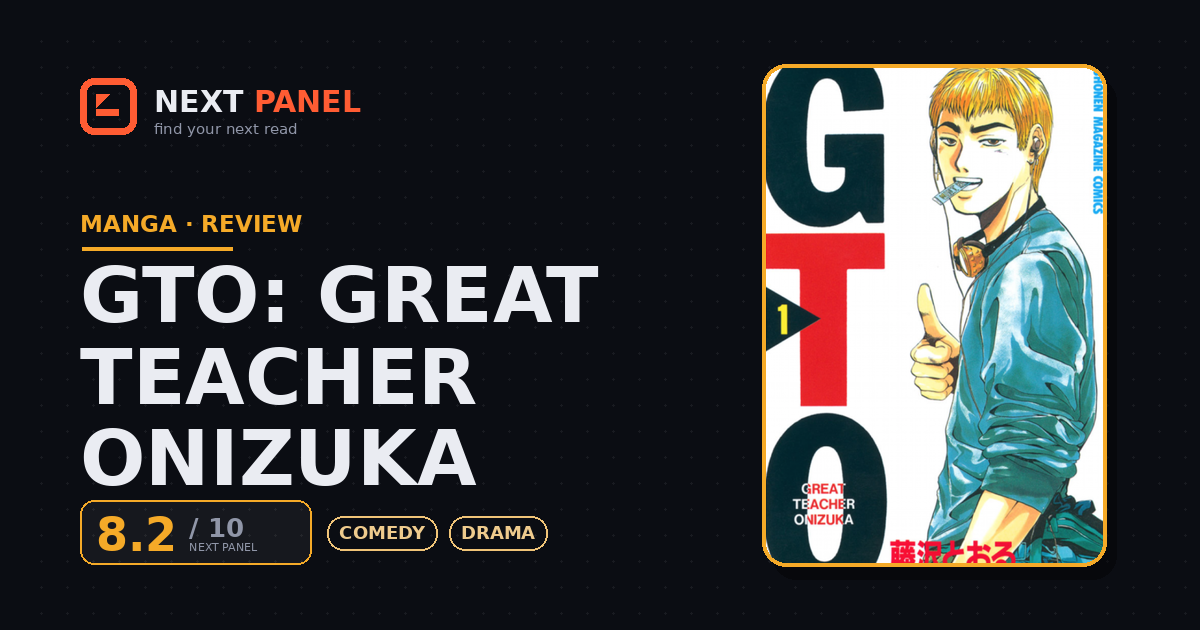
Is GTO: Great Teacher Onizuka Worth Reading? Review & Where to Read
Quick Answer
Yes, if you can stomach some very dated fanservice comedy. Underneath the slapstick is one of manga's best 'terrible person becomes a great mentor' stories, with student arcs that land harder than the goofy setup suggests.
Quick Verdict
“The fanservice hasn't aged well, but strip that away and it's still one of the best delinquent-turned-mentor stories manga has produced.”
Best for: Readers who want a foul-mouthed mentor story that swings hard between raunchy comedy and genuine emotional payoff.
Not for: Readers who want restrained humor or a lead who visibly changes over the course of the story.
- Type
- Manga
- Genres
- Drama, Comedy
- Status
- Completed
- This review
- Minor Spoilers
- Author
- Tooru Fujisawa
- Publisher
- Kodansha
- Platform
- Kodansha
| Quick facts | |
|---|---|
| Format | Manga (shōnen), 208 chapters, 25 volumes |
| Run | 1997–2002 · completed |
| Community score | AniList 8.6 · MangaUpdates 8.8 |
| Content | Sexual content, violence, bullying, drug references |
| Where to read | Kodansha — official |
Overview
Eikichi Onizuka is 22, freshly out of a biker gang, and has decided — for reasons that make sense only to him — that becoming Japan's greatest teacher is his ticket to respect, money, and a girlfriend. He talks his way into a job at a private middle school with a homeroom full of kids who've already broken three teachers that year, and the rest of the series is Onizuka proving, one absurd stunt at a time, that he might actually be the right person for the job.
Tooru Fujisawa structures GTO as a series of student arcs rather than one long plot. A kid is being blackmailed, or bullied, or manipulated by a parent, or slowly convincing themselves nobody cares — and Onizuka wades in with a plan that usually involves property damage, public humiliation of an adult who deserves it, or both. It sounds like a formula, and it is one, but Fujisawa keeps finding new angles into it for over 200 chapters.
What it does well
The best thing GTO has going for it is that Onizuka never stops being believable as the wrong man for the job who somehow keeps being the right one. He's crude, impulsive, and motivated half the time by his own ego — but he actually listens to the kids in front of him in a way none of the credentialed adults around him bother to. That contrast is where the manga earns its emotional moments, and there are more of them than the loud comedy cover would suggest.
The student arcs are the heart of the book, and the strongest ones — Kunio Murai's isolation, Urumi Kanzaki's manipulation of everyone around her, Anko Uehara's home life — hit surprisingly hard for a series this committed to gags and fanservice. Fujisawa is good at setting up a kid as a joke or an antagonist and then, a chapter or two later, revealing exactly why they got that way. It's a simple move, but it's executed well enough times that it stops feeling like a trick.
The art holds up better than you'd expect from a late-'90s shōnen magazine series. Fujisawa's linework is clean, his comic timing on the page is sharp, and by the later chapters he's drawing some genuinely striking dramatic panels alongside the slapstick.
Where it falls short
The elephant in the room is the fanservice. Nudity and crude sexual comedy show up constantly, often in scenes that have nothing to do with the plot, and it hasn't aged well even by the standards of the genre. It's not just a tone thing — it occasionally sits right next to a genuinely sincere emotional beat and undercuts it.
Structurally, the later arcs — particularly the ones involving corrupt school board politics — start repeating the same 'adult in power is secretly the real villain' shape without adding much new to it. And Onizuka himself is essentially the same person in volume 25 that he was in volume 1. He's a fantastic engine for other characters' growth, but he doesn't really have an arc of his own.
Verdict
GTO is a product of its era in ways that will bother some readers and won't bother others, but the core of it — a genuinely lovable disaster of a man who turns out to be exactly what a room full of written-off kids needed — still works. If you can read past the dated fanservice, there's a mentor story here that a lot of manga since has tried to copy and rarely matched.
Strengths & Weaknesses
Strengths
- Onizuka is a genuinely compelling lead — a man with terrible impulse control who somehow keeps proving he cares more than the adults around him.
- The episodic student arcs each open as pure comedy and land a real emotional gut-punch by the end, which is a harder trick than it sounds.
- The art gets more confident as the series goes, handling both wall-to-wall slapstick and quiet emotional beats without either one feeling out of place.
- It doesn't sand down its edges — teachers, parents, and students act genuinely cruel to each other before Onizuka fixes anything, so the wins feel earned instead of handed to him.
Weaknesses
- The fanservice and gag humor are dated and sometimes undercut the more serious material sitting right next to it on the same page.
- A few later arcs lean on the same 'adult authority figure is secretly awful' structure one time too many.
- Onizuka himself barely changes across 25 volumes — he's more a force of nature acting on everyone else than a character with his own growth.
Similar Titles
Great Teacher Onizuka: 14 Days in Shonan
The direct sequel, following Onizuka years later — same voice, same mix of comedy and sincerity.
Another delinquent-lead comedy that keeps finding real heart under the slapstick.
If you want the pure-comedy, all-delinquent-school premise without the mentor arc.
Where to Read Officially
| Platform | Format | Pricing | Region notes | Link |
|---|---|---|---|---|
| Kodansha | Digital volumes | Paid | Region availability varies | Open |
Frequently Asked Questions
Do I need to watch the anime first?
No. The manga runs much longer and covers far more ground than the anime or live-action adaptations, and it's the version most fans consider definitive.
Is GTO finished?
Yes, the original series is complete at 25 volumes, and Fujisawa has continued the story in sequel series since.
How mature is the content?
Very — it's packed with crude humor, nudity played for laughs, and storylines about bullying, abuse, and other heavy topics, so it's aimed at older teens and adults despite its school setting.