Is Gyo Worth Reading? Review & Where to Read
Quick Answer
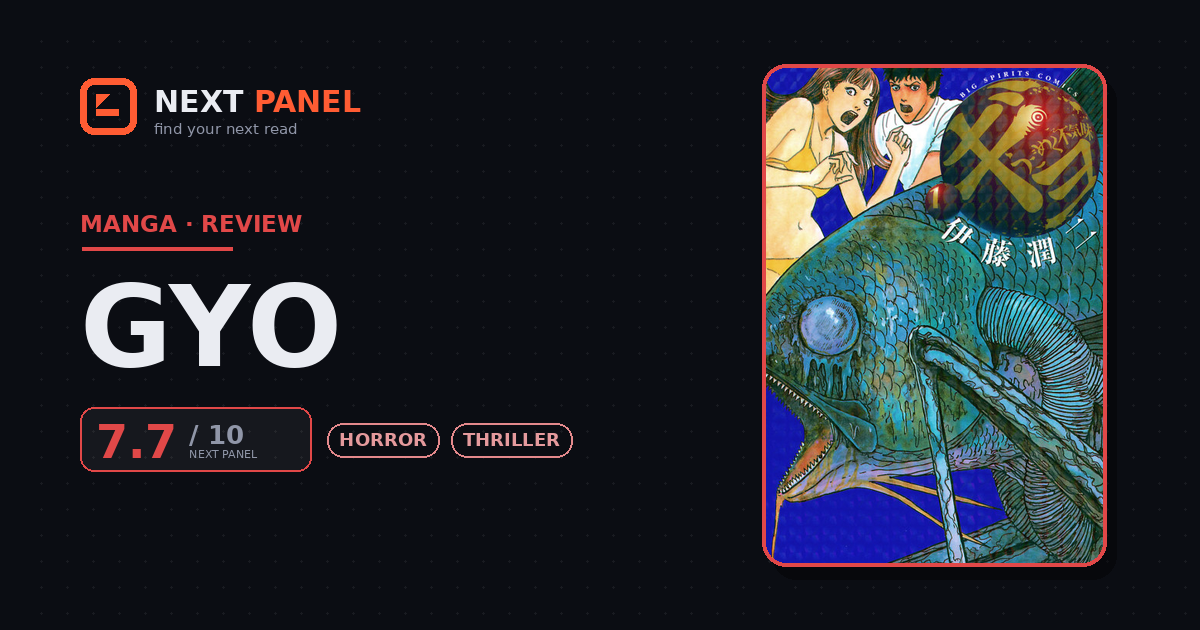
Yes, for the imagery alone — Gyo has some of Junji Ito's most memorable body horror. The plot gets more chaotic than tightly plotted in its later chapters, but the core concept and the dread it builds are worth the short read.
Quick Verdict
“Some of the most stomach-turning imagery Junji Ito has ever drawn, wrapped around a plot that gets messier the longer it runs.”
Best for: Readers who want visceral, escalating body horror and don't need a tidy resolution.
Not for: Readers who want a sympathetic lead or a horror story that stays controlled through the end.
- Type
- Manga
- Genres
- Horror, Thriller
- Status
- Completed
- This review
- Minor Spoilers
- Author
- Junji Ito
- Publisher
- Shogakukan / VIZ Media
- Platform
- VIZ Manga
| Quick facts | |
|---|---|
| Format | Manga (seinen), 21 chapters, 2 volumes |
| Run | 2001–2002 · completed |
| Community score | AniList 6.9 · MangaUpdates 6.9 |
| Content | Body horror, graphic violence |
| Where to read | VIZ Manga — official |
Overview
Gyo starts simple: a young couple on vacation in Okinawa notice a horrific smell, then start seeing dead fish walking on spindly, mechanical-looking legs, dragging themselves out of the ocean and into the city. From there, Junji Ito escalates the concept methodically. What starts as 'why are there fish with legs' turns into a full examination of exactly how far he can push one disturbing idea before it stops being scary in a contained way and turns into something closer to apocalyptic body horror.
What it does well
Ito's core images in Gyo are some of the most purely disgusting and memorable in horror manga. The walking fish alone would be enough, but he keeps finding new, worse variations on the 'dead thing animated by a horrible mechanism' idea until it's genuinely hard to look at some pages without flinching. The 'death stench' concept is a smart engine for horror, because it turns smell, something a comic can't actually depict, into something you're constantly imagining and dreading right alongside the characters. Structurally, the story also makes its human leads part of the horror: Tadashi's cowardice and self-interest under pressure are unsettling in a completely different, quieter way than anything crawling out of the ocean -- by the halfway point you're almost as wary of him as you are of the fish.
Where it falls short
The relationship between Tadashi and Kaori is intentionally toxic, but Tadashi is such a selfish, unlikable protagonist that some readers will have a hard time caring what happens to him specifically, even while the horror around him keeps working. The plot's escalation, a real strength early on, eventually tips into a more chaotic, kitchen-sink final stretch where the central idea keeps mutating past the point of really making sense, trading some of the earlier dread for pure spectacle, and the ending arrives more like an exhausted stopping point than a real resolution. The two bonus stories included in most editions are decent Ito shorts on their own, but they don't connect to the main story and can feel like padding tacked onto the volume.
Verdict
Gyo isn't Ito's tightest or most disciplined work, but it doesn't need to be to earn a read — the central idea is disgusting in exactly the way great body horror should be, and the first half in particular builds dread as well as anything he's drawn. If you go in expecting the plot to hold together as cleanly as the horror imagery does, you'll be a little disappointed by the later chapters. If you go in for the imagery and the mounting sense of wrongness, it delivers from the first page to the last.
Strengths & Weaknesses
Strengths
- The core images — walking fish, the 'death stench' — are some of the most disgusting and memorable in horror manga.
- Turning smell, something a comic can't actually show you, into the source of the horror is a genuinely clever structural choice.
- The human leads' selfishness under pressure adds a second, quieter layer of horror alongside the body-horror spectacle.
- The pacing in the first half builds dread methodically, one worse variation on the premise at a time.
Weaknesses
- Tadashi is such a selfish, unlikable protagonist that it's hard to care what happens to him specifically, even when the horror around him works.
- The plot's escalation eventually tips into chaotic spectacle, where the central idea mutates past the point of really making sense.
- The two bonus stories in most editions are solid on their own but don't connect to the main story and can feel tacked on.
Similar Titles
Another Ito story built around one escalating horror concept, with a tighter overall structure.
Same interest in body horror and human selfishness under pressure, told as a looser episodic series.
A different kind of body horror — more plot-driven, but the same willingness to make human nature part of the threat.
Where to Read Officially
| Platform | Format | Pricing | Region notes | Link |
|---|---|---|---|---|
| VIZ Manga | Digital chapters & volumes | Paid | Region availability varies | Open |
Frequently Asked Questions
Is Gyo connected to Uzumaki or Tomie?
No, it's a standalone story with no shared continuity. All three are separate Junji Ito works exploring different kinds of body horror.
How long is Gyo?
It's a complete two-volume story, plus two unrelated bonus short stories included in most English editions.
Is Gyo as good as Uzumaki?
Most readers rank it a notch below. The imagery is just as memorable, but the plot gets more chaotic in its later chapters, while Uzumaki stays tighter through its ending.