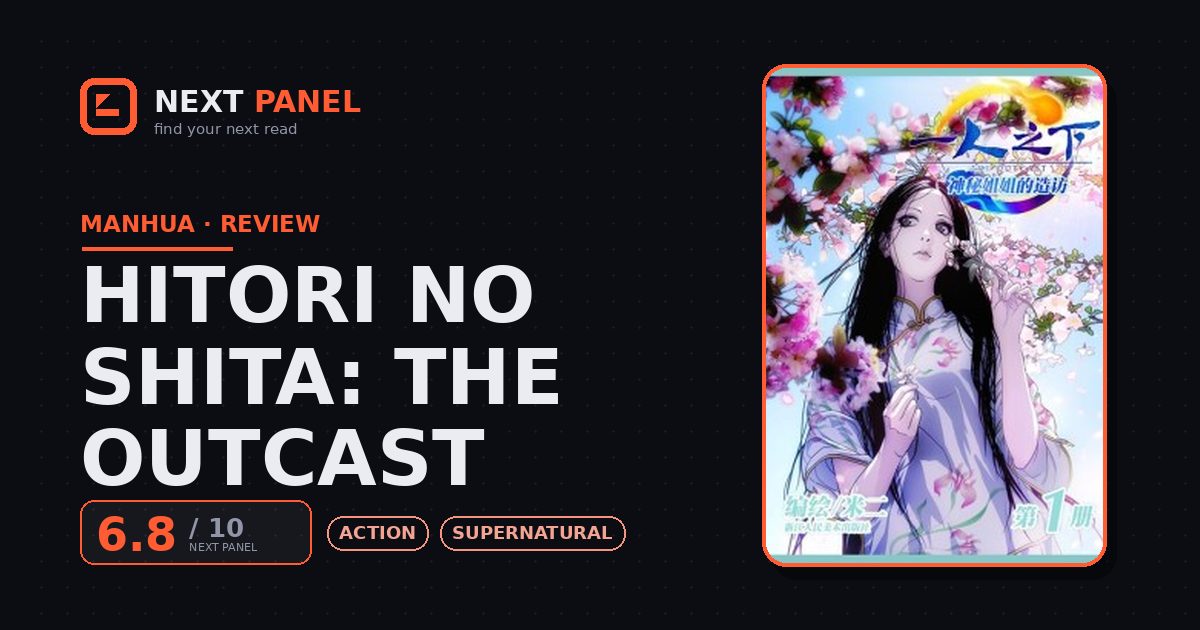
Is Hitori no Shita: The Outcast Worth Reading? Review & Where to Read
Quick Answer
Worth a shot if you want Chinese urban fantasy with a distinct flavor — Daoist mysticism, modern-day settings, and dry humor. It's uneven across its long run, but the core mystery and cast are strong enough to carry it.
Quick Verdict
“It never fully settles into a consistent quality level, but the setting alone — Daoist secret societies hiding in plain sight in modern China — makes it worth the bumps.”
Best for: Readers who want Chinese urban fantasy with real cultural specificity and a slow-burn family mystery at its core.
Not for: Readers who want tight, consistently-paced plotting and art that doesn't fluctuate between arcs.
- Type
- Manhua
- Genres
- Action, Supernatural
- Status
- Ongoing
- This review
- Minor Spoilers
- Author
- Dong Man Tang
- Artist
- Mi Er
- Publisher
- Tencent Comics
| Quick facts | |
|---|---|
| Format | Manhua |
| Run | 2015–present · ongoing |
| Community score | AniList 5.7 |
| Content | Violence, body horror |
Overview
Zhang Chulan is trying to live an unremarkable college life when his late grandfather's grave is dug up and the body goes missing. That single act of grave robbery turns out to be the tip of a much bigger iceberg: a hidden world of Daoist martial artists, secret clans, and people who can reanimate and control corpses, all operating quietly underneath the modern Chinese cities Chulan thought he knew. Dragged in by circumstance and a mysterious bodyguard named Feng Baobao, he spends the series untangling exactly what his family's history has to do with all of it.
What sets The Outcast apart from a lot of urban fantasy is how specifically it's rooted in Chinese folk religion and martial arts tradition rather than a more generic fantasy toolkit. Talismans, qi cultivation, corpse puppetry, and clan politics all feel like they're drawn from a real, coherent belief system rather than invented wholesale for the plot.
What it does well
Chulan is the best thing about the book. He's not the strongest fighter in any room he walks into, and the story never pretends otherwise — instead he survives on quick thinking, misdirection, and a willingness to play the fool so people underestimate him. That makes the conflicts more interesting than a typical power-escalation shonen, because winning usually means out-thinking someone rather than out-punching them.
The mystery at the center — what actually happened to Chulan's family, and why his grandfather's grave mattered enough to dig up — unspools at a reasonable pace. New pieces of the puzzle land regularly enough that long stretches don't feel like stalling, which is a real accomplishment for a series that's been running this long. The humor helps too; Chulan and the supporting cast get genuinely funny beats that relieve tension without turning the story into a joke.
The setting itself is the real selling point. Modern skylines sitting on top of centuries-old clan rivalries, corpse-controlling exorcists riding the subway, secret societies hiding behind ordinary storefronts — it's a genuinely fresh flavor of urban fantasy for readers used to Japanese or Korean takes on the genre.
Where it falls short
The art is inconsistent. Some arcs look sharp and confident, with strong character acting and clean action choreography, while others look visibly rushed, with flatter faces and stiffer fight scenes. It's not a dealbreaker, but it's noticeable enough to mention going in.
Pacing is the other recurring issue. A handful of arcs let fights or explanations run longer than the material needs, and the story occasionally loses momentum in its middle stretches before picking back up. New readers should also expect to piece together some of the Daoist terminology and rules from context, since the manhua doesn't always stop to spell things out — it assumes you'll catch up.
Verdict
The Outcast is a genuinely distinct urban fantasy that leans on Chinese folklore instead of borrowing wholesale from more familiar genre templates, anchored by a lead who wins with his head instead of his fists. It's rough around the edges — inconsistent art, occasional pacing sag — but the setting and mystery are strong enough to make those bumps worth pushing through.
Strengths & Weaknesses
Strengths
- The setting is genuinely distinct — a hidden network of Daoist martial artists, exorcists, and reanimated corpses operating underneath ordinary modern Chinese cities.
- Zhang Chulan works as a lead because he's smart rather than strong; he talks and schemes his way out of fights he can't win, which keeps the story from being just another power escalation chase.
- The family-secret mystery driving the plot pays off in real increments instead of being stretched out indefinitely for its own sake.
- The humor lands more often than not, and it's used to cut tension rather than undercut it.
Weaknesses
- Art quality swings noticeably between arcs, and a handful of stretches look rushed compared to the series' best chapters.
- Pacing sags in the middle of some arcs, with fights or exposition dumps running longer than the material justifies.
- New readers unfamiliar with Daoist folklore concepts will need to piece together some rules and terminology on the fly, since the story doesn't always stop to explain them.
Similar Titles
Different genre entirely, but a similarly grounded, competence-driven Chinese lead carrying a long-running story.
Another long-runner blending modern settings with hidden supernatural power systems.
If you want more straightforward cultivation power-scaling alongside the mystery elements.
Frequently Asked Questions
Is there an official English release?
There's no confirmed official English digital release as of this writing — worth rechecking, since Tencent has licensed some of its other manhua for English platforms.
Do I need to know Daoist mythology going in?
No, but the story doesn't pause much to explain its concepts, so having a passing familiarity with Chinese folklore helps some of the early chapters land better.
Is the manhua finished?
No, it's still ongoing, running alongside its long-running anime adaptation.