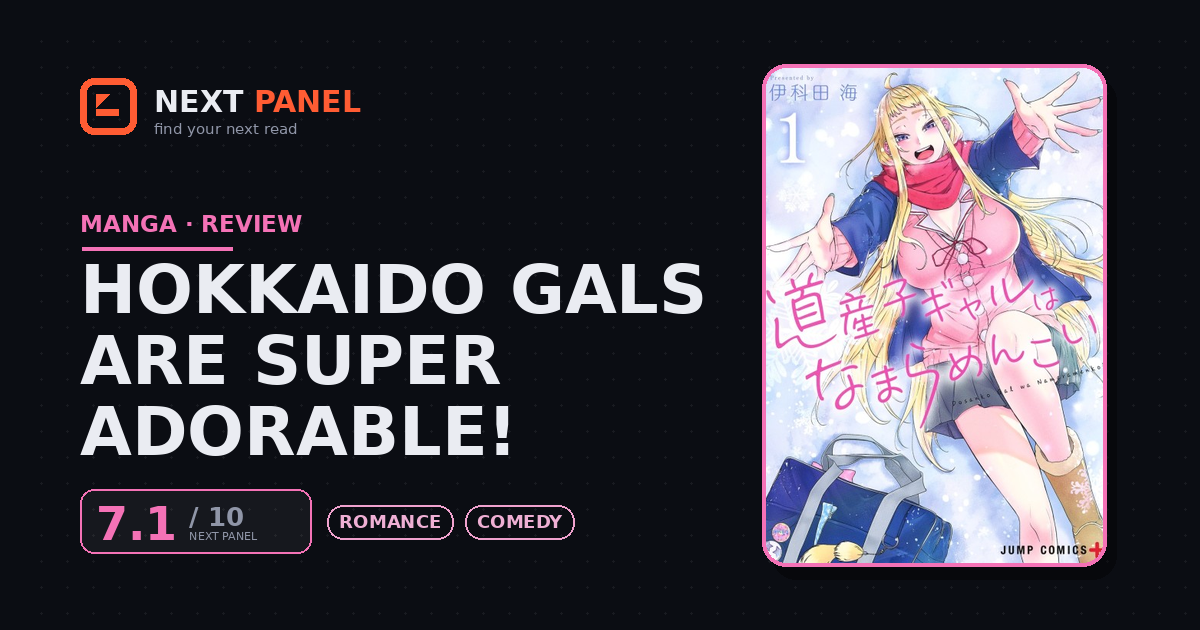
Is Hokkaido Gals Are Super Adorable! Worth Reading? Review & Where to Read
Quick Answer
Worth reading if you want a warm, low-stakes rom-com that uses its city-boy-meets-rural-gal setup as an excuse to celebrate regional food, dialect, and small-town charm.
Quick Verdict
“Dragging a homesick transfer student around Hokkaido could have been a one-note gimmick for a loud gyaru with a thick regional accent, but the specificity of the setting is what makes it charming.”
Best for: Readers who want a gentle, slice-of-life-flavored romance with a strong regional identity and a genuinely likable central pairing.
Not for: Readers who want fast romantic development or a plot-driven story rather than an episodic, vignette-style structure.
- Type
- Manga
- Genres
- Romance, Comedy
- Status
- Completed
- This review
- Minor Spoilers
- Author
- Kai Ikada
- Publisher
- Shueisha
- Platform
- Seven Seas Entertainment
| Quick facts | |
|---|---|
| Format | Manga (shōnen), 123 chapters, 14 volumes |
| Run | 2019–2024 · completed |
| Community score | AniList 7.1 |
| Content | None significant |
| Where to read | Seven Seas Entertainment — official |
Overview
Tsubasa Shiki transfers from Tokyo to a small town in Hokkaido in the dead of winter, unprepared for the cold, the dialect, or much of anything about his new home. Minami Fuyuki, a loud, warm local "dosanko gal," immediately takes an interest in him and appoints herself his guide to everything Hokkaido has to offer -- its food, its regional slang, and its particular brand of small-town warmth. Written and illustrated by Kai Ikada, the manga ran from 2019 to 2024 across 14 volumes and received an anime adaptation. It's licensed in English by Seven Seas Entertainment in print, with Shueisha also running it free digitally through MANGA Plus.
What it does well
What separates this from a generic city-boy-meets-local-girl rom-com is how seriously it takes its setting. Hokkaido's regional food, dialect, and culture aren't just window dressing here -- they're the actual substance of a lot of chapters, and that specificity gives the manga a distinct identity a more generic setting wouldn't provide. Minami herself benefits from that same specificity: she's introduced with all the loud, blunt trappings of a stock gyaru character, but the manga is much more interested in her genuine warmth and consideration than in playing her energy for easy laughs.
The episodic, vignette-style structure suits that focus well, letting individual chapters center on a specific dish, custom, or seasonal event without needing to force a bigger plot to justify them. Tsubasa's culture-shock perspective as a transplant also gives readers a natural, unpretentious entry point into all of it, since his confusion mirrors the reader's own unfamiliarity without feeling condescending.
Where it falls short
The romance itself develops gently and slowly, which is consistent with the manga's overall low-key tone but will read as uneventful for readers wanting faster momentum between the leads. That same episodic approach that makes individual chapters charming also means some installments function more as standalone slice-of-life vignettes than as steps toward a larger arc, which can make the series feel looser structurally than a more plot-driven rom-com. And with the focus so tightly held on Tsubasa and Minami, the supporting cast doesn't get much room to develop across the run.
Verdict
This is a warm, specific, low-conflict rom-com that uses its city-boy-meets-rural-gal setup as a genuine love letter to Hokkaido's food and culture rather than a disposable gimmick. It won't satisfy readers chasing plot momentum, but for a gentle, regionally flavored romance, it's a charming, well-observed read.
Strengths & Weaknesses
Strengths
- The Hokkaido setting is treated as a real character in its own right, with specific regional food, dialect, and local color giving the manga a stronger identity than a generic gyaru rom-com.
- Minami avoids gyaru-archetype flatness -- she's loud and blunt, but genuinely warm and considerate underneath, and the manga is more interested in her kindness than in playing her for cheap comedy.
- The episodic, vignette-driven structure keeps individual chapters light and satisfying even without a big overarching plot to track.
- Tsubasa's culture-shock perspective as a Tokyo transplant gives the reader a natural, non-condescending way into Hokkaido's regional quirks.
Weaknesses
- The central romance develops slowly and gently by design, which will read as uneventful to readers who want faster forward momentum.
- The episodic structure means some chapters function more like standalone slice-of-life vignettes than chapters building toward something larger.
- Side characters outside the core pair get comparatively little development across the run.
Similar Titles
Bocchi the Rock!
Shares a similar warm, character-driven slice-of-life energy, though built around music rather than romance.
Another gentle, episodic school romance driven by a warm, playful central dynamic.
For readers who want another cozy, low-conflict romance anchored by a specific hobby or regional identity.
Where to Read Officially
| Platform | Format | Pricing | Region notes | Link |
|---|---|---|---|---|
| Seven Seas Entertainment | Print omnibus volumes (Seven Seas); also free digital chapters via MANGA Plus | Free + Paid | Region availability varies | Open |
Frequently Asked Questions
Is Hokkaido Gals Are Super Adorable! licensed in English?
Yes -- Seven Seas Entertainment publishes it in print omnibus volumes, and Shueisha also runs it free digitally through the MANGA Plus app and website.
Is the series finished?
Yes, it ran from 2019 to 2024 across 14 volumes.
Is there an anime?
Yes, an anime adaptation covers part of the story.