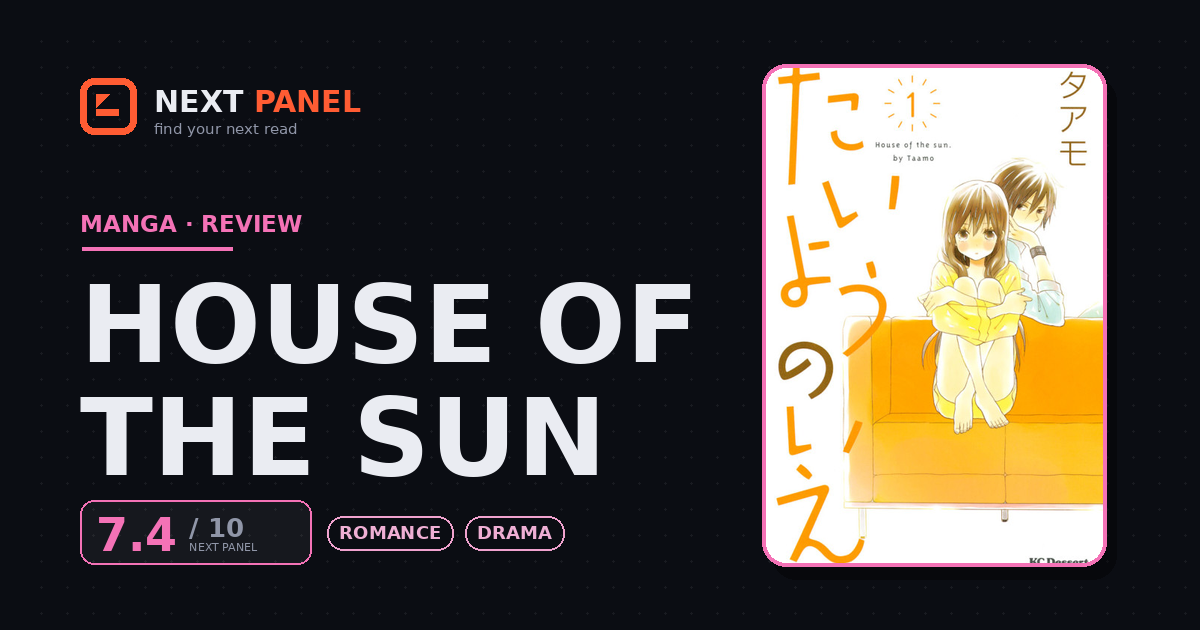
Is House of the Sun Worth Reading? Review & Where to Read
Quick Answer
Yes, if you want a shoujo that leans more into family dysfunction than pure romance. It's less about a fairy-tale love story and more about a girl rebuilding a sense of home — the romance is there, but it's not the whole point.
Quick Verdict
“Stronger as a story about a broken family finding its footing than as the romance it gets marketed as — go in for that and the age-gap complaints matter a lot less.”
Best for: Readers who want shoujo that digs into messy family dynamics alongside its romance, not just the romance itself.
Not for: Readers who want a quick, uncomplicated love story without an ensemble of side romances pulling focus.
- Type
- Manga
- Genres
- Romance, Drama
- Status
- Completed
- This review
- Minor Spoilers
- Author
- Taamo
- Publisher
- Kodansha
- Platform
- Kodansha Comics
| Quick facts | |
|---|---|
| Format | Manga (shōjo), 70 chapters, 13 volumes |
| Run | 2010–2015 · completed |
| Community score | AniList 7.9 |
| Content | Family estrangement, divorce and remarriage themes |
| Where to read | Kodansha Comics — official |
Overview
Mao Motomiya's home life falls apart when her mother leaves for another man, and when her father remarries a woman with a son of her own, Mao doesn't feel like she has a place left to belong. Her childhood friend and neighbor Hiro Nakamura offers her a way out: move in with him. What starts as a practical arrangement between two people who've known each other since childhood slowly turns into something more, but House of the Sun spends as much time on Mao rebuilding a sense of family as it does on the romance that grew it a following.
That framing matters, because this is a shoujo that's more interested in what a home actually is than in delivering a tidy love story. Taamo, who won the 38th Kodansha Manga Award for Best Shoujo for this series, builds the story around small domestic routines — meals, chores, the awkwardness of living with someone you've only ever known as a friend — and lets the romance grow out of that rather than the other way around.
What it does well
The emotional core of House of the Sun is Mao's fractured relationship with her parents, and the manga doesn't rush past it. Her mother's abandonment and her father's remarriage aren't just setup for the cohabitation plot — they're threads the story keeps pulling on throughout its run, and Mao's slow process of figuring out what family means to her carries real weight.
The cohabitation itself is where the manga is most distinctive. Rather than skipping to the romantic beats, Taamo lingers on the everyday mechanics of two people sharing a home: who cooks, who does the dishes, the small irritations and comforts of just being around each other. That groundedness makes the eventual romance between Mao and Hiro feel like it grew out of genuine familiarity rather than shoujo convention.
The art backs all of this up. Quiet, ordinary scenes get the same care as the bigger emotional moments, and it's easy to see why the series picked up a Kodansha Manga Award for it.
Where it falls short
The supporting cast is where the story stretches itself thin. A rotating set of side romances — including a rival's unresolved feelings for Mao that surface fairly late — pull focus from the central relationship without always earning the page time they get, and a few of them read more like obligatory shoujo furniture than storylines that needed to exist.
The age gap between Mao and Hiro (she's a teenager, he's several years into adulthood) is treated mostly as a source of sweetness and a little tension rather than something the story examines closely, which is worth knowing going in if that kind of dynamic isn't for you.
The pacing also sags in the middle stretch, where a string of miscommunications and near-misses delay the central couple's progress without adding much to either character. It's not enough to derail the story, but it does test patience in a way the stronger opening volumes don't.
Verdict
House of the Sun earns its reputation less as a sweeping romance and more as a story about a girl piecing together a family after hers falls apart, with a relationship growing quietly in the background. Read it for that, and the slower stretches and crowded side cast are easy to forgive.
Strengths & Weaknesses
Strengths
- Mao's home situation, shuffled between a mother who left and a father who remarried, is treated with real weight instead of being reduced to a quick tragic backstory.
- Moving in with her childhood friend Hiro gives the story a lived-in, everyday texture — cooking, chores, and awkward routines — that a lot of shoujo skip in favor of pure melodrama.
- The Kodansha Manga Award win is earned by the art, which handles quiet domestic moments and larger emotional beats with equal confidence.
- The slow build between Mao and Hiro rewards patience — small gestures accumulate meaning instead of the story leaning on one big confession to do all the work.
Weaknesses
- The cast of side romances multiplies faster than the story can service them, and some of those subplots (particularly Daiki's arc) get more page time than payoff.
- The age gap between the leads is played mostly for sweetness rather than examined, which will bother some readers more than others.
- The pacing loses momentum in the middle volumes, where several miscommunication-driven detours delay the central relationship without adding much new to it.
Similar Titles
Similar shoujo-with-teeth energy: everyday domestic detail paired with a slow-building central romance.
Another romance that spends real time on a lead rebuilding trust after being isolated or hurt.
Last Game
Shares the found-family-adjacent, slow-burn approach to a central couple surrounded by a busy supporting cast.
Where to Read Officially
| Platform | Format | Pricing | Region notes | Link |
|---|---|---|---|---|
| Kodansha Comics | Digital volumes | Paid | Region availability varies | Open |
Frequently Asked Questions
Is House of the Sun a completed series?
Yes, it's complete at 13 volumes, published between 2010 and 2015.
Where can I read House of the Sun officially in English?
It's available digitally through Kodansha Comics, as well as Azuki and INKR.
Is House of the Sun more about romance or family drama?
Both, but the family drama does a lot of the heavy lifting. Mao's relationship with her parents and stepfamily is as central to the story as her feelings for Hiro.