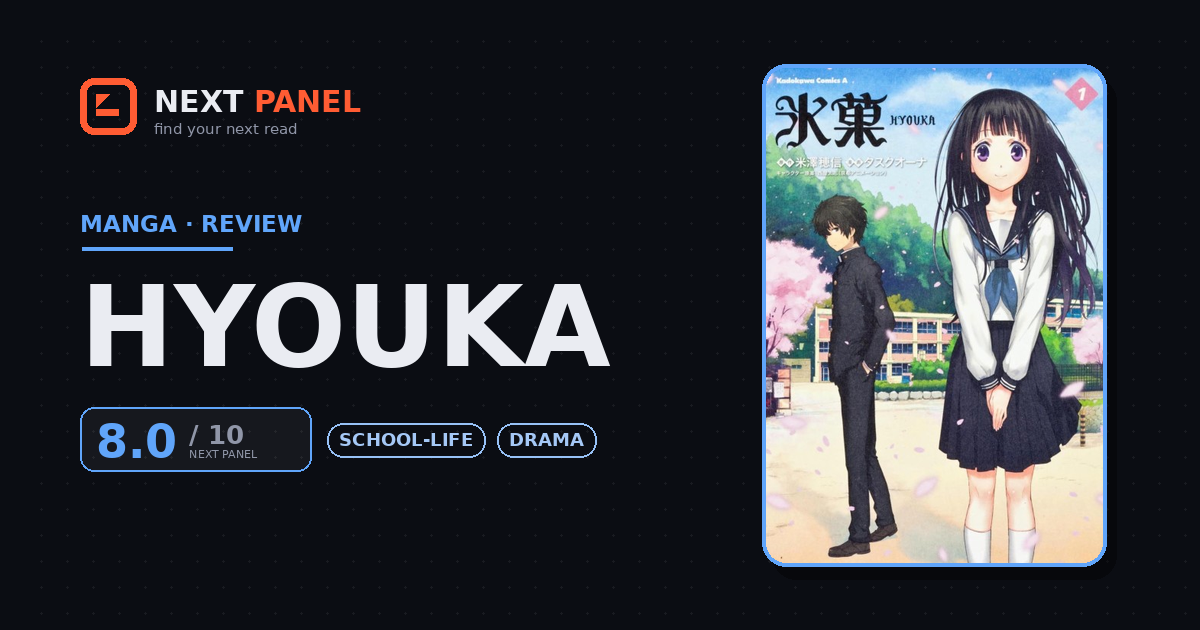
Is Hyouka Worth Reading? Review & Where to Read
Quick Answer
If you like slow-burn character mysteries with no crimes, just curiosity, yes. Hyouka is patient, clever, and quietly rewarding rather than flashy.
Quick Verdict
“Nothing gets stolen, nobody dies, and somehow the mysteries still feel worth solving.”
Best for: Readers who enjoy low-stakes, character-driven mysteries and appreciate a slow, thoughtful pace over twists and action.
Not for: Readers who want real crimes, danger, or fast-paced plotting — the stakes here stay small and personal by design.
- Type
- Manga
- Genres
- School Life, Drama
- Status
- Completed
- This review
- Minor Spoilers
- Author
- Honobu Yonezawa
- Artist
- Task Ohna
- Publisher
- Kadokawa
| Quick facts | |
|---|---|
| Format | Manga (shōnen), 17 volumes |
| Run | 2012–present · completed |
| Community score | AniList 7.8 · MangaUpdates 7.7 |
Overview
Hyouka follows Houtarou Oreki, a high schooler whose entire philosophy is "don't do anything you don't have to." He joins his school's dying Classic Literature Club purely because his sister asked him to, expecting nothing to happen. Instead he meets Eru Chitanda, whose bottomless curiosity keeps pulling him into small, quiet mysteries he's clearly gifted at solving despite wanting nothing to do with any of it. Task Ohna's manga adapts Honobu Yonezawa's novels at a patient, careful pace that trusts its characters more than its plots.
What it does well
The engine of this whole series is the contradiction at Oreki's center: someone who genuinely wants to expend as little effort as possible, who also can't stop himself from noticing the one detail that unravels a mystery once he's actually paying attention. That tension is funny and quietly compelling in equal measure, and it's why watching him get talked into caring works better here than it would with almost any other lead. Chitanda's role as the person who keeps dragging him in — not through force, but through pure, sincere "I'm curious" — gives the dynamic real warmth instead of making it feel like a plot device.
The mysteries themselves are the series' other strength. Nobody's murdered, nothing's really stolen — the puzzles are things like why a classroom got locked decades ago, or what a strange message really meant, and the manga takes the time to build those small mysteries out carefully enough that the reveals feel satisfying rather than trivial. The Classic Literature Club itself, with its small, distinct cast, gives the story a comfortable home base to return to between cases, so the show never feels like it's just cycling through gimmick-of-the-week mysteries.
Where it falls short
This is a genuinely slow, low-key series, and it won't work for readers who want real stakes or fast plotting — everything here is small by design, and some chapters spend more time on mood and conversation than incident. A handful of the mystery solutions also lean more on emotional insight and character reading than strict fair-play clues, so if you want to solve along with the detective, a few answers might feel more felt than deduced. And practically, access is genuinely difficult right now — outside a Malaysia-specific license, there's no broad official English translation to point you to.
Verdict
Hyouka is a patient, thoughtful mystery series that finds real tension in the smallest possible stakes, carried by a genuinely likable central pair. If the slow pace and access issues don't put you off, it's a rewarding, quietly clever read.
Strengths & Weaknesses
Strengths
- Houtarou Oreki's "conserve energy" philosophy versus his obvious deductive talent is a genuinely fun character contradiction that drives the whole series.
- The mysteries are small — a locked classroom, an old school scandal, a strange request — but they're built carefully enough that the answers feel earned rather than arbitrary.
- Chitanda's pure, relentless curiosity works as the perfect engine to keep dragging Oreki (and the reader) into cases he'd rather ignore.
- The Classic Literature Club's dynamic gives the story a warm, grounded home base between mysteries, so it never feels like a case-of-the-week gimmick.
Weaknesses
- The pace is deliberately unhurried, and if you want real danger or higher stakes, the low-key mysteries will feel too small to hold your attention.
- Some cases lean more on emotional insight than fair-play clueing, so mystery purists may find a few solutions feel more intuited than deduced.
- Outside a Malaysia-only regional license, there's no wide official English release yet, which is a real barrier for most readers.
Similar Titles
A very different tone, but another manga built around a sharp, deduction-driven lead solving mysteries with real craft.
Shares Hyouka's patient, character-first pacing and quiet emotional focus over plot momentum.
A more thriller-oriented pick, but similarly built around piecing together a mystery through careful character observation.
Frequently Asked Questions
Is Hyouka based on a novel?
Yes — Honobu Yonezawa wrote the original Classic Literature Club light novels first, and Task Ohna later adapted them into this manga.
Is Hyouka available in English?
Only through a regional Malaysian license as of this review, with no wide official English release elsewhere yet.
Is Hyouka more mystery or slice-of-life?
Both, in equal measure — the mysteries are small and personal, so the character relationships carry as much weight as the puzzles themselves.