Is I Want to Eat Your Pancreas Worth Reading? Review & Where to Read
Quick Answer
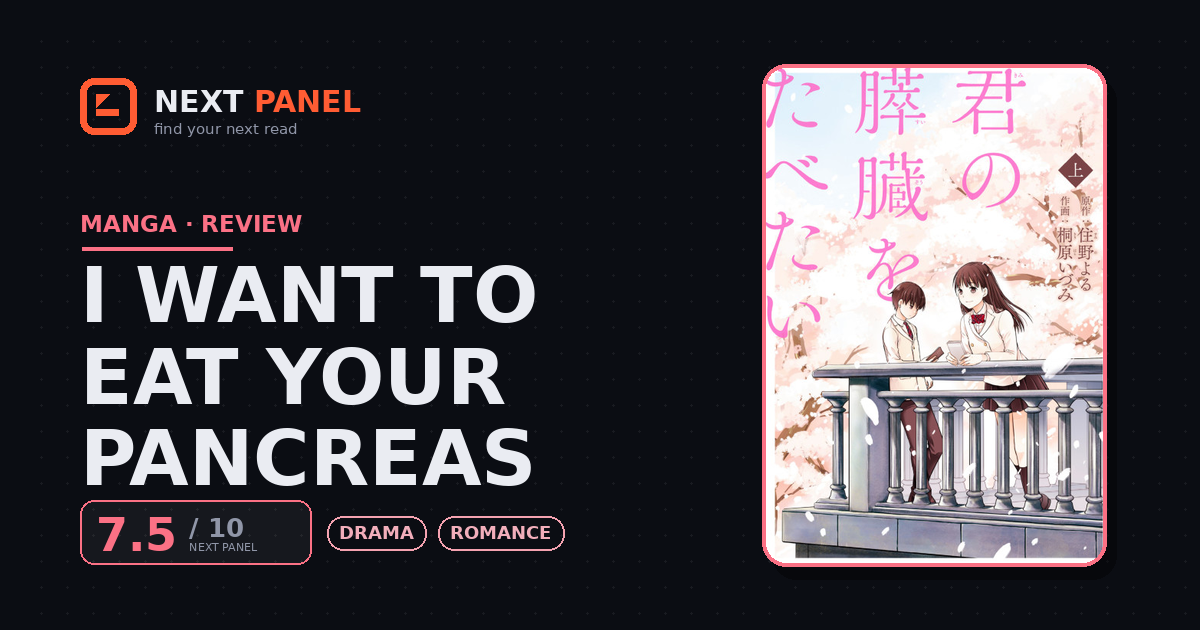
Yes, if you're in the mood for a bittersweet high-school drama and don't mind crying at the end. The manga tells the whole story in one omnibus and lands its emotional punch, though it moves faster than the novel it's based on.
Quick Verdict
“The manga races through a story the novel told slowly, but it still lands the emotional gut-punch it's built around.”
Best for: Readers who like quiet, bittersweet dramas and don't mind a good cry.
Not for: Readers who want an upbeat story or a slow, detailed character study.
- Type
- Manga
- Genres
- Romance, Drama
- Status
- Completed
- This review
- Minor Spoilers
- Author
- Yoru Sumino
- Artist
- Idumi Kirihara
- Publisher
- Seven Seas Entertainment
- Platform
- Seven Seas Entertainment
| Quick facts | |
|---|---|
| Format | Manga (shōnen), 10 chapters, 2 volumes |
| Run | 2016–2017 · completed |
| Community score | AniList 8.3 · MangaUpdates 8.0 |
| Content | Terminal illness, grief |
| Where to read | Seven Seas Entertainment — official |
Overview
A high schooler finds a worn diary in a hospital waiting room. It belongs to Sakura Yamauchi, a bright, popular girl from his class — and it spells out a secret: she has a pancreatic illness and only months left to live. He's now the one classmate who knows, which, oddly, makes him the one person she can drop the act around. From there the story is just the two of them spending her remaining time together. It's adapted from Yoru Sumino's bestselling novel, with art by Idumi Kirihara, and it runs a single omnibus in English.
What it does well
The relationship is the whole show, and it works. Sakura is pushy, playful, and a little exhausting on purpose, and the quiet narrator is the perfect straight man for her. Their banter is genuinely funny, and that matters — the book spends real time letting you enjoy their company before it asks you to be sad about it. By the time the story turns, you're attached, so the ending hits because you earned it with them, not because a caption told you to feel something.
Kirihara's art carries a lot of that weight. It's clean and readable, with expressive faces that do the heavy lifting in the silent panels. The book knows when to stop talking and just let a look or a pause sit there, and those moments are where it's strongest. Nothing is overcooked; there are no giant sparkles or melodramatic close-ups where a plain reaction would do.
It's also refreshingly complete. One omnibus, start to finish, no cliffhanger and no filler. For a story this focused, that's the right length — you can read it in an afternoon and get the full arc without committing to a shelf's worth of volumes.
Where it falls short
The trade-off for that tidiness is speed. This is a condensed adaptation, and you can feel it. A few of the bigger emotional turns show up a beat early, before the scene has fully set them up, so they land softer than they should. Readers who love slow, detailed character work will notice the gaps.
The narrator is the other soft spot. He's written to be a blank, thoughtful observer, which fits the story, but it means Sakura is doing almost all the lifting. When she's not in a scene, the book loses some of its spark. You're here for her, and the manga knows it.
Verdict
This is a small, sad, well-made story that does exactly what it sets out to do. It's not trying to reinvent the tearjerker — it just executes one cleanly, with likable leads and art that knows when to be quiet. If a bittersweet romance about borrowed time sounds like your kind of read, it's an easy afternoon well spent. If you want something upbeat, or the deep interiority of the original novel, you'll feel what got trimmed.
Strengths & Weaknesses
Strengths
- The two leads have real chemistry — their back-and-forth is warm and funny well before the story turns sad, so you actually care by the time it does.
- Kirihara's art is clean and expressive, and it plays the quiet emotional beats straight instead of drowning them in effects.
- It's a complete story in a single omnibus, so you get the full arc without signing up for a long series.
- It earns its ending — the payoff comes from time spent with the characters, not a cheap last-page twist.
Weaknesses
- It moves quickly, and a few emotional turns arrive before they're fully earned, so some beats land softer than they should.
- The narrator is written thin on purpose, which leaves Sakura carrying almost the whole book — when she's off the page, it sags.
Similar Titles
Another emotionally heavy school drama about guilt, connection, and second chances.
Bittersweet romance built around illness and a bright girl who changes a withdrawn boy.
Quiet high-school drama about regret and trying to save someone you care about.
Where to Read Officially
| Platform | Format | Pricing | Region notes | Link |
|---|---|---|---|---|
| Seven Seas Entertainment | Print & digital omnibus | Paid | Region availability varies | Open |
Frequently Asked Questions
Is there an official English release?
Yes. Seven Seas Entertainment publishes it in English as a single omnibus, 'I Want to Eat Your Pancreas: The Complete Manga Collection.'
Do I need to read the novel first?
No. The manga tells the complete story on its own. Yoru Sumino's original novel goes deeper into the narrator's head, but you won't be lost starting here.
Is it worth reading if I've seen the animated film?
It covers the same story, so it won't surprise you. Read it if you'd rather sit with the manga's pacing and art, or want a physical copy to keep.