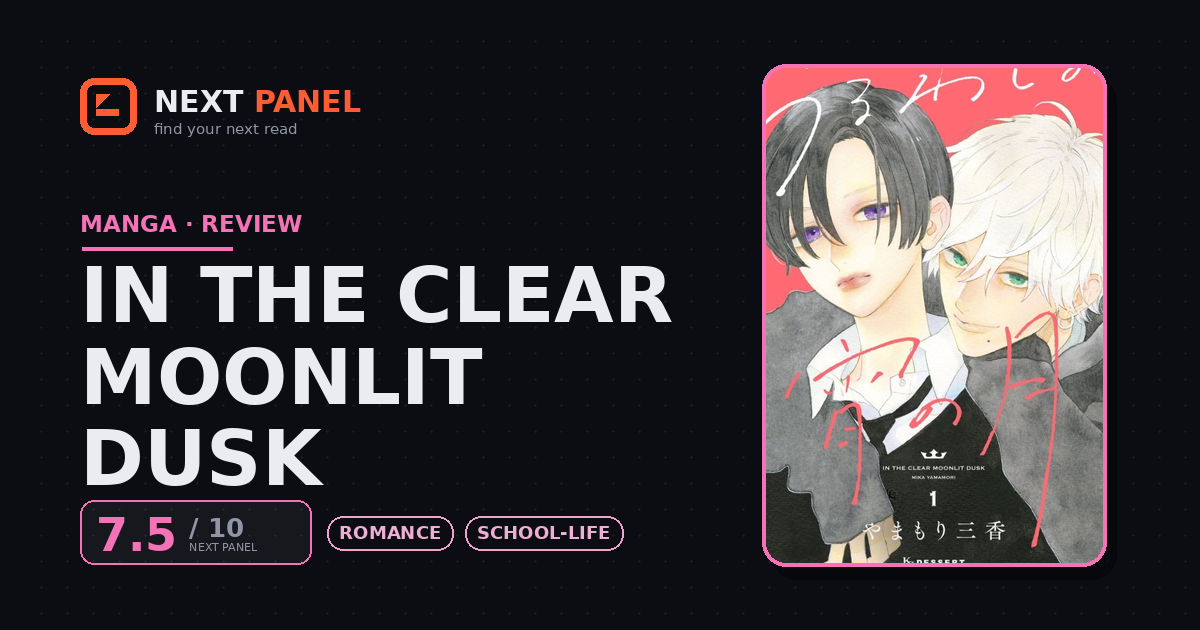
Is In the Clear Moonlit Dusk Worth Reading? Review & Where to Read
Quick Answer
Yes, if you want a shojo romance with a genuinely different hook — the identity/gender-presentation angle gives it more to chew on than a typical popular-boy-meets-quiet-girl setup.
Quick Verdict
“The trial-relationship gimmick could've been a one-chapter joke, but Yamamori uses it to actually dig into what Yoi wants versus what everyone assumes about her.”
Best for: Readers who want a shojo romance that uses its central gimmick to explore identity and self-perception rather than just as a cute hook.
Not for: Readers who want a fast-moving plot rather than a slower character study built around two leads figuring themselves out.
- Type
- Manga
- Genres
- School Life, Romance
- Status
- Ongoing
- This review
- Minor Spoilers
- Author
- Mika Yamamori
- Publisher
- Shueisha
- Platform
- Kodansha
| Quick facts | |
|---|---|
| Format | Manga (shōjo) |
| Run | 2020–present · ongoing |
| Community score | AniList 7.8 |
| Where to read | Kodansha — official |
Overview
Yoi Takiguchi is tall, has a deep voice, and gets mistaken for a boy so often that her classmates nicknamed her "Prince." Kohaku Ichimura is the school's actual heartthrob — also, unofficially, a prince — and when he takes an interest in Yoi, neither of them is quite sure what to make of it. Rather than assume, they agree to a trial relationship: date for a while and see what they actually feel. In the Clear Moonlit Dusk builds its whole story around that uncertainty.
What it does well
The central gimmick could easily have stayed a one-note joke — girl mistaken for a boy, cue romantic-comedy misunderstandings — but Mika Yamamori uses it as a real entry point into how Yoi experiences being seen. Her frustration isn't played for laughs; it's treated as a genuine question about identity and how much of what people respond to in her is actually her, versus a type they've decided she fits. That gives the romance more to work with than a typical shojo setup, and it keeps both leads' uncertainty feeling earned rather than manufactured.
The trial-dating structure is the smartest structural choice in the book. It gives Yoi and Kohaku (and by extension the reader) permission to actually examine what they feel instead of jumping straight to a confession, and that self-examination is where the story's best material lives. Yamamori's art supports all of this well — it's detailed and expressive enough to sit in a quiet, uncertain moment without needing a lot of dialogue to carry it.
Where it falls short
The deliberate pace is a real tradeoff. This isn't a story that moves quickly, and some chapters spend a long time on internal uncertainty without much external plot progress, which will test readers looking for faster momentum. Some of the surrounding classroom drama also feels like it exists mainly to generate friction between the leads rather than to develop into anything on its own.
And because the manga is still ongoing, a lot of the bigger questions the premise raises — what Yoi and Kohaku actually resolve to be to each other, how her sense of identity settles — remain open. You're reading a story still finding its shape, not a finished arc.
Verdict
In the Clear Moonlit Dusk takes a premise that could've been a gimmick and turns it into a genuinely thoughtful, patient romance about identity and self-perception. If you want a shojo series willing to slow down and actually dig into its hook instead of just using it for cute misunderstandings, it's well worth following.
Strengths & Weaknesses
Strengths
- The central hook — a tall, deep-voiced girl mistaken for a boy, courted by the school's actual male heartthrob — gives the story real thematic material about identity and self-perception, not just a cute setup.
- The trial-relationship structure lets both leads (and the manga) interrogate what they actually feel instead of assuming attraction has to mean one thing.
- Yamamori's art is expressive and detailed enough to carry the story's quieter emotional beats.
- Yoi is written with real interiority — her frustration with being seen as a type rather than a person comes through clearly.
Weaknesses
- The pace is deliberate, and readers wanting a faster-moving plot may find some chapters slow.
- Some supporting classroom drama exists mainly to create friction rather than develop its own characters.
- As an ongoing series, several of the bigger emotional questions the setup raises are still unresolved.
Similar Titles
same careful, emotionally patient shojo romance pacing
similar focus on characters figuring out who they actually are versus who others assume them to be
same knack for turning an identity-driven premise into real emotional stakes
Where to Read Officially
| Platform | Format | Pricing | Region notes | Link |
|---|---|---|---|---|
| Kodansha | Print & digital volumes | Paid | Region availability varies | Open |
Frequently Asked Questions
Is this an LGBTQ romance?
No — despite Yoi's androgynous appearance and the 'prince' framing, the central relationship is between her and Kohaku, a boy who's fully aware she's a girl and pursues her as such.
Is the manga finished?
No, it's still ongoing, so you're following an unresolved story rather than a complete one.
What does the 'trial dating' premise actually mean?
Rather than assuming their attraction is romantic, the two leads agree to date on a trial basis to figure out what they actually feel — it's the emotional engine of the whole story.