Is Innocent Worth Reading? Review & Where to Read
Quick Answer
Yes, if you can handle it. Innocent is a stunningly drawn, unflinching historical drama about the Sanson family of executioners, and it's one of the best-looking manga ever printed — but it earns every bit of its mature rating.
Quick Verdict
“The art alone justifies the price of the omnibus; the willingness to sit in genuine horror without flinching is what makes it stick with you afterward.”
Best for: Readers who want dense historical drama and don't mind a manga that's genuinely upsetting in places.
Not for: Readers who want a fast, casual read or prefer their violence kept off the page.
- Type
- Manga
- Genres
- Drama, Historical
- Status
- Completed
- This review
- Minor Spoilers
- Author
- Shin'ichi Sakamoto
- Publisher
- Dark Horse Manga
- Platform
- Dark Horse Digital
| Quick facts | |
|---|---|
| Format | Manga (seinen), 99 chapters, 9 volumes |
| Run | 2013–2015 · completed |
| Community score | AniList 8.1 · MangaUpdates 6.2 |
| Content | Graphic violence, executions, sexual content, disturbing imagery |
| Where to read | Dark Horse Digital — official |
Overview
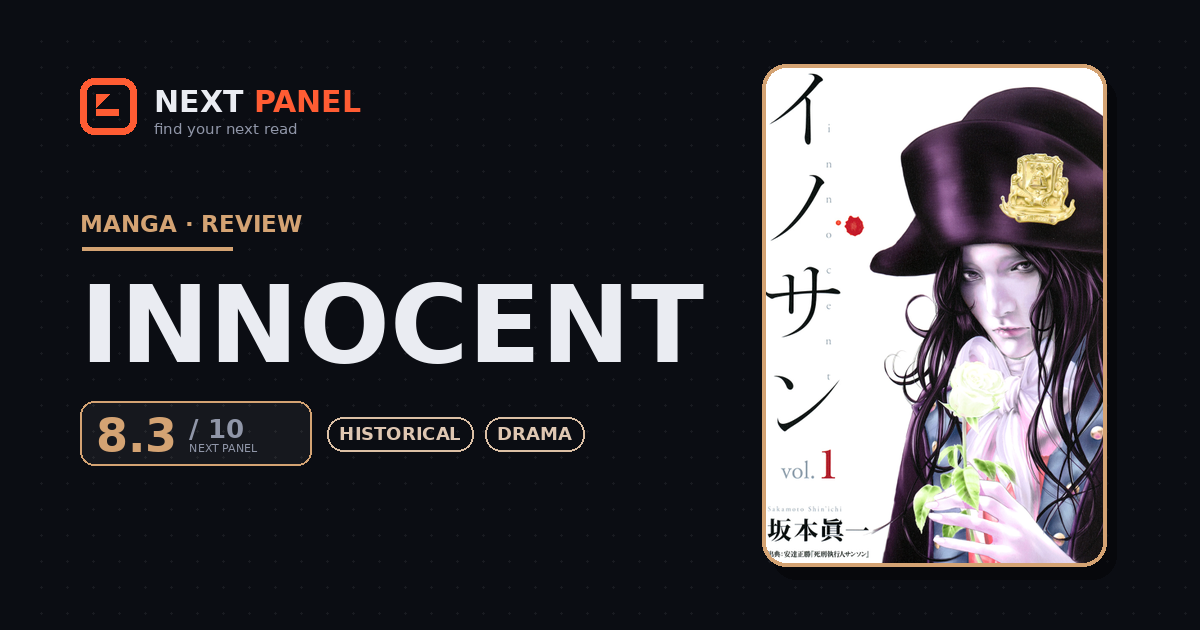
Innocent tells the story of the Sanson family, hereditary royal executioners in 18th-century France, centered on Charles-Henri Sanson — a gentle, sensitive young man who inherits a job that requires him to become an expert in killing people cleanly. Shin'ichi Sakamoto builds the story around the real historical figure, but this isn't a dry biography. It's a gothic, operatic tragedy about a family trapped by duty, dressed in some of the most obsessively detailed linework you'll find in manga.
What it does well
The art is the first thing anyone mentions about Innocent, and for good reason. Sakamoto draws faces, fabric, and architecture with a density that borders on absurd — full-page spreads look like engravings, and even quiet dialogue scenes are staged with real visual ambition. It's not just pretty; the linework does storytelling work, using contrast and shadow to make the horror of a beheading or the tension of a courtroom land harder than words could.
Charles-Henri is the reason the story holds together emotionally. He's not a stoic executioner archetype — he's a kind person who hates what his bloodline demands of him, and watching him get slowly worn down by that contradiction is genuinely affecting. Marie-Josephe, his sister, gets just as much attention, and her arc avoids the trap of existing purely to support her brother's story.
To Sakamoto's credit, the manga refuses to look away from what it's depicting. Executions are shown as the brutal, mechanical acts they were, not as clean movie violence. Court cruelty, class rot, and the machinery of the ancien régime are rendered with real specificity. That commitment to honesty is what separates Innocent from a more generic period drama — it earns its darkness instead of using it as decoration.
Where it falls short
The unrelenting intensity is also the manga's biggest ask of a reader. There's almost no comic relief or quiet stretch to recover in — one horror follows another, and by the midpoint it can feel more punishing than compelling. A handful of plot beats, particularly in the latter half of the original run, lean on shock for its own sake rather than earning the reaction they're going for, which undercuts the more thoughtful character work surrounding them. And because the art is so dense, fast or chaotic scenes can be genuinely hard to follow on a first read.
Verdict
Innocent isn't for everyone, and it doesn't want to be. It's a manga built to be uncomfortable, and it uses that discomfort in service of a real, human story about a family cursed by its own competence. If you can stomach the content, the craft on every page makes it one of the best-looking historical manga ever printed.
Strengths & Weaknesses
Strengths
- The linework is some of the most technically ambitious in manga — every page looks like it took a week to draw, and the historical detail in costuming and architecture holds up under scrutiny.
- Charles-Henri Sanson is a genuinely compelling lead: a gentle person forced into his family's grim trade, and the manga never lets you forget the cost of that job on him.
- It doesn't sanitize the period. Executions, torture, and court cruelty are shown with a directness most historical fiction avoids, which gives the whole thing real weight.
- The supporting cast, especially Marie-Josephe, gets real interiority instead of existing just to orbit the protagonist.
Weaknesses
- The content is relentless — there's very little breathing room between one horror and the next, and some readers will find the pacing exhausting rather than gripping.
- A few plot threads lean on shock value in a way that feels more like provocation than storytelling.
- The dense, ornate art style occasionally makes fast-moving scenes hard to parse.
Similar Titles
Another historical epic willing to sit in real violence and its consequences rather than glorify it.
Similar commitment to painterly, obsessive linework in a historical setting.
Where to Read Officially
| Platform | Format | Pricing | Region notes | Link |
|---|---|---|---|---|
| Dark Horse Digital | Print & digital omnibus volumes | Paid | Region availability varies | Open |
Frequently Asked Questions
Is Innocent based on a true story?
Yes — it's a heavily fictionalized account of Charles-Henri Sanson, the real royal executioner of 18th-century France, and his family.
How much of Innocent is available in English?
The full 9-volume original series is out in English from Dark Horse Manga across three omnibus editions (released 2023–2024). The sequel, Innocent Rouge, is being released separately.
Is Innocent very graphic?
Yes. It depicts execution methods, torture, and sexual content in detail. This isn't a manga for casual or younger readers.