Is Karakuri Circus Worth Reading? Review & Where to Read
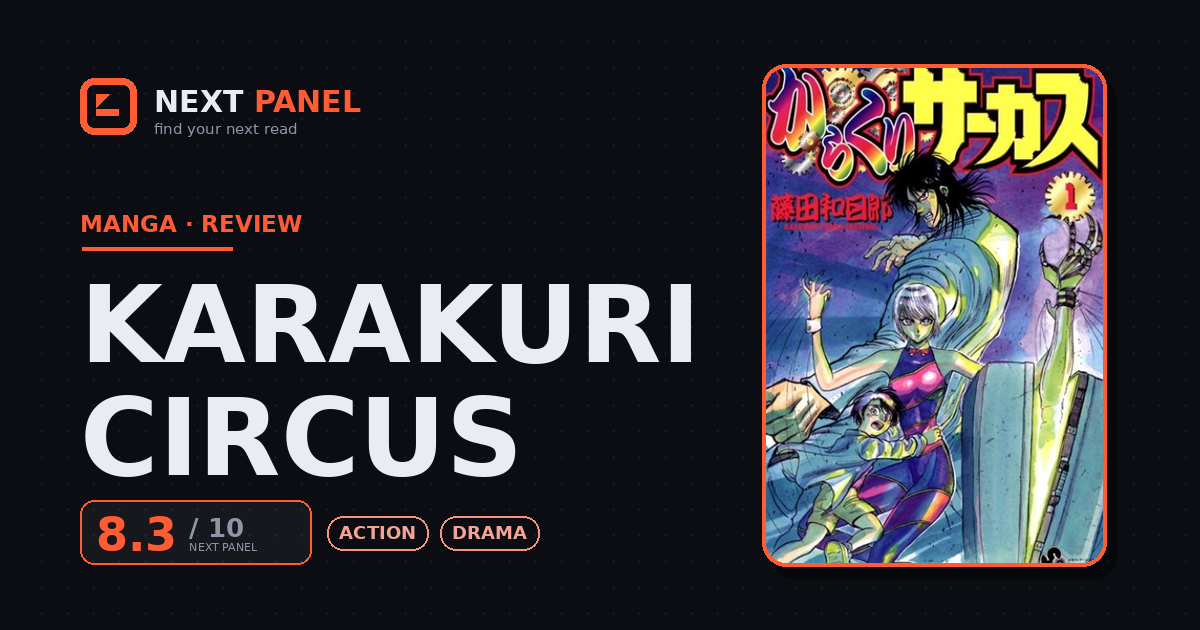
Quick Answer
Yes — it's one of the great sprawling shonen epics, mixing wild action with real emotional weight and a story that ties together beautifully. The big catch is there's still no official English release.
Quick Verdict
“It's a huge, ridiculous, deeply moving saga about killer puppets and the people who won't stop fighting them — held back mainly by the fact that there's still no official English release.”
Best for: Readers who want a long, ambitious epic that mixes wild action with real emotional heft.
Not for: Readers who want a short, tidy story or clean, polished artwork.
- Type
- Manga
- Genres
- Drama, Action
- Status
- Completed
- Author
- Kazuhiro Fujita
- Publisher
- Shogakukan
| Quick facts | |
|---|---|
| Format | Manga (shōnen), 425 chapters, 43 volumes |
| Run | 1997–2006 · completed |
| Community score | AniList 8.2 · MangaUpdates 7.7 |
| Content | Graphic violence, dark themes |
Overview
Masaru Saiga is a young boy who inherits a fortune after his father dies — and immediately finds himself hunted by assassins, including deadly automata: puppets that move and kill on their own. Two strangers end up protecting him. One is Narumi Katō, a powerful martial artist cursed with a disease that makes him laugh uncontrollably unless he can make other people laugh. The other is Shirogane, a mysterious woman who fights with a marionette of her own. What looks at first like a simple "protect the kid" setup slowly unfolds into an enormous saga about the centuries-old war between humans and the automata, the immortal figure behind them, and a strange water that grants eternal life. It's by Kazuhiro Fujita.
What it does well
The scope is the headline. Karakuri Circus keeps expanding — from a street-level fight over one boy into a globe-spanning history of puppets, alchemy, and a very old grudge — and the remarkable thing is how well it all connects. Threads you forgot about pay off hundreds of chapters later, and by the end you can see the whole machine clicking into place. For a series this long, that kind of control is rare.
What really makes it land is the emotion. Fujita writes characters you get badly attached to, then puts them through real loss. The laughing-sickness hook sounds gimmicky on paper, but it becomes the emotional core of the whole thing — a story about people who keep going, and keep making others smile, even when it costs them. It earns its big moments, and there are a lot of them.
The action holds up its end too. Fights mix hand-to-hand kung fu with elaborate puppet battles, and Fujita's imagination for set pieces keeps them varied. His art is scratchy and kinetic rather than pretty, but it's fantastic in motion — chaotic fights and huge emotional beats both come through.
Where it falls short
It's a lot. This is a long, dense series that asks for real patience, and a few of the middle arcs drag or pile on more than they need to. Going in, know that you're signing up for a big commitment, not a quick read.
The tone can also whiplash. Fujita swings between goofy slapstick and genuine tragedy, sometimes right next to each other, and if you're not on board with that mix it can feel uneven. And his rough art style is an acquired taste — expressive, but not the clean linework some readers want.
Verdict
Karakuri Circus is one of those series people fall hard for: a strange, sprawling, deeply felt epic that turns killer puppets into a story about grief and perseverance, and pulls off an ending that makes the whole journey worth it. The barriers are real — it's long, tonally wild, and roughly drawn — and the biggest one isn't the manga's fault at all: there's still no official English release. If you can get to it, it's a special one.
Strengths & Weaknesses
Strengths
- It's wildly ambitious — what starts as 'protect a rich kid from killer puppets' grows into a huge saga about immortality, grief, and stubborn hope, and it actually holds together.
- The emotional writing hits hard; Fujita builds characters you get deeply attached to and isn't afraid to put them through real tragedy.
- The action is inventive and varied, blending kung-fu martial arts with elaborate puppet battles, so the fights rarely feel samey.
- It weaves a massive number of plotlines and characters into a payoff that ties the whole thing together — genuinely impressive for a series this size.
Weaknesses
- It's long and dense and takes its time; the full story is a real commitment, and the pacing sags in a few of the middle arcs.
- The tone swings between broad slapstick and heavy tragedy, which can be jarring if you're not on its wavelength.
- Fujita's art is rough and kinetic — expressive and great in motion, but it's a scratchy style that won't click with everyone.
Similar Titles
Fujita's other big epic — the same mix of monster-fighting action, comedy, and heavy emotion.
Another ambitious, complete shonen that balances action with grief and ties its threads together.
A sprawling, emotionally heavy epic that rewards a long commitment.
Frequently Asked Questions
Can I read Karakuri Circus officially in English?
Not yet. Despite its reputation, the manga has never had an official English release — you'll find French, Spanish, and other editions, but no licensed English one so far. We'll re-check it as future licenses are announced.
Is it just an action series?
No. It has plenty of martial-arts and puppet action, but it's really a long-form drama about loss, family, and why people keep fighting. The emotional side is what people remember.
Do I need to watch the anime first?
No. The manga is the original and more complete telling. The anime adapts the same story but compresses a lot, so the manga is the fuller experience.