Is Kino's Journey Worth Reading? Review & Where to Read
Quick Answer
If you like short, standalone stories that make you sit and think rather than build toward one big plot, yes. If you want a continuous story with ongoing stakes, this isn't that.
Quick Verdict
“Every chapter is basically its own short story, and some land harder than others — but the best ones stick with you for days.”
Best for: Readers who like anthology-style storytelling and don't mind a slow, thoughtful pace over fast plotting.
Not for: Readers who want one continuous plot with a cast that grows and changes over the course of the story.
- Type
- Manga
- Genres
- Drama, Slice of Life
- Status
- Completed
- This review
- Minor Spoilers
- Author
- Keiichi Sigsawa
- Artist
- Iruka Shiomiya
- Publisher
- Kodansha (Vertical Comics, English)
- Platform
- Kodansha
| Quick facts | |
|---|---|
| Format | Manga |
| Run | 2000–present · completed |
| Community score | AniList 8.4 |
| Where to read | Kodansha — official |
Overview
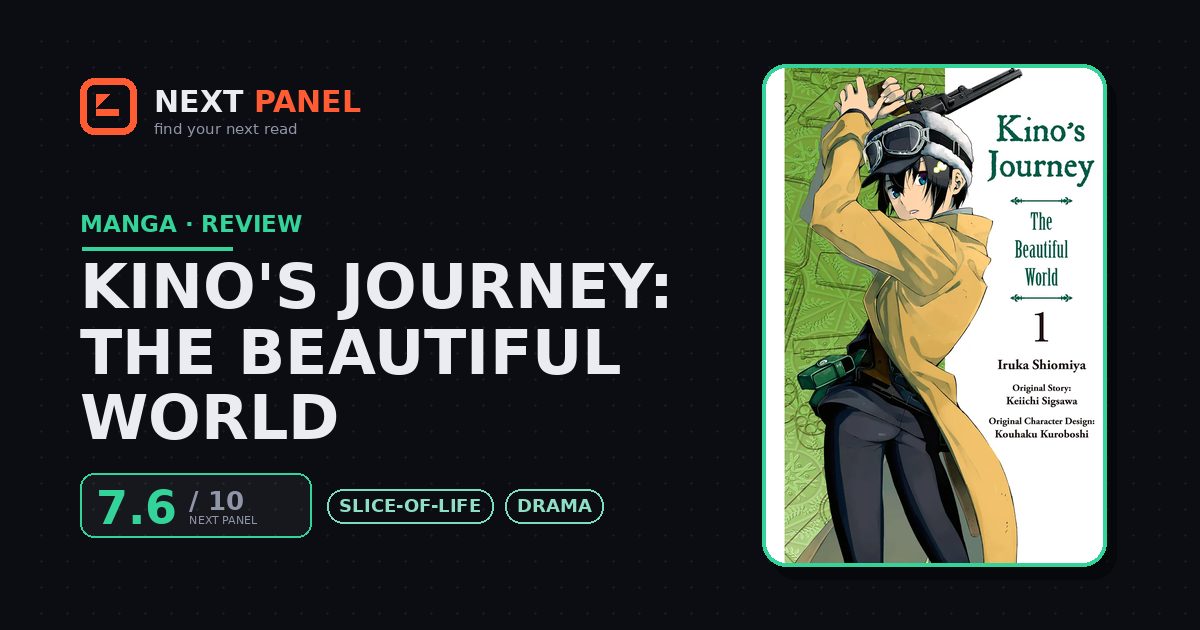
Kino travels the world on her motorcycle Hermes, who talks, and the two of them have a rule: never stay in one country more than three days. That's the entire structural conceit of Kino's Journey, and the manga (adapted by Iruka Shiomiya from Keiichi Sigsawa's original light novels) uses it exactly as intended — nearly every chapter is a fresh, self-contained visit to a new place with its own customs, its own quiet horror or insight, and its own ending. There's no overarching plot to track. The point is the ideas each stop raises, not a story building toward a climax.
What it does well
The anthology structure is what makes this manga distinct, and it's used well. Some countries are built around a single unsettling idea — a society that's organized itself around one strange law, a utopia with an ugly cost hidden underneath — and the manga trusts the reader to sit with the implications rather than explaining the moral outright. Kino herself works as a lead precisely because she's an observer, not a crusader; she rarely intervenes in what she sees, which keeps the stories feeling more like thought experiments than after-school specials. Hermes, the talking motorcycle, is a smart addition — giving Kino someone to actually talk through her observations with keeps the tone from becoming too detached or cold. The best chapters here are the kind that stay with you well after you've closed the volume.
Where it falls short
Episodic formats live and die by consistency, and this one is uneven. For every country that lands as a sharp, memorable piece of writing, there's another that feels like a half-formed idea stretched to fill its chapter. Because Kino doesn't change much from story to story, long reading sessions can start to feel repetitive — the format that makes individual chapters interesting in isolation works against the manga when read many chapters at once. It's also worth knowing going in that a number of the stories lean deliberately bleak or cynical about human nature, which is clearly intentional but won't be to every reader's taste.
Verdict
Kino's Journey isn't for readers chasing a plot with rising stakes — it's for readers who like being handed a new idea every chapter and left to sit with it. Read in smaller doses rather than all at once, the best of these stories are as sharp and thought-provoking as anything in the genre.
Strengths & Weaknesses
Strengths
- The anthology format means every chapter can try something different — a country built on a single strange rule, a moral dilemma with no clean answer, a quiet character study — without needing to connect to a bigger plot.
- Kino as a lead is calm and observant rather than preachy, so the stories mostly let readers draw their own conclusions instead of spelling out a moral.
- Several individual chapters are genuinely memorable and unsettling in a way that lingers well past the page.
- Hermes, the talking motorcycle, gives the otherwise quiet, detached Kino someone to actually talk to, which keeps the tone from feeling too cold.
Weaknesses
- Because it's episodic, the quality swings — some countries' stories are sharp and memorable, others feel like a rough idea that didn't get fully worked out.
- There's very little ongoing character development for Kino herself across the volumes, which can make long reading sessions feel repetitive.
- Some chapters lean hard into being intentionally bleak or cynical, which won't land for every reader's taste.
Similar Titles
similar quiet, wandering pace and a thoughtful tone, with a smaller two-person cast
same episodic, one-story-per-chapter structure built around a traveling protagonist
for readers who want more plot continuity while keeping some of the same reflective, philosophical bent
Where to Read Officially
| Platform | Format | Pricing | Region notes | Link |
|---|---|---|---|---|
| Kodansha | Digital chapters | Print volumes | Free + Paid | Region availability varies | Open |
Frequently Asked Questions
Is this the same story as the original light novels?
It's an adaptation of the same episodic concept and reuses several of the original stories, drawn by Iruka Shiomiya rather than Sigsawa's original prose.
Do the chapters connect to each other?
Mostly not — each country Kino visits is its own self-contained story, so you can read them out of order without losing much.
Is Kino's Journey finished?
Yes, the manga run is complete at eight volumes, all released in English.