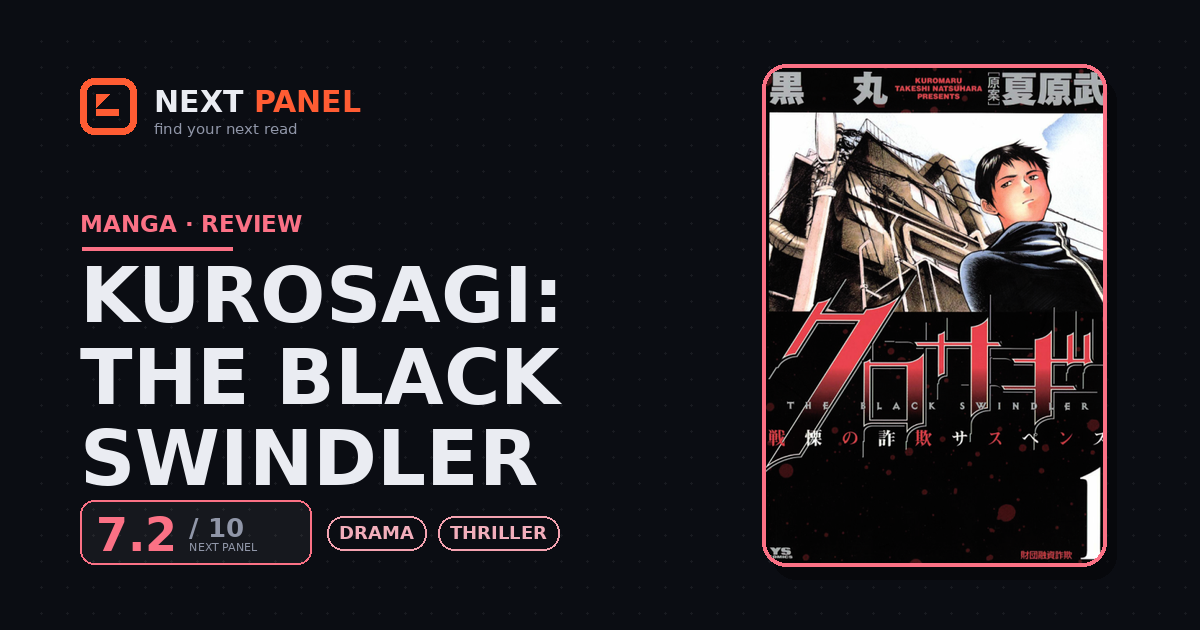
Is Kurosagi: The Black Swindler Worth Reading? Review & Where to Read
Quick Answer
Yes, if you want an episodic crime drama with a clear hook. It's not flashy or twisty like Liar Game, but the case-of-the-volume structure is easy to pick up and the research behind each scam is genuinely interesting.
Quick Verdict
“The premise carries this further than the writing does — a reliable comfort read for anyone who likes watching schemes unravel, less so for anyone who needs the plot to keep moving forward.”
Best for: Readers who like procedural, case-of-the-week crime stories and don't mind a slow-burn lead.
Not for: Readers who want a tightly serialized plot with constant forward momentum and escalating stakes.
- Type
- Manga
- Genres
- Drama, Thriller
- Status
- Completed
- This review
- Minor Spoilers
- Author
- Takeshi Natsuhara
- Artist
- Kuromaru
- Publisher
- Shogakukan
| Quick facts | |
|---|---|
| Format | Manga (seinen), 20 volumes |
| Run | completed |
| Community score | MangaUpdates 8.1 |
| Content | Fraud, violence, themes of financial exploitation |
Overview
Kurosagi: The Black Swindler is built around a premise sturdy enough to carry a much longer series than most: white swindlers cheat ordinary people, red swindlers cheat lovers, and black swindlers cheat the other two. After his family is destroyed by a group of white swindlers, Kurosaki becomes a black swindler himself, running elaborate cons against the people running cons on everyone else. It's a revenge story dressed up as a heist show, and for a good stretch of its 20-volume run, that combination works.
Each volume (or pair of volumes) tends to function like its own case file. A new scam targets a new victim, Kurosaki gets pulled in, and the latter half of the arc is spent watching him reverse-engineer the fraud and turn it back on the people running it. Natsuhara clearly did his homework on how these schemes actually operate — land fraud, marriage scams, insurance fraud — and that research is the backbone of what makes the series worth reading instead of just another crime-of-the-week comic.
What it does well
The biggest strength here is the reveal structure. Kurosagi doesn't lean on twists for shock value; it lays out a scam, lets you think you understand it, and then shows you the extra move Kurosaki had planned three steps back. When it works, it's genuinely satisfying in a way that doesn't require you to track a huge cast or remember convoluted rules — you just need to trust that Kurosaki is smarter than the person he's targeting, and the manga reliably delivers on that promise.
It also helps that the tone never overreaches. This isn't trying to be a grim psychological thriller or a flashy shonen power struggle — it knows it's a competent, research-backed crime drama, and it stays in that lane for the whole run. That consistency makes it easy to pick up for a volume or two at a time without needing to remember a dense ongoing plot, which is part of why it won a Shogakukan Manga Award and built a loyal readership over its run.
The art carries its weight too. A lot of this manga is people talking in offices, cafes, and back rooms, and Kuromaru keeps those scenes visually readable — body language and expression do a lot of the tension-building that a weaker artist would have had to offload onto captions.
Where it falls short
The formula that makes Kurosagi easy to read in short bursts is also its biggest weakness over a long read. By the midpoint of the series, you can usually tell which beats are coming: the setup, the moment Kurosaki looks like he's losing, and the reversal. The manga doesn't do much to vary that shape, and readers who binge it in a short window tend to feel the repetition more than readers who read it in occasional chunks.
Kurosaki himself doesn't grow much either. He's defined almost entirely by his backstory and his competence, and the series treats him more as a fixed lens for viewing each new scam than as a character with his own throughline. That's a deliberate choice that suits the case-of-the-volume format, but it means the emotional stakes rarely rise above whether this particular con will work, even 15 volumes in.
The ending also doesn't quite match the patience of everything before it. It resolves faster than the pacing elsewhere would suggest, and a few plot threads get tied off in a way that reads more like a stopping point than a real conclusion, which the existence of a direct sequel series doesn't do much to smooth over.
Verdict
Kurosagi earns its reputation as a dependable, well-researched crime drama rather than an essential one. If you want a series you can dip into for a satisfying case without committing to a dense ongoing plot, it delivers that reliably for most of its run. If you need your protagonist to change or your plot to keep escalating, the repetition will start to show well before the end.
Strengths & Weaknesses
Strengths
- The central hook is genuinely clever: a con man who only swindles other con men gives every arc a built-in moral loophole that keeps Kurosaki likable even when he's lying to everyone around him.
- Each scheme is researched well enough that the mechanics of the fraud feel real rather than hand-waved, which makes the reveal of how a mark gets played land harder than it has any right to.
- The tone stays consistent for 20 volumes — it never tries to be darker or grittier than it is, and that restraint keeps the show-don't-tell plotting readable in long stretches.
- Won the Shogakukan Manga Award for a reason: the art is clean and expressive enough to carry dialogue-heavy negotiation scenes without them dragging visually.
Weaknesses
- The structure repeats itself. Once you've read five or six cases, you can see the shape of the next one coming, and the manga doesn't do much to disguise the formula.
- Kurosaki himself barely changes across the run — he's more a vehicle for the schemes than a character with his own arc, which flattens the emotional stakes over a long read.
- The ending wraps up faster than the pacing elsewhere in the series suggests it should, leaving a few threads (including the sequel setup) feeling more like a shrug than a conclusion.
Similar Titles
Another con-and-counter-con series, but tighter and more overtly game-like in its structure.
Same appeal of watching a clever protagonist out-scheme people who think they hold all the cards.
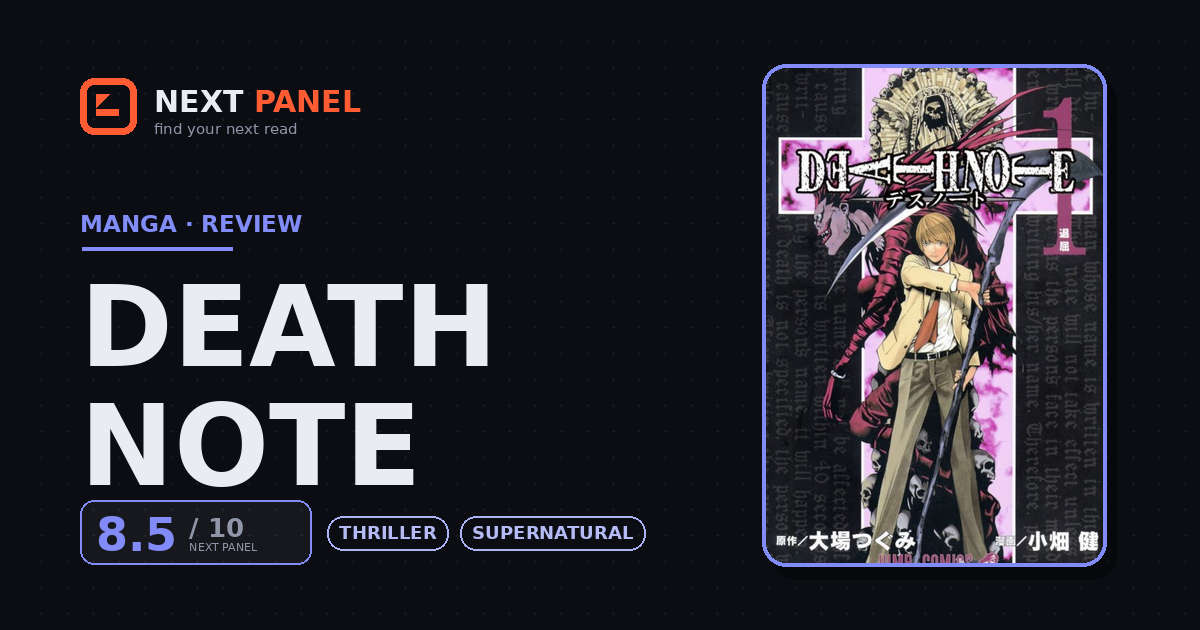
If you like the cat-and-mouse plotting here, Death Note ratchets the same idea up to a much higher-stakes game.
Frequently Asked Questions
Is Kurosagi finished?
Yes. The original series ran for 20 volumes and is complete, with a sequel series (Shin Kurosagi) continuing the story afterward.
Is there an official English translation of Kurosagi?
No, there is currently no official English release of Kurosagi. It hasn't been picked up by an English-language publisher, so there's no legal digital or print edition to point to right now — that's worth rechecking down the line in case that changes.
Do I need to watch the drama adaptation first?
No. The 2006 TBS drama adapts the same premise but tells its own condensed story — you can read the manga on its own without it.