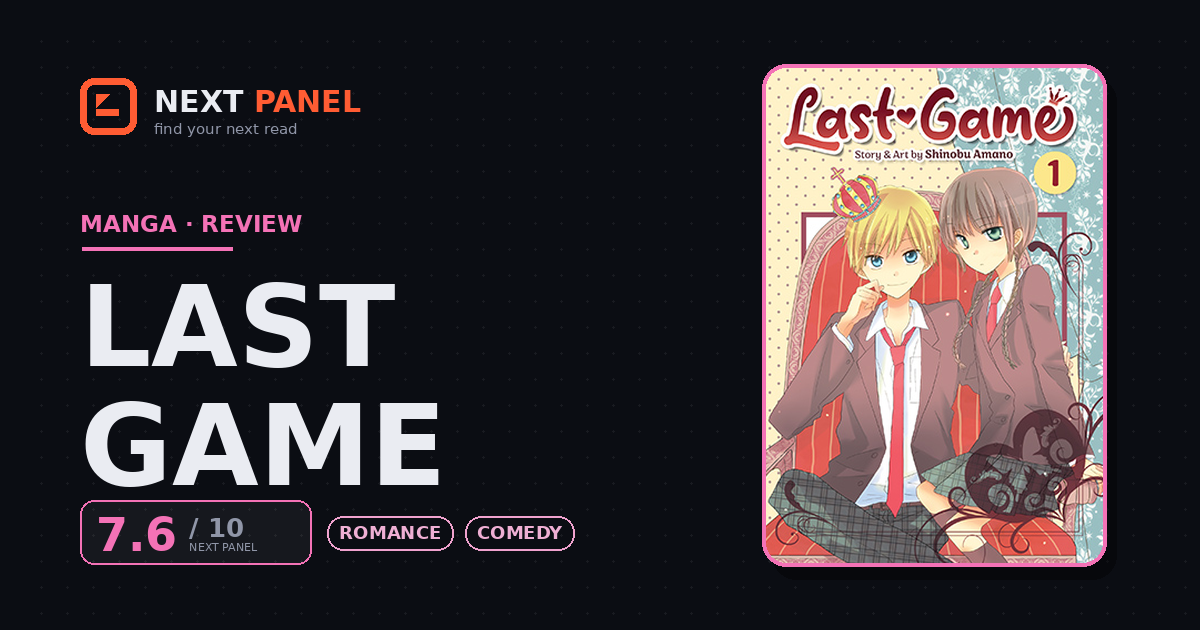
Is Last Game Worth Reading? Review & Where to Read
Quick Answer
Worth reading if you want a shoujo rivals-to-lovers romance that actually earns its slow burn across school and into college instead of rushing the couple together in volume one.
Quick Verdict
“Petty revenge schemes make an unusually strong foundation for a love story here, mostly because Mikoto never lets Naoto get away with any of them.”
Best for: Readers who want a long, patient rivals-to-lovers romance with real character growth on both sides.
Not for: Readers who want a fast-moving romance or a male lead who's likable from page one.
- Type
- Manga
- Genres
- Romance, Comedy
- Status
- Completed
- This review
- Minor Spoilers
- Author
- Shinobu Amano
- Publisher
- Hakusensha
- Platform
- Seven Seas Entertainment
| Quick facts | |
|---|---|
| Format | Manga (shōjo), 66 chapters, 11 volumes |
| Run | 2011–2016 · completed |
| Community score | AniList 7.9 · MangaUpdates 8.6 |
| Content | None significant |
| Where to read | Seven Seas Entertainment — official |
Overview
Naoto Yanagi has never lost at anything — not academics, not sports, not popularity — until Mikoto Kujō transfers into his class and beats him at every turn without even trying. Wounded pride turns into a years-long, one-sided rivalry that follows the two of them from elementary school through high school and into college, where Naoto finally proposes a "last game" to settle things between them once and for all. Written and illustrated by Shinobu Amano, the series ran in Hakusensha's LaLa from 2011 to 2016 and is licensed in English by Seven Seas Entertainment.
What it does well
What sets this apart from a typical shoujo slow burn is how unflattering Naoto's original motivation is allowed to be. He isn't secretly interested in Mikoto from the start — he genuinely wants to beat her and hurt her pride the way his was hurt, and the manga lets that pettiness sit uncomfortably for a while before it starts curdling into real feelings. That gives the eventual romance more weight, because it's built on watching a flawed character actually change rather than revealing hidden good intentions he had all along.
Mikoto herself is the other reason this works. She's blunt, practical, and almost entirely unbothered by Naoto's schemes, which denies him the easy emotional victories he's used to and forces the story to find funnier, more honest ways for him to get under her skin. She's never framed as a prize waiting to be won — she has her own interior life and her own confusion about her feelings, which keeps the power dynamic between them from tipping too far in his favor.
Stretching the story from childhood through college also gives it room that a single-arc high school romance wouldn't have. Both leads visibly grow up, and the shift in their dynamic once they're adults navigating the same rivalry with more maturity is one of the stronger later stretches of the series.
Where it falls short
The biggest hurdle is Naoto himself in the early volumes — he's written to be genuinely manipulative and arrogant, and readers who need an immediately likable lead may struggle to get past that stretch before the story starts humanizing him. The core setup, a boy trying to make a girl fall for him purely out of spite, is also a hard sell even once it's recontextualized as a real slow burn; it asks for some patience and trust that the reframing is coming.
The supporting cast's own romantic subplots, while sometimes charming, do slow the pacing in the middle volumes without adding much momentum to the central relationship, and a reader mainly here for Naoto and Mikoto may find those detours drag.
Verdict
This is a rivals-to-lovers romance that earns its slow burn by starting its lead in a genuinely unflattering place and making him work for the reader's sympathy, with Mikoto's stubborn indifference doing a lot of the heavy lifting to keep it funny along the way. It asks for patience early on, but the payoff across school and college makes it one of the sturdier long-form shoujo romances out there.
Strengths & Weaknesses
Strengths
- Naoto's original motivation — petty wounded pride, not genuine interest — gives the slow-burn romance an unusually honest starting point, and watching that motivation curdle into real feelings is more satisfying than a straightforward meet-cute.
- Mikoto is never reduced to a prize to be won; her bluntness and total indifference to Naoto's schemes are what drive the comedy and consistently deny him the easy victories he expects.
- Spanning elementary school through college lets the series show real character growth instead of freezing its leads in a single high school arc, which pays off especially in the later college volumes.
- The supporting cast, particularly Kei and Momoka, get their own small arcs of growth rather than existing purely to complicate the central couple.
Weaknesses
- Naoto is written to be genuinely unlikable in the early volumes — arrogant and manipulative — and the manga asks you to sit with that for a while before he starts to soften.
- The central conceit of a boy trying to romantically manipulate a girl out of spite is a hard sell on its own terms, even once the story reframes it as him falling for her.
- Some side arcs involving the supporting cast's own crushes slow the pacing in the middle volumes without adding much to the central relationship.
Similar Titles
Another rivals-first romance built on two proud leads scheming against each other before admitting their feelings.
Shares the slow-burn structure and a central pair who grow up together over the course of the story.
For readers who want another earnest, character-driven shoujo romance that takes its time.
Where to Read Officially
| Platform | Format | Pricing | Region notes | Link |
|---|---|---|---|---|
| Seven Seas Entertainment | Print & digital volumes | Paid | Region availability varies | Open |
Frequently Asked Questions
Is Last Game licensed in English?
Yes — Seven Seas Entertainment publishes the full series in print and digital.
Is the series finished?
Yes, it ran from 2011 to 2016 across 11 volumes.
How much of the story is set in college?
Most of it — the leads meet in elementary school, but the bulk of the plot takes place once they're both in college.