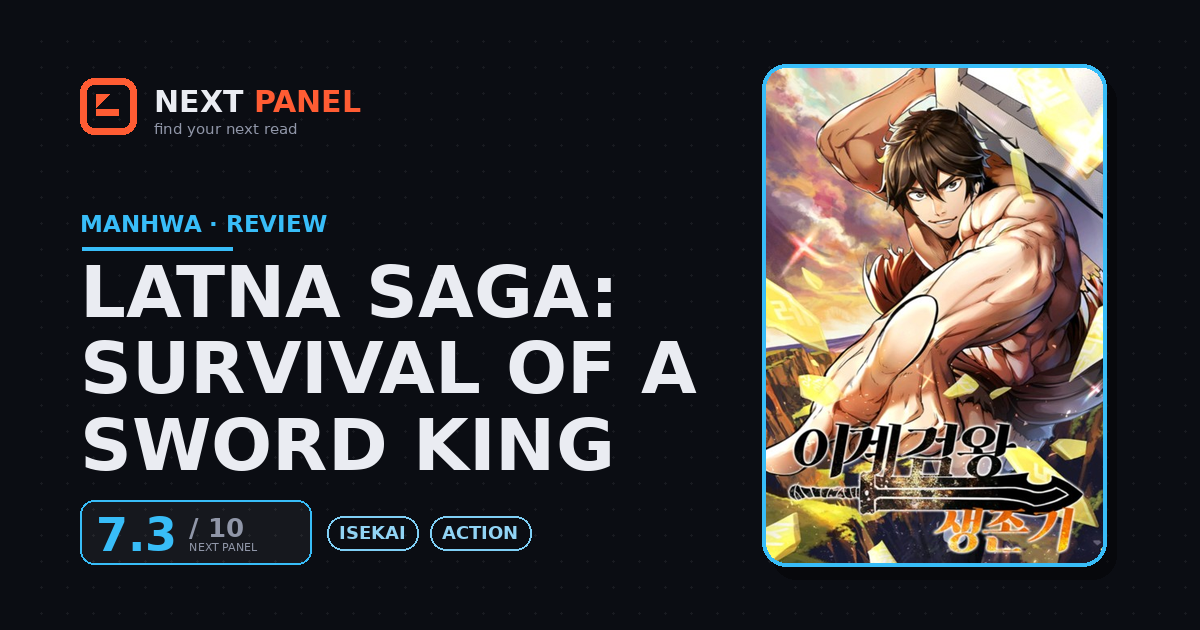
Is Latna Saga: Survival of a Sword King Worth Reading? Review & Where to Read
Quick Answer
Yes, if you want an isekai lead who's genuinely shaped by hardship instead of instantly heroic. Ryu Hanbin's twenty years of tutorial hell make him a divisive, sometimes frustrating protagonist, but that's the point, and Latna Saga commits to it.
Quick Verdict
“Twenty years of glitched-tutorial hell turns the lead into someone genuinely hard to like sometimes, and the manhwa is more interesting for actually committing to that instead of smoothing him out.”
Best for: Readers who want an isekai protagonist visibly damaged by his backstory instead of unrealistically well-adjusted.
Not for: Readers who want a consistently likable, straightforwardly heroic lead.
- Type
- Manhwa
- Genres
- Action, Isekai
- Status
- Ongoing
- This review
- Minor Spoilers
- Author
- Kyungbae Lim (story), Soon-Q Kwon (art)
- Artist
- Soon-Q Kwon
- Publisher
- KakaoPage / Tapas
- Platform
- Tapas
| Quick facts | |
|---|---|
| Format | Manhwa, 290 chapters |
| Run | 2019–present · ongoing |
| Community score | AniList 7.6 · MangaUpdates 7.6 |
| Content | Violence |
| Where to read | Tapas — official |
Overview
Ryu Hanbin is a recently discharged soldier who gets pulled into another world along with a group of fellow otherworlders, and given a 'guide line' system meant to help him survive and grow. His copy of the system is broken, though, and instead of a quick tutorial, he ends up trapped in it for twenty years. When he's finally released, the world has turned hard against otherworlders in general, and Hanbin has to find his footing in a setting that sees him as a threat before it sees him as a person -- all while carrying two decades of isolation that didn't leave him unscathed.
What it does well
The central conceit is doing real character work instead of just being a cool backstory hook. Twenty years alone in a hostile tutorial would change anyone, and Latna Saga actually lets that show in how Hanbin acts: he's cautious, sometimes cold, and slow to extend trust, which makes him feel like a plausible product of what he survived rather than a hero who happens to have a rough origin story. The wider setting's hostility toward otherworlders gives the plot ongoing stakes beyond the next fight, since Hanbin can't just win a battle and move on; he has to actually navigate a world that doesn't want him in it. Kivye's growing bond with him develops through shared danger and slow trust-building rather than instant chemistry, which fits the story's more grounded tone, and the fights make good use of the specific, hard-won instincts his tutorial years left him with.
Where it falls short
The flip side of a deliberately damaged protagonist is that Hanbin is, by design, a harder lead to root for than most isekai protagonists, and some readers will bounce off him specifically because the story doesn't rush to make him more likable. The overall tone stays heavy for long stretches, without much comic relief or lighter chapters to break up the grimness. And at well over 275 episodes and counting, reading it as it releases means feeling the slower pacing between major arcs more than you would in a finished, collected version.
Verdict
Latna Saga earns points for actually following through on its premise instead of just using 'twenty years in a broken tutorial' as flavor text. Hanbin's rough edges are the story's biggest strength and its biggest ask of the reader at the same time. If you want an isekai lead shaped by real hardship rather than smoothed over for likability, this delivers something more distinctive than most of the genre.
Strengths & Weaknesses
Strengths
- Ryu Hanbin's twenty years stuck in a broken tutorial actually shapes his personality instead of being a backstory detail he shrugs off once the real story starts.
- The world's blanket hostility toward otherworlders gives the story real, ongoing stakes beyond the next fight.
- Kivye's relationship with Hanbin develops through shared hardship rather than instant attraction.
- The action is well-choreographed and gets real tactical mileage out of Hanbin's tutorial-honed instincts.
Weaknesses
- Hanbin is written to be genuinely difficult to like at points, which is a deliberate choice but a real barrier for readers who want a more conventionally likable lead.
- The premise's grimness is consistent almost to a fault; there's not much tonal relief across long reading stretches.
- As a 275-plus-episode ongoing series, the pacing between major arcs can feel slow if you're reading week to week.
Similar Titles
A different flavor of second-chance power fantasy, with a more straightforwardly heroic lead.
A cleaner, more crowd-pleasing version of the underestimated-hunter-grows-powerful arc.
Similar interest in how surviving a broken system actually changes a person, told from a different angle.
Where to Read Officially
| Platform | Format | Pricing | Region notes | Link |
|---|---|---|---|---|
| Tapas | Digital chapters | Free + Paid | Region availability varies | Open |
Frequently Asked Questions
Is Latna Saga finished?
No, it's an ongoing manhwa with well over 275 episodes released so far and more continuing.
Why is Ryu Hanbin considered a controversial protagonist?
Twenty years trapped in a glitched tutorial left him guarded, sometimes selfish, and slow to trust — the manhwa treats that as a real consequence of trauma rather than something to quietly smooth over, which some readers find compelling and others find genuinely frustrating.
Is there a romance in this series?
Yes, a slow-developing relationship between Hanbin and Kivye, one of the otherworlders who stays by his side.