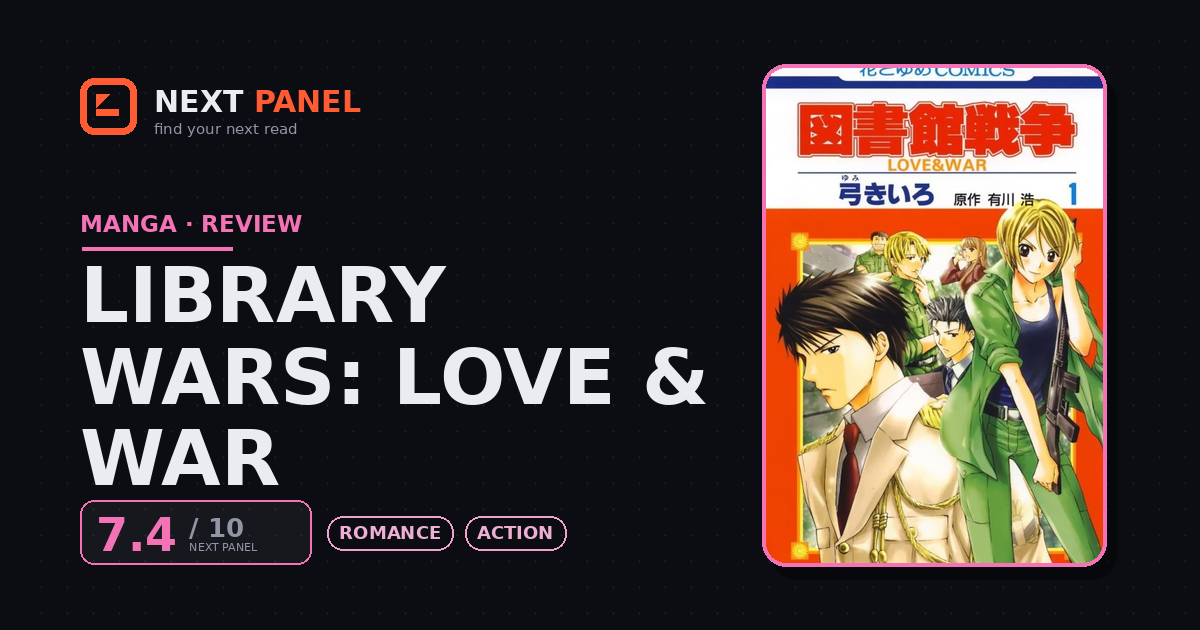
Is Library Wars: Love & War Worth Reading? Review & Where to Read
Quick Answer
Yes, if you want a shojo romance with an unusually high-concept backdrop. The censorship-versus-library-defense premise gives the story real stakes beyond the central will-they-won't-they.
Quick Verdict
“Armed librarians fighting a censorship war sounds like a joke premise, and the manga plays it completely straight without ever losing its footing.”
Best for: Readers who want a shojo romance with genuine action stakes and a distinctive, high-concept setting.
Not for: Readers who want the premise's action elements to be the main focus rather than a backdrop for the central romance.
- Type
- Manga
- Genres
- Romance, Action
- Status
- Completed
- This review
- Minor Spoilers
- Author
- Kiiro Yumi (manga), Hiro Arikawa (original novel)
- Artist
- Kiiro Yumi
- Publisher
- Hakusensha
- Platform
- Viz Media
| Quick facts | |
|---|---|
| Format | Manga (shōjo), 90 chapters, 15 volumes |
| Run | 2007–2015 · completed |
| Community score | AniList 7.7 |
| Where to read | Viz Media — official |
Overview
Library Wars: Love & War is set in a near-future Japan where a government agency enforces strict censorship, and libraries have formed an armed Library Defense Force to physically protect books from seizure. Iku Kasahara joins the force after a librarian once protected a book she loved as a teenager, and she's determined to become just as capable a defender, not realizing that the officer who inspired her all those years ago might be closer than she thinks.
What it does well
The premise alone sets this apart from most shojo romance. Fighting censorship with an actual paramilitary library defense force is a genuinely bold, high-concept setup, and Kiiro Yumi commits to it fully, treating the raids and confrontations with real tension rather than playing the concept for comedy. That commitment gives the story stakes beyond the central romance, which helps the slower relationship-focused chapters feel like part of a bigger, more purposeful world.
Iku is a strong lead specifically because her growth isn't rushed. She starts genuinely underqualified and impulsive, and the manga takes its time showing her develop real competence and judgment rather than skipping straight to capability. That patience makes her arc satisfying in a way a lot of shojo protagonists don't get.
The central romance benefits from a clever structural hook: Iku doesn't initially realize that her strict superior, Dojo, is the officer who inspired her to join in the first place, which gives their slow-burn dynamic a layer of dramatic irony that keeps it engaging without relying on the genre's usual miscommunication tropes. The action sequences, particularly the censorship raids, are staged with real urgency and give the manga forward momentum beyond typical romance pacing.
Where it falls short
The broader censorship-war worldbuilding stays fairly surface-level. The larger political conflict between the library forces and the censorship agency mostly functions as a backdrop and obstacle generator rather than getting the deeper exploration its premise seems to promise.
Iku's impulsiveness, a core part of her character, occasionally crosses into genuinely frustrating recklessness that creates conflict for its own sake rather than meaningfully developing her. And while the central romance gets plenty of attention, several side characters and their own romantic subplots feel comparatively thin, existing mostly to support the main couple's story.
Verdict
Library Wars: Love & War pairs a genuinely distinctive high-concept premise with a well-paced, patient central romance, and the combination mostly works. The worldbuilding doesn't dig as deep as the setup deserves, and Iku's recklessness can grate at times, but the slow-burn dynamic between Iku and Dojo, backed by real action stakes, makes this a memorable entry in shojo romance.
Strengths & Weaknesses
Strengths
- The central premise, a militarized Library Defense Force protecting books from a government censorship agency, gives the story real stakes and a genuinely distinctive setting for a shojo romance.
- Iku's arc from an impulsive, underqualified recruit to a competent Library Force member is handled with real care and doesn't rush her growth.
- The romance between Iku and Dojo benefits from a clever hidden-identity hook that keeps the slow burn interesting without relying on typical miscommunication.
- Action sequences involving the censorship raids are staged with real tension, giving the manga more forward momentum than a typical shojo romance.
Weaknesses
- The censorship-war worldbuilding stays fairly thin around the edges; the larger political conflict mostly exists to create obstacles for the characters rather than getting deep exploration.
- Iku's impulsiveness, while central to her character, occasionally tips into frustration-inducing recklessness that slows the plot rather than developing her.
- Some side romances and supporting arcs feel comparatively underdeveloped next to the attention given to the two leads.
Similar Titles
Shares a willingness to build a shojo romance around an unusually high-concept institutional setting.
Similar pairing of a determined, growing heroine with a slow-burn romantic arc set against a demanding profession.
Where to Read Officially
| Platform | Format | Pricing | Region notes | Link |
|---|---|---|---|---|
| Viz Media | Print & digital volumes | Paid | Region availability varies | Open |
Frequently Asked Questions
Is the action a major part of the story?
It's present throughout, especially during censorship raid arcs, but the romance between Iku and Dojo remains the central focus.
Is the manga complete?
Yes, it ran to completion across fifteen volumes.
Do I need to read the original light novels?
No, the manga tells a complete, self-contained version of the story.