Is Log-in Murim Worth Reading?
Quick Answer
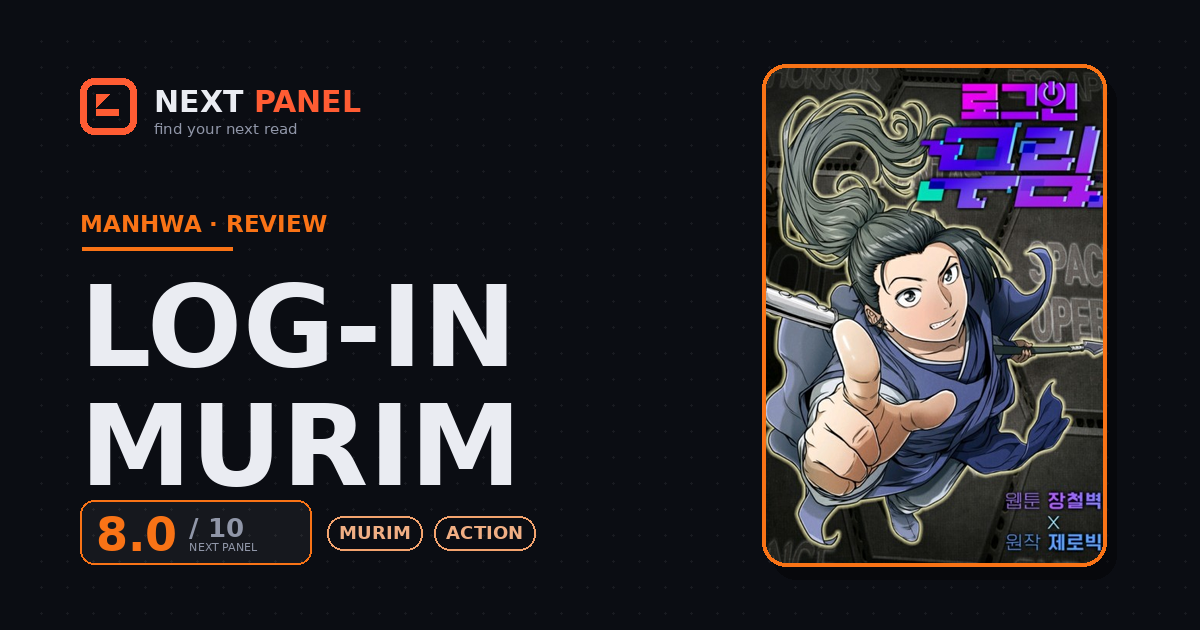
Log-in Murim is worth reading for a genuinely weak, relatable lead and strong murim-style fight choreography across its dual real-world/murim structure.
Quick Verdict
“Well-built dual-world power fantasy that earns its comedy through a genuinely weak, relatable lead instead of empty modesty before an inevitable power-up.”
Best for: Readers who want murim-style martial arts action paired with a genuinely weak, realistic protagonist.
Not for: Readers who want a deep supporting cast, or who want a completed story instead of an ongoing one.
- Type
- Manhwa
- Genres
- Action, Murim
- Status
- Ongoing
- Author
- Zero Big
- Artist
- Jang Cheol-Byuk
- Publisher
- Kakao Webtoon
- Platform
- Tapas
| Quick facts | |
|---|---|
| Format | Manhwa, 250 chapters |
| Run | 2020–present · ongoing |
| Community score | AniList 8.0 · MangaUpdates 8.2 |
| Where to read | Tapas — official |
Overview
Log-in Murim follows Jin Taekyung, a weak, low-rank monster hunter in a modern world full of dungeons, who finds an old training-simulator pod and gets pulled into the body of his own murim-world counterpart, an ancient Korean martial arts setting layered underneath the real one. Zero Big's story, adapted here by Jang Cheol-Byuk, runs a dual-world structure where Taekyung's growth in the murim simulation carries back into his real body, letting a genuinely weak modern hunter become dangerous by training in a world where martial arts, not dungeon-clearing gear, decides who wins. That structure gives the manhwa two separate power ladders to climb at once, and watching Taekyung apply murim instincts to modern dungeon problems, and vice versa, becomes one of its most reliable sources of both comedy and tension.
What it does well
The dual-world hook is more than a gimmick: because Taekyung's real-world hunter career and his murim training feed into each other, the manhwa gets to run two different flavors of power growth side by side without either one feeling redundant. Taekyung himself is the strongest part of the cast, an honestly weak lead whose mistakes and limitations feel real rather than a delay tactic before an inevitable overpowered reveal, and the comedy grows naturally out of him being an outsider in both worlds instead of being bolted on for pacing breaks. He gets recruited by a real-world guild on the strength of instincts he can barely explain, and the gap between what he can suddenly do and what he understands about why keeps him sympathetic even as he climbs. The art handles the murim-style combat especially well; fight choreography and skill effects land with real impact, and Jang Cheol-Byuk keeps the pacing tight by trimming the novel's denser passages of internal narration down into something that reads cleanly panel to panel.
Where it falls short
Character depth outside Taekyung is thinner than the fight choreography and world-building; the supporting cast tends to exist to react to him rather than carry independent arcs of their own. Taekyung's real-world character design is also less distinctive than his murim counterpart, which undersells some of the fish-out-of-water comedy the story is going for. And as a still-ongoing series without an English print release yet, readers are committing to a long, digital-only, still-unfolding story with no guaranteed endpoint in sight.
Verdict
A well-built dual-world power fantasy that earns its comedy honestly through a genuinely weak, relatable lead rather than empty modesty before an inevitable power-up. Worth it for murim and system-fantasy fans who want strong fight choreography and a protagonist whose growth actually feels earned.
Strengths & Weaknesses
Strengths
- A dual-world structure where real-world hunting and murim training feed into each other instead of feeling redundant.
- Jin Taekyung is honestly weak at the start, making his growth and mistakes feel earned rather than delayed.
- Strong fight choreography and skill effects that make the murim-style combat land with real impact.
- Tighter pacing than the source novel, trimming dense internal narration into clean panel-to-panel storytelling.
Weaknesses
- Supporting characters mostly react to Taekyung rather than carrying arcs of their own.
- Taekyung's real-world character design is less distinctive than his murim counterpart.
- Still ongoing with no English print release yet, only digital chapters.
Similar Titles
Another modern-hunter power fantasy, though built on straightforward escalation rather than a dual-world structure.
A closer genre match for murim-specific martial arts action and internal power systems.
A similar blend of modern setting and older-world combat knowledge driving the power growth.
Where to Read Officially
| Platform | Format | Pricing | Region notes | Link |
|---|---|---|---|---|
| Tapas | Digital | Free + Paid | Region availability varies | Open |
Frequently Asked Questions
Is Log-in Murim finished?
No, it's still ongoing, with new chapters continuing to release.
Where can I read it officially in English?
Tapas licensed the series in 2024 and publishes it digitally in English.
Is Log-in Murim based on a novel?
Yes. It adapts Zero Big's web novel, with the manhwa trimming down some of the novel's denser narration.