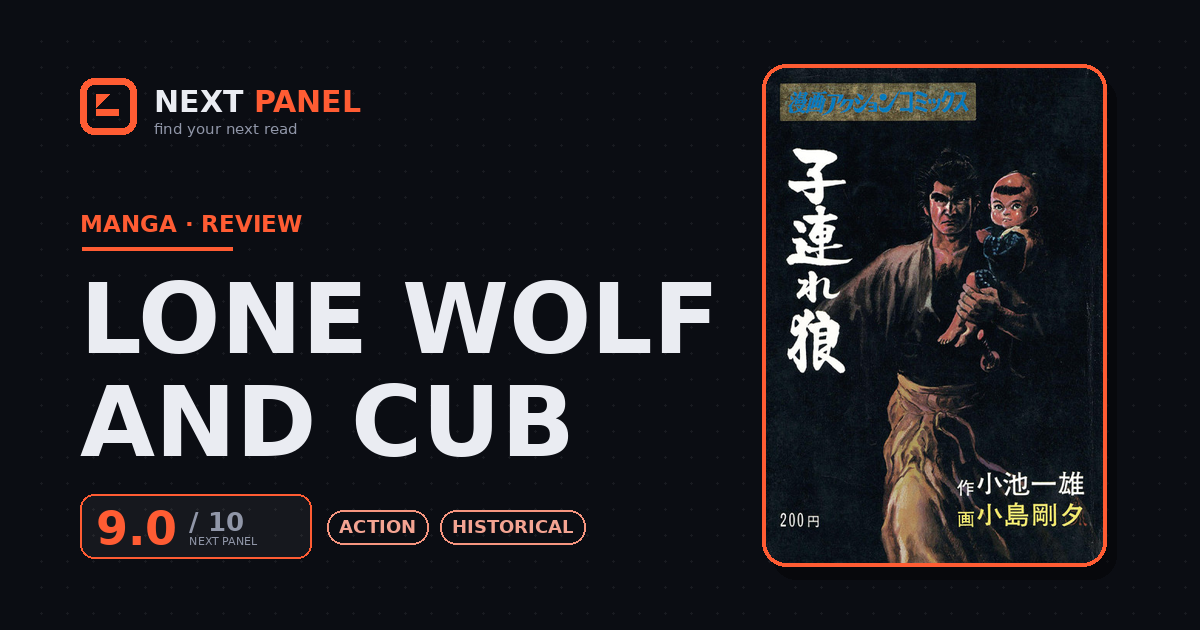
Is Lone Wolf and Cub Worth Reading? Classic Samurai Manga Review
Quick Answer
Yes -- Lone Wolf and Cub is one of the true landmark samurai manga, prized for Goseki Kojima's cinematic art and Kazuo Koike's unsentimental storytelling. It's a long, violent, adult classic rather than a light read.
Quick Verdict
“Kojima's paneling changed how action gets drawn in comics, and Koike never once softens Ogami into a conventional hero -- this is a slow, brutal masterpiece, not a quick genre fix.”
Best for: Readers who want a serious, violent historical epic with real artistic ambition and don't mind a long, episodic read.
Not for: Readers who want a fast-moving plot, a redemptive or upbeat tone, or a short time commitment.
- Type
- Manga
- Genres
- Action, Historical
- Status
- Completed
- This review
- Minor Spoilers
- Author
- Kazuo Koike
- Artist
- Goseki Kojima
- Publisher
- Koike Shoin / Dark Horse Manga
- Platform
- Dark Horse Manga
| Quick facts | |
|---|---|
| Format | Manga (seinen), 142 chapters, 28 volumes |
| Run | 1970–1976 · completed |
| Community score | AniList 8.5 · MangaUpdates 6.8 |
| Content | Extreme violence, dark historical themes |
| Where to read | Dark Horse Manga — official |
Overview
Lone Wolf and Cub (Kozure Okami) is a samurai epic manga written by Kazuo Koike and illustrated by Goseki Kojima, originally serialized from 1970 to 1976. Ogami Itto was the shogun's official executioner until a rival clan framed him and murdered his wife, leaving him with nothing but his infant son, Daigoro. Ogami chooses the path of the ronin, wandering feudal Japan as a hired assassin, pushing Daigoro's cart everywhere he goes, while the two of them move steadily toward vengeance against the men who destroyed their family. It's a completed series. This review stays spoiler-free.
What it does well
Kojima's art is the reason this manga is still studied by cartoonists decades later. His paneling is cinematic in a way that feels ahead of its time: long wordless sequences, dramatic shifts in scale, and compositions that let silence and stillness carry as much weight as the violence does. When a fight happens, it's sudden, brutal, and clearly staged, and the quiet stretches between fights are just as carefully built.
Ogami himself is a fascinating lead precisely because the manga refuses to soften him. He's not a noble hero in any conventional sense -- he kills for money, he's coldly pragmatic, and the story is upfront about the toll that life takes on him and on Daigoro. That honesty gives the series a weight that a more sanitized version of the same premise wouldn't have.
The structure also holds up remarkably well. Told mostly as episodic jobs and encounters that build toward a larger revenge plot, the manga can be picked up in chunks without losing the thread, while still paying off a long-form story about grief, duty, and what vengeance actually costs the person carrying it out. Across thousands of pages, it rarely feels padded, and the historical detail about feudal Japan and the samurai code gives every arc real texture.
Where it falls short
This is an unflinching, adult series, and it doesn't pull punches -- the violence is frequent and graphic, and the tone stays somber for very long stretches. Readers looking for levity or a conventional emotional arc will find little of either; this is not a manga interested in comfort.
The episodic structure that makes it easy to dip into also means pacing can feel slow if you're reading for plot momentum alone -- some jobs exist mainly to deepen the atmosphere and the world rather than to move the main revenge story forward, and it can take a while before the larger plot threads click into place. And at over two dozen volumes in its original form, it's a serious time investment before the full arc pays off.
Verdict
Lone Wolf and Cub earns its reputation as one of the genuine landmarks of the medium -- Kojima's art alone would make it worth reading, and the combination of unsentimental characters, careful pacing, and real historical weight makes the whole thing hold up decades later. If you want a serious, violent, beautifully drawn samurai epic and don't need a fast plot or a redemptive arc, this is essential reading. Just go in ready for a long, somber, adult story rather than a quick genre thrill.
Strengths & Weaknesses
Strengths
- Goseki Kojima's art is genuinely groundbreaking -- cinematic paneling, dramatic use of scale and silence, and fight choreography that influenced generations of cartoonists after it.
- Ogami Itto is written with real honesty instead of being softened into a conventional hero, which gives the revenge story more weight than a cleaner version of the same premise would have.
- The historical detail about feudal Japan and the samurai code gives the world real texture without turning into a lecture.
- The episodic job-by-job structure makes a very long series easier to read in chunks while still paying off a larger, long-form story.
Weaknesses
- The violence is frequent and graphic, and the tone stays somber for very long stretches with little comic relief.
- The episodic pacing can feel slow if you're reading purely for plot momentum, since some chapters exist to build atmosphere rather than advance the main story.
- At well over two dozen volumes in its original form, it's a serious time investment before the full arc resolves.
Similar Titles
Another art-driven, historically grounded samurai epic.
Similar mix of period violence and a morally complicated lead.
Where to Read Officially
| Platform | Format | Pricing | Region notes | Link |
|---|---|---|---|---|
| Dark Horse Manga | Print omnibus & digital volumes | Paid | Region availability varies | Open |
Frequently Asked Questions
Is Lone Wolf and Cub finished?
Yes, it's a complete classic series, originally serialized from 1970 to 1976 and collected in 28 volumes in Japan.
How is it available in English?
Dark Horse Manga publishes it in English, currently through omnibus paperbacks and a newer oversized Deluxe Edition hardcover line.
Is this appropriate for younger readers?
No -- it's a violent, adult-oriented seinen series aimed at mature readers.