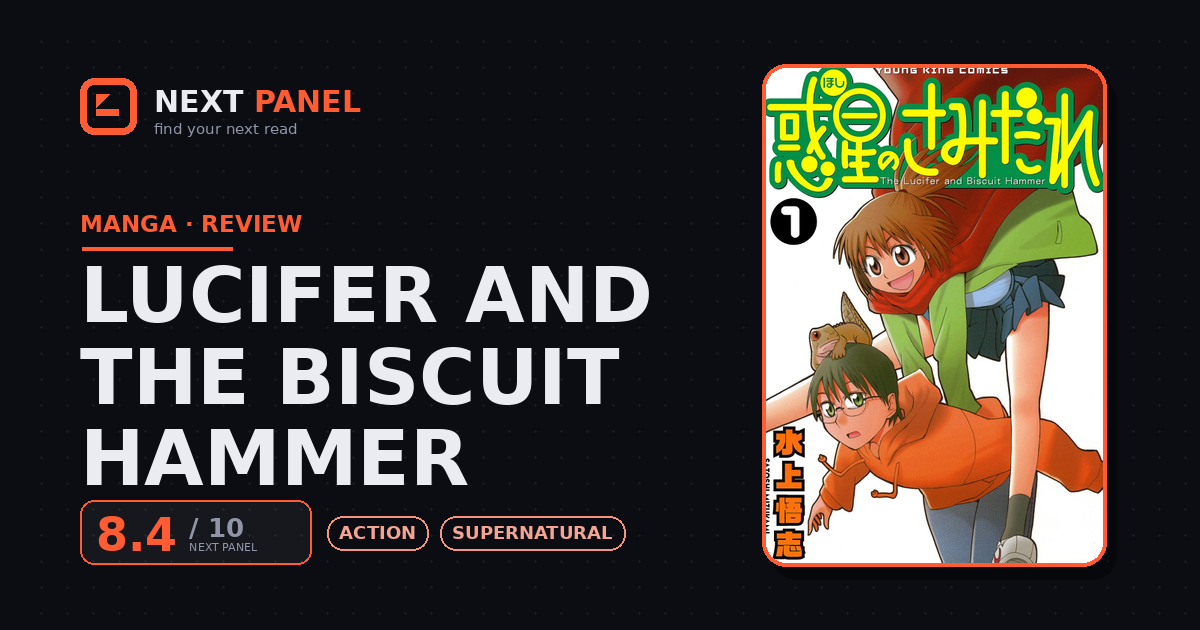
Is Lucifer and the Biscuit Hammer Worth Reading? Review & Where to Read
Quick Answer
Yes — it's a cult classic for a reason. What looks like a silly premise turns into a moving, complete story about twelve strangers deciding what their lives are worth. The early art is rough, but the writing more than carries it.
Quick Verdict
“Rough early art, goofy jokes, a lizard sidekick — and somehow one of the most affecting battle manga of its era. Push through the plain first volumes and it repays you twice over.”
Best for: Readers who want a completed, character-first battle story where every side character gets their due.
Not for: Readers who need polished art from page one or a serious tone all the way through.
- Type
- Manga
- Genres
- Action, Supernatural
- Status
- Completed
- This review
- Minor Spoilers
- Author
- Satoshi Mizukami
- Publisher
- Shonen Gahosha
- Platform
- Seven Seas
| Quick facts | |
|---|---|
| Format | Manga (seinen), 65 chapters, 10 volumes |
| Run | 2005–2010 · completed |
| Community score | AniList 8.0 |
| Content | Violence, some crude humor |
| Where to read | Seven Seas — official |
Overview
Amamiya Yuuhi is a college student who has arranged his life so that nothing touches him. Then he wakes up to a talking lizard on his pillow, gets drafted as a Beast Knight, and learns there's a giant hammer hanging in space, ready to crack the Earth open. He's supposed to fight to protect the planet alongside the "princess" — his neighbor, Asahina Samidare. Except Samidare intends to save the world only so she can break it herself, and Yuuhi, given the choice between the Earth and her, picks her without much hesitation. What follows is a war against the mage Animus and his golems, fought by twelve knights who each have their own reasons for showing up.
What it does well
The cast is the whole point. Twelve Beast Knights is a lot of characters for a mid-length series, and Mizukami gives every single one a life: jobs, regrets, crushes, families, things they still want. The fights matter because the people in them matter, and when the story starts spending those characters, it hurts in a way most battle manga never manage. By the endgame you can name the whole roster and say what each of them wants — that's rarer than it should be.
The tonal control is the other trick. This series swings from dumb gags to real grief inside a single chapter and somehow never breaks, because the comedy and the tragedy come out of the same people. The silly stuff isn't filler; it's how you get attached, so the serious stuff lands harder.
And underneath it all is Yuuhi, who starts the story as a quietly damaged person planning to drift through life alone. His slow decision to actually want things — friends, a future, her — is written with patience and no shortcuts. The premise sounds like a joke, but the series is really about why people choose to keep living, and it earns every bit of that weight.
It's also finished, and the ending is one of the good ones: the mysteries resolve, the character arcs pay off, and the final chapters deliver on promises made in volume one.
Where it falls short
The art is the honest barrier. Early on it's flat, stiff, and plain — functional at best — and it doesn't match the ambition of the writing. It improves considerably as the series goes, but readers who bounce off ugly early volumes will have to take the payoff on faith.
The middle stretch also meanders. There's a run of episodic golem fights where the larger plot mostly idles, and while those chapters do quiet character work, the momentum dips before the final act picks everything back up. Add some broad, dated humor, and you have a series that asks for a little patience. It rewards it, but it asks.
Verdict
This is the definition of a cult classic: a series that looks disposable and turns out to be one of the most heartfelt battle stories in seinen. If you can get past plain art and a goofy surface, the character writing is genuinely special, and the complete run means you get the whole arc with no risk of an unfinished ending. Read it before someone spoils the princess's plan for you.
Strengths & Weaknesses
Strengths
- All twelve Beast Knights get real arcs — the story spends its time making you care about the whole roster, and it pays off in the endgame.
- The tone swerves from gag comedy to genuine grief and back without breaking, because the jokes and the drama come from the same characters.
- Yuuhi's growth from walled-off loner to someone who chooses people is one of the best protagonist arcs in seinen fantasy.
- It's complete, and the ending delivers on everything the early chapters set up.
Weaknesses
- The art is plain and stiff in the early volumes — it improves, but the first stretch doesn't sell the story's ambition.
- The episodic middle wanders through monster-of-the-week fights before the endgame locks in.
- Some of the humor is broad and shows its age.
Similar Titles
Mizukami's follow-up — tighter, stranger, and just as much heart in a shorter run.
Another battle series where the real fight is growing up.
A boy, a monster, and a fight for the world — the same big-hearted energy in a classic shonen shell.
Where to Read Officially
| Platform | Format | Pricing | Region notes | Link |
|---|---|---|---|---|
| Seven Seas | Print & digital omnibus volumes | Paid | Region availability varies | Open |
Frequently Asked Questions
Is Lucifer and the Biscuit Hammer finished?
Yes, the story is complete. Seven Seas published the entire series in English across five 2-in-1 omnibus editions.
Is it the same series as Hoshi no Samidare?
Yes. Hoshi no Samidare is the Japanese title; Seven Seas released the English edition as Lucifer and the Biscuit Hammer.
Should I read this or Spirit Circle first?
Either works — Mizukami's series stand alone. Biscuit Hammer is longer and battle-focused; Spirit Circle is shorter and tighter. Most fans end up reading both.