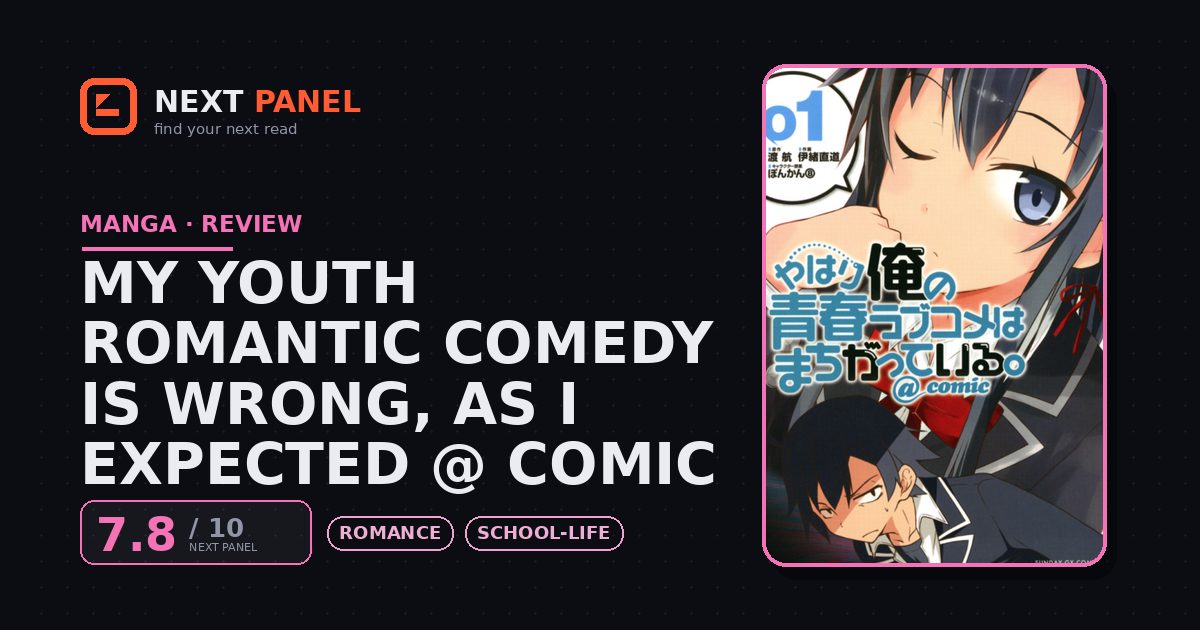
Is My Youth Romantic Comedy Is Wrong, As I Expected Worth Reading? Review & Where to Read
Quick Answer
Yes, especially if you want a romantic comedy that treats its central love triangle as something with real emotional cost rather than a series of misunderstandings. It gets more melancholy than its comedic opening suggests, and that shift is where it earns its reputation.
Quick Verdict
“Starts as a cynic's rom-com and slowly turns into something sadder and more honest about what it costs to actually connect with people.”
Best for: Readers who want a slow-burn romance willing to sit with genuine emotional discomfort instead of resolving every conflict with a joke.
Not for: Readers who want a breezy, low-stakes school rom-com or a lead who's easy to like from page one.
- Type
- Manga
- Genres
- School Life, Romance
- Status
- Completed
- This review
- Minor Spoilers
- Author
- Wataru Watari
- Artist
- Naomichi Io
- Publisher
- Yen Press
- Platform
- Yen Press
| Quick facts | |
|---|---|
| Format | Manga (shōnen), 118 chapters, 22 volumes |
| Run | 2012–2023 · completed |
| Community score | AniList 7.9 · MangaUpdates 7.1 |
| Content | None significant |
| Where to read | Yen Press — official |
Overview
Hachiman Hikigaya opens the story by turning in a school essay arguing that youth, as everyone else understands it, is a lie — a performance people put on to convince themselves their high school years mean something. His teacher's response is to sentence him to the Service Club, a nearly empty after-school group tasked with helping other students solve their problems. There he meets Yukino Yukinoshita, sharp-tongued and just as isolated as he is, and Yui Yuigahama, warm and eager to be liked by everyone around her. The three of them spend the rest of the series solving other people's problems while their own relationships slowly, messily become the actual story.
What starts as an episodic, mildly cynical rom-com gradually reveals itself to be something more melancholy: a story about people who are good at fixing other people's problems because it's easier than being honest about their own.
What it does well
Hachiman's voice is the manga's engine, and it works because the story doesn't just let his cynicism sit there being funny — it slowly interrogates it. His "solutions" to the Service Club's cases often involve sacrificing himself socially to fix things quietly, and watching Yukino and Yui notice that pattern, and push back on it, is where the character work really sharpens.
The central trio's dynamic carries the whole series. Rather than settling into an easy love-triangle formula, the manga lets Hachiman, Yukino, and Yui's relationships develop through genuine vulnerability and real hurt feelings, not just comedic misunderstandings. By the time the story's emotional stakes are fully in view, the earlier comedic chapters read differently in hindsight — the laughs were setup for something quieter and more serious.
The episodic Service Club cases also do real work structurally, giving each arc a clean hook while steadily revealing more about all three leads through how they handle other people's problems.
Where it falls short
The pacing asks for patience. This is a slow burn in the most literal sense, and readers hoping for a faster romantic resolution may find the drawn-out ambiguity frustrating rather than compelling. Hachiman's internal narration, while central to the story's appeal, can also start to feel repetitive in longer stretches before his outlook meaningfully shifts.
Some of the side-character arcs involving other Service Club cases don't hit as hard as the central trio's material, functioning more as structure than as fully realized stories in their own right.
Verdict
My Youth Romantic Comedy Is Wrong, As I Expected earns its reputation by refusing to stay a light rom-com. Underneath the cynical jokes is a genuinely thoughtful story about the cost of connection, carried by a trio of leads who all get real room to be flawed. It asks for patience, but the payoff is one of the more emotionally honest school romances out there.
Strengths & Weaknesses
Strengths
- Hachiman's cynicism is written with enough self-awareness that his growth over the series feels earned rather than forced by the plot.
- The central trio's dynamic — Hachiman, Yukino, and Yui — gets real emotional texture instead of staying in easy rom-com misunderstandings.
- The Service Club's episodic problem-of-the-week structure gives each arc a clear hook while still building toward the larger relationships underneath.
- The manga is willing to let its characters hurt each other honestly instead of smoothing every conflict over by the end of the chapter.
Weaknesses
- The pace is slow by design, and readers looking for quick romantic payoff will find the will-they-won't-they stretched out significantly.
- Hachiman's narration-heavy internal cynicism can wear thin in longer stretches, especially before his character growth kicks in.
- Some side arcs involving supporting classmates don't land with the same weight as the central trio's material.
Similar Titles
Another slow-burn school romance willing to let its central relationship get genuinely messy before it gets better.
Wotakoi: Love is Hard for Otaku
For a different, more grown-up flavor of awkward, sincerity-first romance.
The Quintessential Quintuplets
If you want another long-running romance built around a slow-developing central relationship.
Where to Read Officially
| Platform | Format | Pricing | Region notes | Link |
|---|---|---|---|---|
| Yen Press | Print & digital volumes | Paid | Region availability varies | Open |
Frequently Asked Questions
Is this the same as the light novel?
It's an adaptation of the same story by Wataru Watari, illustrated by Naomichi Io — the plot follows the novels closely but is its own complete manga.
Is the manga finished?
Yes, it's complete at 22 volumes.
Do I need to watch the anime first?
No, the manga tells the same story and is a fine entry point on its own, though the anime is also a popular way into the series.