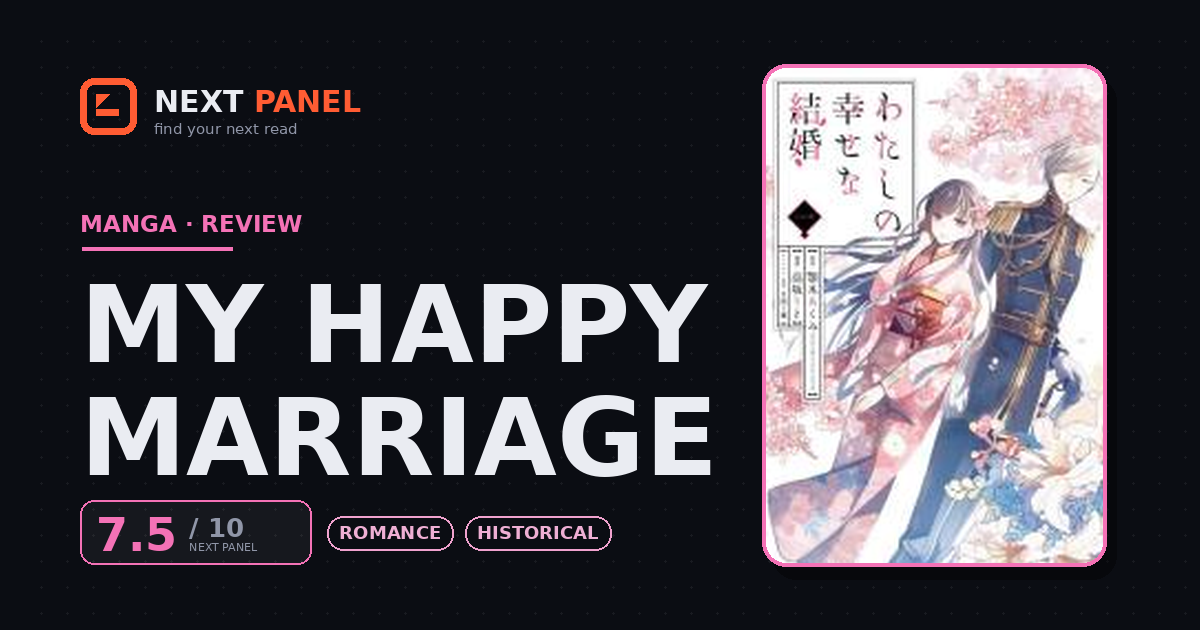
Is My Happy Marriage Worth Reading? Review & Where to Read
Quick Answer
Yes, if you want a slow, comforting Cinderella-style romance with a supernatural-powers backdrop instead of a magic school. It's not reinventing the arranged-marriage genre, but it executes the comfort-read formula with real care.
Quick Verdict
“Everyone in Miyo's life has told her she's unlovable; the whole manga is just her husband, quietly and repeatedly, proving them wrong.”
Best for: Readers who want a gentle, healing arranged-marriage romance with a Taisho-fantasy backdrop and a scary-on-the-outside love interest.
Not for: Readers who want fast-burn romance or a plot driven by conflict rather than emotional healing.
- Type
- Manga
- Genres
- Romance, Historical
- Status
- Ongoing
- This review
- Minor Spoilers
- Author
- Akumi Agitogi
- Artist
- Rito Kousaka
- Publisher
- Square Enix
- Platform
- Manga Up! Global / Square Enix Manga & Books
| Quick facts | |
|---|---|
| Format | Manga |
| Run | 2018–present · ongoing |
| Community score | AniList 7.9 |
| Where to read | Manga Up! Global / Square Enix Manga & Books — official |
Overview
Miyo Saimori has grown up being told, constantly and directly, that she's worth less than her half-sister -- who inherited the supernatural gift their family prizes, while Miyo got nothing. Unloved by her father and treated as a servant by her stepmother, she's eventually shipped off as a bridal candidate for Kiyoka Kudo, heir to the most powerful family in the land and a man rumored to have driven off every previous candidate. My Happy Marriage follows what happens when the marriage nobody expected to work quietly starts to.
What it does well
The manga's central trick is patience. Miyo's years of mistreatment are shown with real restraint -- it never turns her suffering into spectacle, which means when Kiyoka turns out to be nothing like his reputation, the shift in tone lands as genuine relief rather than melodrama. And the story doesn't waste time pretending otherwise: Kiyoka's kindness shows up early and consistently, so the tension isn't 'will he hurt her' but something gentler -- can Miyo actually let herself believe someone's being kind to her without an angle.
The Taisho-era setting, with its hereditary supernatural bloodlines and military hierarchy, gives what's otherwise a familiar arranged-marriage premise a genuinely distinct look and texture. Rito Kousaka's art carries a lot of that atmosphere -- soft, detailed linework that puts as much care into a quiet dinner-table scene as it does into the occasional supernatural flourish, which keeps the domestic scenes from feeling like filler between the plot beats.
Where it falls short
This is a slow story, and it stays slow. If you're looking for a relationship that has to work through real obstacles and conflict, you'll be waiting a long time -- large stretches of the manga are Kiyoka reassuring Miyo and Miyo slowly accepting it, without much external plot pressing on either of them. That's clearly intentional, but it does mean the pacing rewards patience more than momentum.
Miyo's own arc is also more about being affirmed than about building her own agency. She's a sympathetic lead, but a lot of her growth comes from someone else insisting she's worth something rather than her proving it through her own choices, which will read as a little too passive for readers who want their protagonists driving the plot rather than receiving it.
Verdict
My Happy Marriage isn't trying to subvert the healing arranged-marriage romance -- it's trying to execute it as well as it can, and mostly succeeds. The pace is gentle to the point of slow, and Miyo's arc leans more on being rescued than on self-determination, but if you're in the mood for a genuinely soft, well-drawn comfort read, this delivers exactly what it promises.
Strengths & Weaknesses
Strengths
- Miyo's mistreatment never tips into shock-value misery -- it's drawn with restraint, which makes Kiyoka's kindness land as relief instead of whiplash.
- Kiyoka subverts the 'terrifying husband' archetype early and often; the manga isn't interested in dragging out a will-he-hurt-her tension it never intended to deliver on.
- The Taisho-era setting with hereditary supernatural gifts gives a familiar arranged-marriage plot a distinct visual identity instead of feeling generic.
- Rito Kousaka's art is soft and detailed in exactly the scenes that need it -- quiet domestic moments get as much care as the occasional supernatural set-piece.
Weaknesses
- The plot moves slowly, and readers who want the central relationship to hit obstacles and conflict will find long stretches where the story is mostly reassurance.
- Miyo's arc leans hard on being rescued and affirmed by Kiyoka rather than building her own agency, which some readers will find a little too passive for a lead character.
Similar Titles
Similar gentle, healing romance tone, minus the arranged-marriage setup.
Same historical-fantasy Japanese court backdrop, if you want more worldbuilding with your romance.
Similar comfort-read pacing and a scary-seeming love interest who turns out to be anything but.
Where to Read Officially
| Platform | Format | Pricing | Region notes | Link |
|---|---|---|---|---|
| Manga Up! Global / Square Enix Manga & Books | Digital chapters & print volumes | Free + Paid | Region availability varies | Open |
Frequently Asked Questions
Is this the same as the anime?
Yes -- the anime (two seasons so far) adapts the manga/light novel's early arcs closely, so either version works as an entry point.
Does Miyo get her own supernatural powers?
Her arc deals directly with her lack of powers and what she's capable of without them -- that's part of the point of the story rather than something spoiled here.
Is it still being released?
Yes, both the manga adaptation and the original light novels are ongoing/still being translated, so new volumes keep coming.