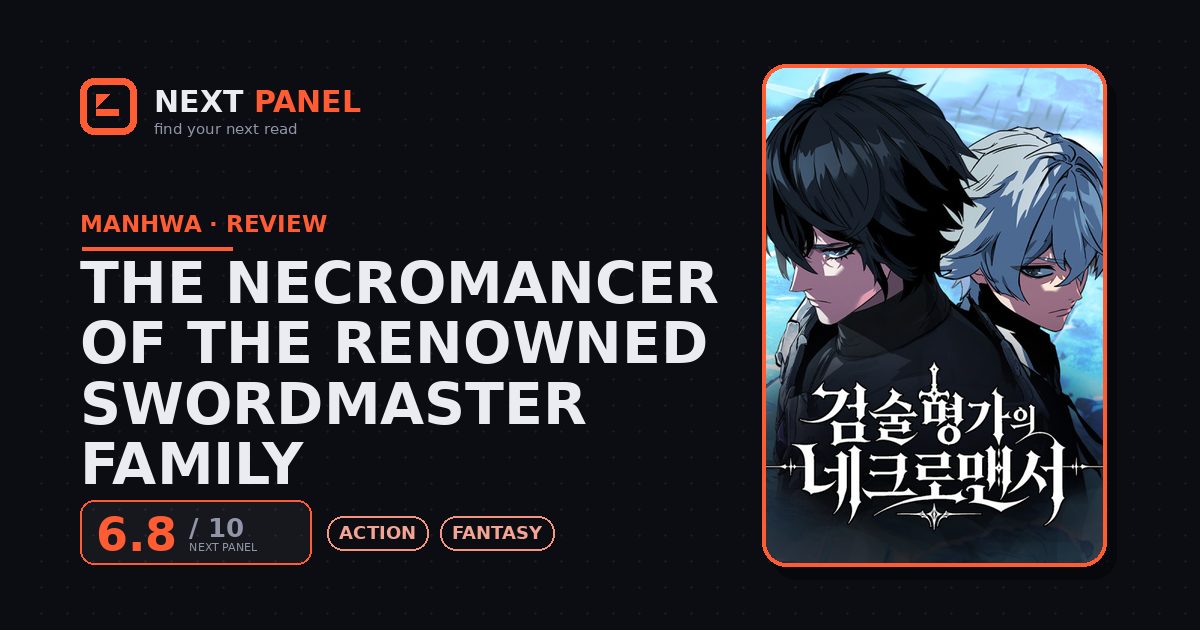
Is The Necromancer of the Renowned Swordmaster Family Worth Reading? Review & Where to Read
Quick Answer
If you want a villain-reincarnation story with a genuinely clever twist — being reborn inside your killer's own family line — yes, the premise carries real tension.
Quick Verdict
“Archimonde doesn't just get a second chance, he gets one inside the house of the man who ended his first life, and that irony shapes everything about how carefully he has to move.”
Best for: Readers who want a villain-protagonist reincarnation story with real stakes around survival, not just power accumulation.
Not for: Readers who want a straightforward heroic protagonist rather than a morally ambiguous necromancer as the lead.
- Type
- Manhwa
- Genres
- Fantasy, Action
- Status
- Ongoing
- This review
- Minor Spoilers
- Author
- Gamtwiiii
- Artist
- Gwang-Su Lee
- Publisher
- WEBTOON
- Platform
- WEBTOON
| Quick facts | |
|---|---|
| Format | Manhwa, 20 chapters |
| Run | 2026–present · ongoing |
| Community score | AniList 6.4 · MangaUpdates 6.4 |
| Where to read | WEBTOON — official |
Overview
Archimonde the necromancer once summoned hordes of the undead and ravaged the continent for a decade before the hero Birkel Reinrandt finally killed him. Two centuries and eight generations later, an infant born into House Reinrandt — the very family founded by the man who ended his life — screams Archimonde's own incantation. The necromancer has returned, but this time he's growing up inside the household of his once-mortal enemy, and it's an open question whether that house will let him survive long enough to matter again.
What it does well
The premise's central irony is what makes it work: Archimonde isn't just getting a second chance, he's getting one inside the bloodline of the man who killed him. That built-in tension gives the reincarnation setup real stakes from the very first chapter, rather than the generic blank-slate rebirth so many similar stories rely on.
Making the lead the original villain, rather than a hero given another shot, is a distinct choice that shapes the whole story's moral texture. Archimonde has to actually reckon with being the historical threat everyone in this world fears, which adds complexity that a standard heroic-reincarnation story wouldn't have.
The two-century, eight-generation gap between the original conflict and Archimonde's return also gives the story room to explore how House Reinrandt's legacy and identity have shifted since his defeat — this isn't the same family he fought, and that distance matters.
Where it falls short
Centering a villain-protagonist means the story asks more of readers who prefer a straightforwardly sympathetic lead — Archimonde's goals and methods carry real moral weight that won't sit comfortably with everyone.
The infancy stretch at the start of the story necessarily limits how directly he can act, which means the early chapters deal with more passive positioning before he can meaningfully pursue his own agenda.
And since the series is ongoing, whether House Reinrandt ever learns who's actually been raised among them — and what happens if they do — is still very much unresolved.
Verdict
This is a villain-reincarnation story that earns its premise through genuine irony: the necromancer reborn inside his killer's own family. If you want real stakes tied to identity and survival rather than a straightforward power fantasy, Archimonde's second life delivers that, even with plenty still left to play out.
Strengths & Weaknesses
Strengths
- Being reborn inside House Reinrandt, the very bloodline of the hero who killed him, gives the necromancer's second life immediate, built-in stakes rather than a generic reincarnation setup.
- Framing the lead as the original villain rather than a hero gives the story a distinct moral flavor — his survival strategy has to account for actually being the historical threat everyone fears.
- The two-century gap and eight generations of distance from the original conflict give the story room to explore how much House Reinrandt's legacy has shifted since Archimonde's defeat.
Weaknesses
- Playing a villain-protagonist means readers looking for a straightforwardly sympathetic hero may find Archimonde's motivations and methods harder to root for.
- The infancy setup means an early stretch of the story deals with limited agency before Archimonde can act more directly on his goals.
- As an ongoing series, how the swordmaster family reacts once (or if) they learn who's really been raised among them is still unresolved.
Similar Titles
Similar reincarnation-as-a-historically-significant-figure structure with real consequences tied to that identity.
Shares a fantasy action framework with a protagonist whose past identity complicates their present situation.
Where to Read Officially
| Platform | Format | Pricing | Region notes | Link |
|---|---|---|---|---|
| WEBTOON | Digital chapters | Free | Region availability varies | Open |
Frequently Asked Questions
Is Archimonde a villain or a hero in this story?
He's the original villain, the necromancer who terrorized the continent — his return inside his killer's bloodline is what drives the story's central tension.
Does House Reinrandt know who the baby really is?
No, that's part of what gives the premise its tension — Archimonde has to navigate his second life without the family realizing who he actually is.
Is this series finished?
No, it's ongoing, so how Archimonde's presence within House Reinrandt ultimately plays out is still unfolding.