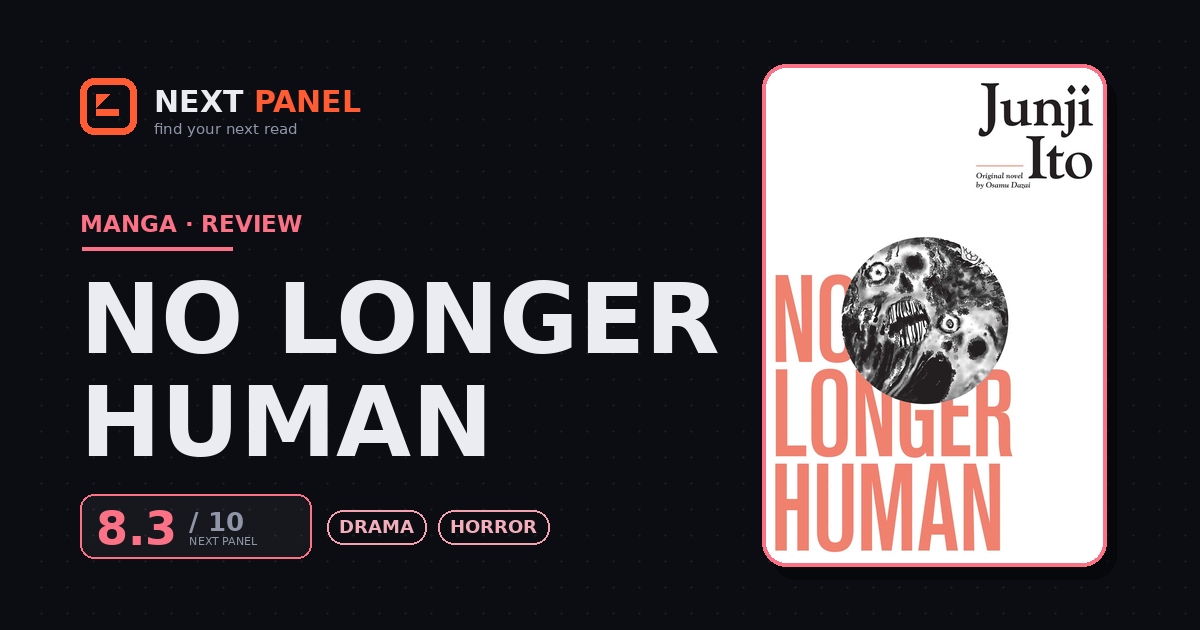
Is No Longer Human Worth Reading? Review & Where to Read
Quick Answer
Yes, especially if you want horror that comes from psychological disintegration rather than monsters. Ito's art style turns Dazai's already bleak novel into something even more visually unsettling, without losing the source material's emotional core.
Quick Verdict
“Ito's grotesque, warped faces are the perfect match for a novel about a man performing humanity he's never actually felt.”
Best for: Readers who want psychological horror rooted in real despair and self-destruction rather than supernatural threats.
Not for: Readers who want a hopeful arc or a protagonist whose choices are easy to root for.
- Type
- Manga
- Genres
- Drama, Horror
- Status
- Completed
- This review
- Minor Spoilers
- Author
- Osamu Dazai (original novel), adapted by Junji Ito
- Artist
- Junji Ito
- Publisher
- Shogakukan
- Platform
- Viz Media
| Quick facts | |
|---|---|
| Format | Manga (seinen), 12 chapters, 3 volumes |
| Run | 2009–2011 · completed |
| Community score | AniList 7.7 · MangaUpdates 7.3 |
| Content | Suicide, self-harm, addiction |
| Where to read | Viz Media — official |
Overview
No Longer Human adapts Osamu Dazai's classic 1948 novel, following Yozo Oba, a man who has never understood how to genuinely connect with other people and instead spends his life performing the role of a carefree clown to mask his complete disconnection from what he believes is normal human experience. Junji Ito, best known for supernatural horror, takes on the material with a director's restraint, letting Dazai's bleak, confessional story of addiction, failed relationships, and self-destruction speak largely for itself, amplified by Ito's unmistakable visual style.
What it does well
The pairing of Ito and Dazai turns out to be a genuinely inspired match. Yozo's psychological unraveling, his belief that he's fundamentally incapable of being human the way everyone around him seems to be, is exactly the kind of internal horror Ito's art excels at externalizing. Faces warp, expressions curdle into something uncanny, and ordinary social scenes take on a genuinely unsettling quality that mirrors Yozo's own alienation without needing a literal monster to generate dread.
The adaptation is faithful to the novel's structure and tone, following Yozo's life through a series of increasingly desperate chapters, failed relationships, addiction, suicide attempts, without softening any of it. Ito doesn't try to make Yozo sympathetic in a conventional sense; he renders his self-deception and cruelty honestly, which keeps the story feeling true to Dazai's original intent rather than sanding down its edges for easier consumption.
The pacing handles the source material's episodic, confessional structure well, giving each phase of Yozo's decline room to land before moving forward, and Ito's linework gives even quiet, mundane scenes an underlying visual tension that keeps the horror present even when nothing overtly frightening is happening.
Where it falls short
This is a genuinely bleak read, and it does not offer catharsis or redemption by the end. If you're looking for any real hope woven through Yozo's story, that's simply not the kind of book this is, and it's worth going in with clear expectations about the weight of the subject matter.
Because the story is adapted so faithfully from a dense, introspective novel, some of Dazai's essayistic, first-person voice doesn't always translate seamlessly into a visual medium; certain stretches lean heavily on narration to carry ideas that prose handles more naturally. And because everything is filtered through Yozo's own unreliable self-perception, the side characters stay intentionally underdeveloped, which is true to the source material but can feel thin if you're expecting more rounded supporting cast.
Verdict
No Longer Human is a genuinely powerful, deeply uncomfortable adaptation that finds the perfect visual language for Dazai's bleak, confessional novel. It offers no comfort and no easy answers, but Ito's ability to render psychological disintegration as literal visual horror makes this one of the more effective literary adaptations in manga.
Strengths & Weaknesses
Strengths
- Ito's adaptation stays faithful to the emotional core of Dazai's novel while using visual horror to externalize Yozo's internal disintegration in ways prose alone can't.
- Yozo's performance of normalcy, and the exhaustion underneath it, is rendered with real psychological precision rather than melodrama.
- Ito's grotesque, warped character art gives literal shape to social anxiety and self-loathing, making abstract dread viscerally uncomfortable to look at.
- The pacing mirrors the novel's structure well, moving through distinct chapters of Yozo's decline without losing narrative clarity.
Weaknesses
- The subject matter is unrelentingly bleak, and readers looking for any real hope or redemption in the ending won't find it here.
- Because it's a fairly direct adaptation, some of the novel's introspective, essayistic tone doesn't always translate smoothly into visual storytelling.
- Side characters remain intentionally thin, since the story is filtered almost entirely through Yozo's unreliable self-perception, which some readers may find frustrating.
Similar Titles
Oyasumi Punpun
Similar unflinching look at psychological decline and self-destructive behavior over a long timescale.
Shares Ito's gift for turning psychological dread into genuinely unsettling visual horror.
Where to Read Officially
| Platform | Format | Pricing | Region notes | Link |
|---|---|---|---|---|
| Viz Media | Print & digital (hardcover collected edition) | Paid | Region availability varies | Open |
Frequently Asked Questions
Do I need to read Dazai's original novel first?
No, the manga adapts the story faithfully enough to stand on its own, though fans of the novel will recognize how closely Ito follows it.
Is this typical Junji Ito horror?
Not exactly — there's no supernatural monster here. The horror is entirely psychological, rooted in Yozo's self-destruction and social alienation.
Is the manga complete?
Yes, it's a complete adaptation collected in one English hardcover edition.