Is No. 5 Worth Reading? Review & Where to Read
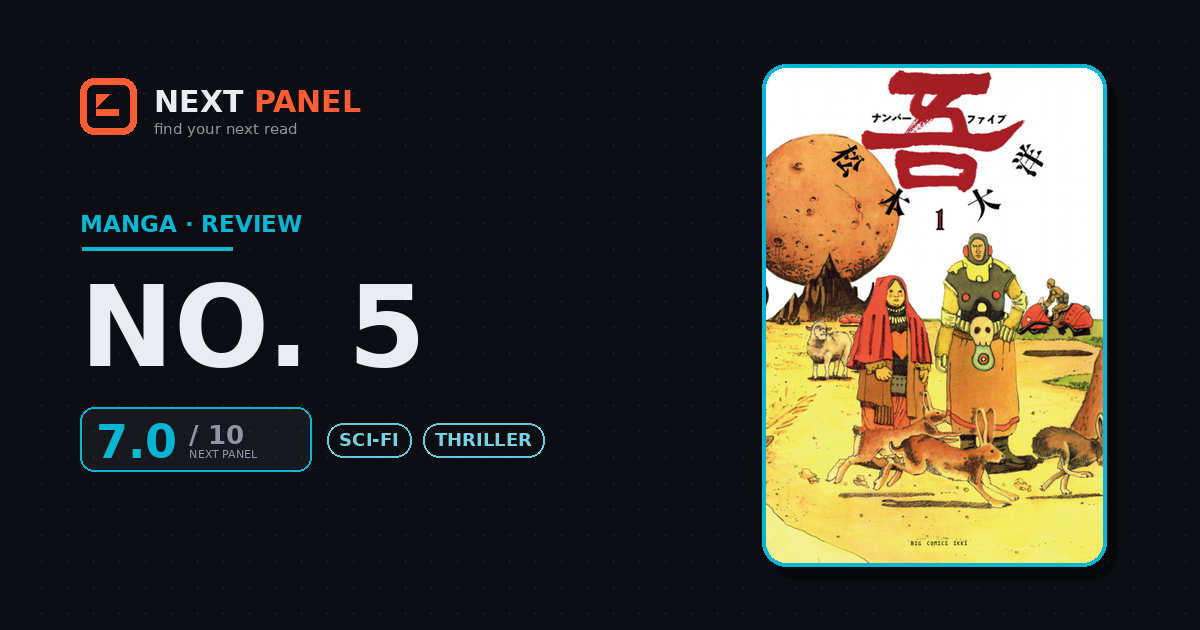
Quick Answer
Yes, if you're willing to surrender to a disorienting, non-linear sci-fi story rather than one that explains itself as it goes.
Quick Verdict
“It rewards patience with genuinely striking art and ideas, but it will actively resist readers who want a conventional power-scaling plot.”
Best for: Readers who want an artsy, unconventional sci-fi manga that prioritizes mood, imagery, and theme over a clear linear plot.
Not for: Readers who want a straightforward action story with clean exposition and characters who behave like plot devices.
- Type
- Manga
- Genres
- Thriller, Sci-Fi
- Status
- Completed
- This review
- Minor Spoilers
- Author
- Taiyo Matsumoto
- Publisher
- Shogakukan
- Platform
- Viz Media
| Quick facts | |
|---|---|
| Format | Manga, 37 chapters, 8 volumes |
| Run | 2000–2005 · completed |
| Community score | AniList 7.6 |
| Where to read | Viz Media — official |
Overview
In a world where most of the earth has become desert wasteland, the Rainbow Council — a team of superpowered global peacekeepers — faces a crisis: one of their own, the sharpshooting No. 5, has gone rogue alongside a mysterious companion named Matryoshka. The rest of the Council has to track him down, but Taiyo Matsumoto's manga isn't especially interested in a clean hunt narrative. Instead, it drops readers into the middle of this fractured world and lets them wander through it.
That disorientation is deliberate. No. 5 asks readers to give up the expectation of clear exposition and let its surreal, jazz-like rhythm of storytelling do the work instead.
What it does well
Matsumoto's art is the clearest reason to read this: he cuts between sprawling desert landscapes, sudden bursts of violence, and small mundane details — a yawn, water being poured — with a rhythm that feels closer to musical composition than conventional paneling. That approach extends to the cast: every member of the Rainbow Council comes across as a distinct individual with their own priorities, quirks, and small rebellions, rather than existing purely to advance a plot.
Underneath the eccentricity, the story has real thematic weight — it's fundamentally about systems of control and the people who break under them or slip through their cracks, using its cyclical, crumbling world as a lens for ideas about freedom and futility. Matsumoto commits fully to this vision rather than smoothing it out for easier consumption, which gives the manga a genuinely distinct identity.
Where it falls short
The opening stretch is disorienting in a way that will test some readers' patience — there's minimal handholding about who these numbered warriors are or what's actually at stake, and it can take real time before the pieces start to click into place. The story's rejection of linear plotting is a feature for readers willing to meet it on its own terms, but a real obstacle for anyone wanting clean answers along the way.
No. 5 himself is deliberately aloof and hard to read, which keeps him from being an easy character to latch onto even as the nominal protagonist. And because the manga leans so heavily on mood and fragmented imagery over narrative momentum, it's the kind of book some readers will bounce off entirely before reaching the volumes where its ideas fully pay off.
Verdict
No. 5 is a strange, artistically ambitious sci-fi manga that rewards patience with genuinely striking visuals and ideas about freedom and control — but it demands real surrender from readers used to more conventional storytelling. Worth seeking out if you want something that reads more like a puzzle or a piece of music than a typical action manga.
Strengths & Weaknesses
Strengths
- Matsumoto's art uses paneling almost like musical rhythm, cutting between grand action and small mundane details in a way that's genuinely distinctive.
- Every member of the Rainbow Council feels like an individual with their own priorities and quirks rather than existing purely to serve the plot.
- The story's themes about individuals breaking under or slipping through systems of control give the surreal setting real substance underneath the strangeness.
- It commits fully to a specific artistic vision rather than softening its eccentricities to be more accessible, which gives it a distinct identity.
Weaknesses
- The story drops readers into the middle of its world with minimal exposition, which can feel genuinely disorienting for a long stretch before things click.
- The pacing and structure reject linear, conventional plotting, which will frustrate readers who want clear answers about the world and its rules.
- No. 5 himself, the ostensible protagonist, is deliberately withholding and hard to connect with, which limits emotional investment early on.
- The story's fragmented, mood-driven approach means some readers may bounce off entirely before reaching the payoff in later volumes.
Similar Titles
Gannibal
A very different, more grounded horror-thriller if you want something more linear from Japanese seinen manga.
Brutal: Confessions of a Homicide Investigator
A more conventional thriller structure if No. 5's fragmented style isn't for you.
Where to Read Officially
| Platform | Format | Pricing | Region notes | Link |
|---|---|---|---|---|
| Viz Media | Print / digital volumes | Paid | Region availability varies | Open |
Frequently Asked Questions
Is No. 5 finished?
Yes, it's complete across 8 original volumes, collected into a 4-volume omnibus in its English release.
Where can I read No. 5 in English?
It's officially available in English from Viz Media, currently as a 4-volume omnibus edition.
Is No. 5 a typical superpowered action manga?
Not really — while it centers on superpowered characters, the storytelling is fragmented and mood-driven rather than following a conventional action-manga structure.