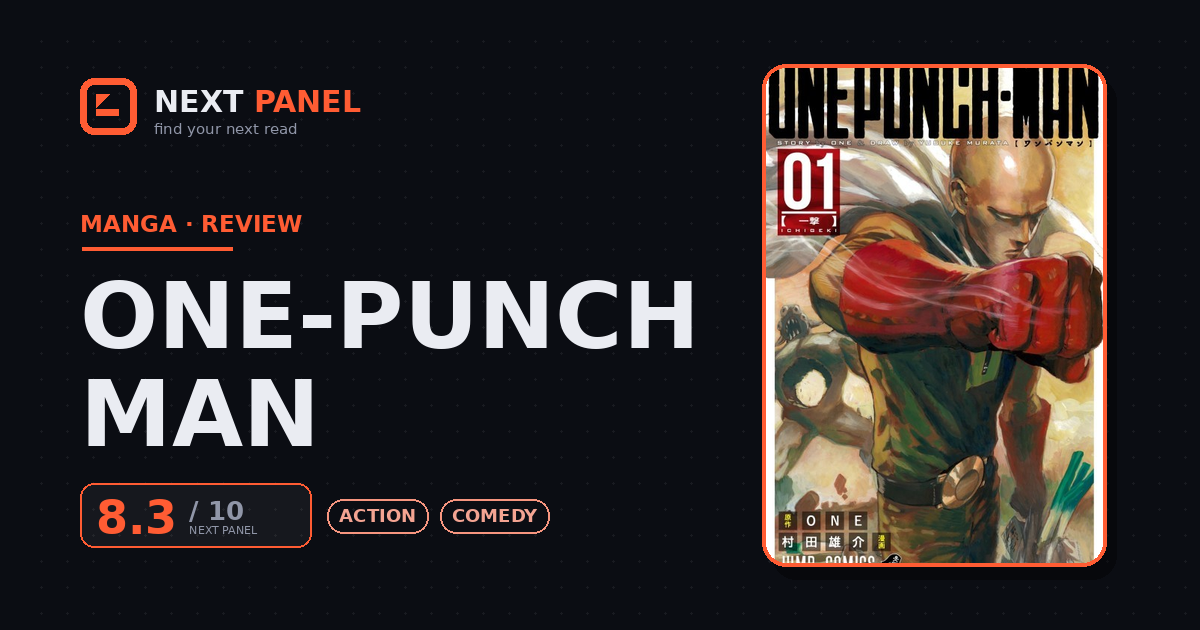
Is One-Punch Man Worth Reading? Superhero Manga Review
Quick Answer
Saitama can defeat almost anything with one punch, which should destroy tension. Instead, the manga shifts tension toward boredom, recognition, hero bureaucracy, and the absurdity of ranking strength like a spreadsheet.
Quick Verdict
“Murata's art makes even a guaranteed one-hit win jaw-dropping, and the simple joke keeps finding new angles — even when Saitama sits an arc out.”
Best for: Readers who like comedy, superhero satire, and high-quality fight art.
Not for: Readers who want a protagonist who struggles physically in every fight.
- Type
- Manga
- Genres
- Sci-Fi, Action, Comedy
- Status
- Ongoing
- This review
- Minor Spoilers
- Author
- ONE
- Artist
- Yusuke Murata
- Publisher
- Shueisha
- Platform
- VIZ Media
| Quick facts | |
|---|---|
| Format | Manga, 36 volumes |
| Run | 2012–present · ongoing |
| Community score | AniList 8.5 · MAL 8.7 · MangaUpdates 8.8 |
| Where to read | VIZ Media — official |
Overview
Saitama can beat any opponent with a single punch. That's not a spoiler, it's the premise stated in the first chapter, and by every normal rule of storytelling it should kill all tension immediately. One-Punch Man works anyway, because ONE and Yusuke Murata didn't just build a gag around an unbeatable hero, they built an entire functioning superhero society around him: a bureaucratic hero-ranking association, monster attacks treated with the mundane dread of a natural disaster, and a supporting cast who take every bit of it far more seriously than Saitama ever does.
What it does well
Murata's art is the first thing anyone mentions about this manga, and it earns the reputation. Fights that end in a single punch still get pages of buildup, wind-up, scale, dread, so that the anticlimax lands as a punchline instead of a letdown. It's some of the best-drawn action in modern manga, spent almost entirely in service of a joke about how none of it was ever going to matter.
Saitama himself is funnier than the premise suggests because he's not written as smug or all-powerful in spirit, he's bored. He's emotionally flat in moments where everyone around him is screaming, sweating, or having a breakdown, and the manga slowly reveals that his flatness isn't confidence, it's a specific kind of loneliness that comes from being unbeatable and having nobody to actually struggle alongside. That's a sharper joke than the simple strong-guy-wins premise, and it gives the character somewhere to go even without physical stakes.
The supporting cast is where the series gets its actual mileage. Genos, the cyborg disciple who takes everything with total sincerity, the ranked professional heroes obsessed with public image, the frauds, the monsters who have their own internal logic, all of them let the manga run through a whole catalogue of superhero and shonen archetypes while Saitama stands just outside the joke, watching it happen.
Where it falls short
The cost of building out that whole world is that Saitama disappears from long stretches of the story. Entire arcs shift focus to Genos, to the hero association's internal politics, or to a rival hero's backstory, and while that expands the world in interesting ways, it's a real detour if what you came for is the specific joke of the one-punch premise. Some of these stretches run long enough that the manga's central hook goes quiet for a while.
The structural joke also has a hard ceiling. If you need conventional power-scaling tension, wondering whether the hero can actually win, the central gag will never give you that, by design. That's not a flaw exactly, but it does mean the series asks you to find tension somewhere other than the fight itself, in spectacle, character, or worldbuilding, and that's a different kind of manga than the premise might suggest at a glance.
Verdict
One-Punch Man turns a one-line joke into a genuinely sustained superhero satire, and Murata's art makes the inevitable payoff land every single time. It's less about whether Saitama wins, that's never in question, and more about everything built around the certainty of that win. Readers looking for real physical stakes in every fight should sample an arc before committing, but for comedy, spectacle, and a surprisingly specific kind of loneliness at its center, it holds up.
Strengths & Weaknesses
Strengths
- Murata’s art makes the action spectacular even when the outcome is obvious.
- Saitama is funny because he is emotionally flat in situations where everyone else is screaming internally.
- The side cast lets the manga play with many superhero archetypes: cyborg disciple, martial artists, ranked professionals, frauds, monsters, and people who simply refuse to quit.
Weaknesses
- Some arcs spend long stretches away from Saitama. That helps the world expand, but not every reader wants that detour.
- If you need conventional power-scaling tension around the main character, the central joke may frustrate you.
Similar Titles
Mob Psycho 100Manga
Same author, deadpan power.
Kaiju No. 8Manga
Spectacle action.
Where to Read Officially
| Platform | Format | Pricing | Region notes | Link |
|---|---|---|---|---|
| VIZ Media | Digital chapters (subscription) | Free + Paid | Subscription; some regions limited | Open |
Frequently Asked Questions
Is One-Punch Man good for beginners?
Usually yes if the “Best for” section sounds like you. New readers should start with official preview chapters when available, because tone matters more than hype.
Is this review spoiler-free?
It is spoiler-light. It discusses the premise, style, reader fit, and general strengths without explaining major twists or late-arc reveals.
Where should I read it?
Use the official links in the Basic facts section. Availability can vary by country and app, so check the linked platform directly before buying or subscribing.