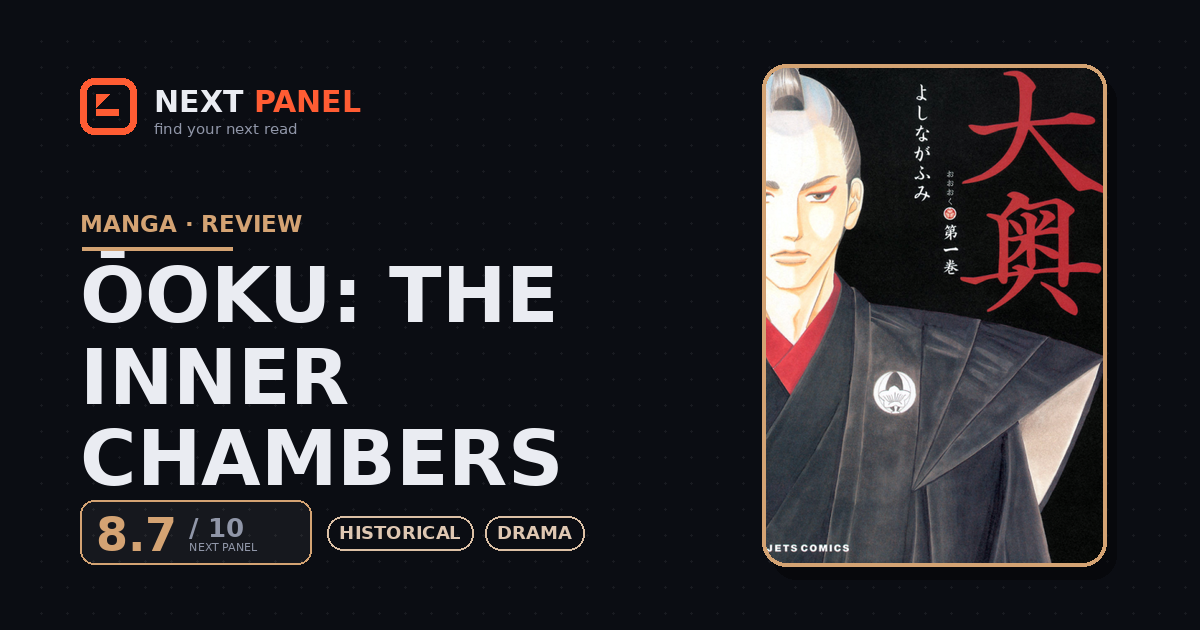
Is Ōoku: The Inner Chambers Worth Reading? Review & Where to Read
Quick Answer
Yes — this is one of the smartest, most fully-realized alternate histories manga has produced, if you're willing to slow down for it.
Quick Verdict
“Rebuilding two and a half centuries of Japanese history around a single flipped premise, and following through on every political consequence of it, is a genuinely rare achievement.”
Best for: Readers who want dense, dialogue-driven historical fiction that takes its gender-politics premise completely seriously.
Not for: Readers who want fast-paced action or plot momentum over slow, talky political and courtly maneuvering.
- Type
- Manga
- Genres
- Drama, Historical
- Status
- Completed
- This review
- Minor Spoilers
- Author
- Fumi Yoshinaga
- Publisher
- VIZ Media
- Platform
- VIZ
| Quick facts | |
|---|---|
| Format | Manga (josei), 79 chapters, 19 volumes |
| Run | 2004–2020 · completed |
| Community score | AniList 8.1 · MangaUpdates 8.3 |
| Content | Disease and death, sexual content, political violence |
| Where to read | VIZ — official |
Overview
In Edo-period Japan, a disease called the Redface Pox begins killing the country's men. Within eighty years, the male population has fallen by three-quarters, and Japan is quietly reorganized into a matriarchy: women take over as samurai, merchants, and eventually the shogun itself, while the rare surviving men are protected as precious resources, the most beautiful of them sent to serve in the shogun's Inner Chambers. Ōoku follows this alternate history across multiple generations of shoguns, real and reimagined, as the consequences of the plague ripple through politics, succession, and daily life.
What it does well
What sets Ōoku apart is how completely Fumi Yoshinaga follows through on its premise. This isn't a gender-swap gimmick used for a few scenes of novelty; it's a rigorous, generations-spanning reconstruction of real Japanese history, with real shoguns and real events reimagined around a single flipped variable and then traced out to their full economic, medical, and dynastic consequences. Succession crises, arranged marriages, and matters of state all get rebuilt from the ground up around who actually holds power now, and the story trusts the premise enough to let those consequences play out slowly and completely.
The dialogue carries most of the weight, and it's genuinely sharp: dense court intrigue, careful political reasoning, and character motivations that reward close reading rather than skimming. Yoshinaga treats the premise with total sincerity throughout, which is what elevates it above a clever thought experiment into something that reads like real, lived-in history.
Where it falls short
The pacing is slow and conversation-heavy by design, and that's a deliberate choice that won't suit every reader. If you want action or forward momentum, long stretches of courtly dialogue and political maneuvering can feel like a lot to sit through.
The story also jumps across different shogun eras and generations as it goes, which means investing in one cast only to have the story move on to an entirely new set of characters and a new historical period, and that structural reset happens more than once over the course of the series.
Verdict
Rebuilding two and a half centuries of Japanese history around a single flipped premise, and following through on every political consequence of it, is a genuinely rare achievement. The slow, dialogue-driven pace demands patience, but for readers willing to settle into it, Ōoku: The Inner Chambers is one of the smartest and most fully realized alternate histories manga has produced.
Strengths & Weaknesses
Strengths
- The central premise, a plague called Redface Pox wiping out three-quarters of Japan's male population, is followed through with real rigor across generations, reshaping inheritance, succession, and every layer of the shogunate rather than staying a background gimmick.
- Yoshinaga uses real historical shoguns and events as scaffolding, then rebuilds their motivations and decisions around the gender-flipped premise, which gives the alternate history genuine intellectual weight.
- The dialogue is dense but sharp, full of political maneuvering, court intrigue, and character-driven reasoning that rewards close attention.
- The series treats its central 'what if' with total sincerity, exploring the economic, medical, and dynastic consequences of losing most of a country's men instead of just using the premise for shock value.
Weaknesses
- The pacing is slow and dialogue-heavy by design, and readers wanting momentum or action will find long stretches of courtly conversation instead.
- Jumping across different shogun eras and generations means getting attached to one cast before the story moves on to the next historical period.
Similar Titles
For more meticulous, intelligence-driven court intrigue set in a richly detailed imperial palace.
Another historical epic willing to take its time building out the political and human consequences of its era.
Where to Read Officially
| Platform | Format | Pricing | Region notes | Link |
|---|---|---|---|---|
| VIZ | Print & digital volumes | Paid | Region availability varies | Open |
Frequently Asked Questions
Is Ōoku: The Inner Chambers finished?
Yes, it's complete at 19 volumes, having concluded its serialization in 2020.
Do I need to know Japanese history to follow it?
No — the manga reintroduces its real historical shoguns and events as it goes, and the alternate-history premise is explained clearly from the first volume.
Is this more romance or political drama?
It's primarily political and historical drama; there's romance woven through individual arcs, but the throughline is succession, power, and the reshaped shogunate.