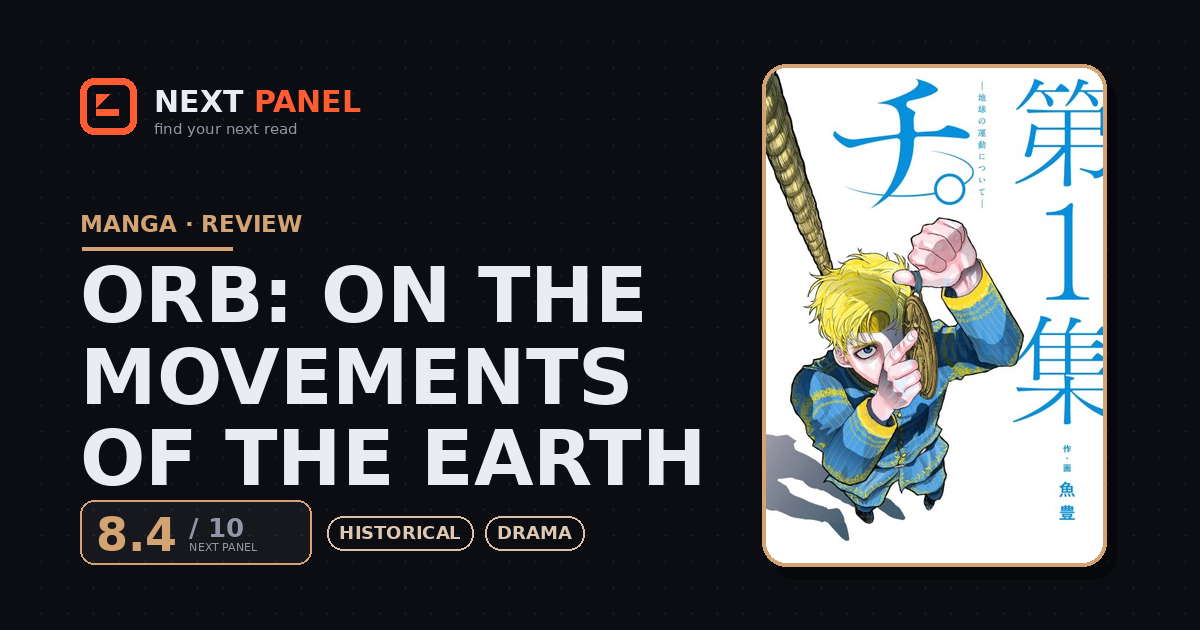
Is Orb: On the Movements of the Earth Worth Reading? Review & Where to Read
Quick Answer
Yes, if you want big ideas over big action. Orb makes the fight to prove the Earth moves genuinely gripping, and it's gorgeously drawn. Just know it gets preachy and swaps protagonists in ways that can feel abrupt.
Quick Verdict
“Uoto turns a math problem into life-or-death drama, and even when it preaches, it's one of the most ambitious manga you'll pick up.”
Best for: Readers who love history, philosophy, and characters willing to die for an idea.
Not for: Readers who want steady action, a single lead to follow, or a light, easy read.
- Type
- Manga
- Genres
- Drama, Historical
- Status
- Completed
- This review
- Minor Spoilers
- Author
- Uoto
- Publisher
- Shogakukan
- Platform
- Seven Seas Entertainment
| Quick facts | |
|---|---|
| Format | Manga (seinen), 62 chapters, 8 volumes |
| Run | 2020–2022 · completed |
| Community score | AniList 8.2 · MangaUpdates 7.4 |
| Content | Violence, torture, religious persecution |
| Where to read | Seven Seas Entertainment — official |
Overview
Orb: On the Movements of the Earth is a historical drama by Uoto, set in a fictional version of 15th-century Europe where believing the Earth orbits the sun can get you tortured and killed. The Church has declared the heliocentric model heresy, but a handful of people, a gifted student, a jailed heretic, a hired thug, a young woman shut out of scholarship, keep chasing the idea anyway, passing their forbidden research from one set of hands to the next. It won the Tezuka Osamu Cultural Prize, and it's easy to see why: it takes a dry astronomy problem and turns it into a matter of life and death.
What it does well
The central trick is making an abstract idea feel thrilling. Nobody here is throwing punches over treasure; they're risking the stake over whether the Earth moves. Uoto sells that tension so well that a character sketching planetary orbits by candlelight can be more gripping than most action scenes. When someone finally watches the math click into place, the book treats it like a religious experience, and you feel it too.
It's also gorgeous and grim in equal measure. The art swings between the quiet wonder of the night sky and the very real brutality of the Inquisition, and it doesn't flinch from either. It takes its themes seriously, as well. Faith, doubt, reason, and obsession all get honest weight, so the believers aren't strawmen and the truth-seekers aren't flawless heroes. The structure is unusual, too: instead of one lead, the story runs like a relay race, handing the pursuit of knowledge from one doomed character to the next across years. That gives the whole thing a sweep a single-hero story couldn't manage.
Where it falls short
Orb has a preachy streak. It sometimes stops cold to lecture you about truth, reason, and the beauty of inquiry, and the speeches can run long enough that you feel the author's thumb on the scale. If you don't already share its worldview, some of it will land as a sermon.
The relay structure cuts both ways, too. Characters you've grown attached to get written out, sometimes abruptly, and the focus jumps to someone new just as you'd settled in. It's an intentional design, but it keeps you at arm's length. And while the setting looks like real history, it isn't: the series bends events and invents its cast freely, so treat it as fiction about ideas rather than a record of how heliocentrism actually won.
Verdict
Orb is ambitious, beautiful, and genuinely moving when it's firing on all cylinders, which is often. It asks you to care about an idea more than any single character, and mostly it earns that. Go in ready for some lecturing and some heartbreak as the cast turns over, and you'll get one of the most distinctive manga of its era. Seven Seas publishes it in English omnibuses, so it's easy to find, and it's one worth reading slowly.
Strengths & Weaknesses
Strengths
- It makes an abstract idea, that the Earth moves, feel urgent and dangerous, which is a genuinely hard trick to pull off.
- The art is striking and atmospheric, selling both the awe of discovery and the horror of the Inquisition.
- It takes its themes seriously: faith, doubt, and obsession get real weight instead of easy answers.
- The relay-race structure, where knowledge passes from one doomed character to the next, gives it a real sense of scale.
Weaknesses
- It can get preachy, stopping the story to lecture about truth and reason more than it needs to.
- Protagonists change or die between arcs, so just as you bond with someone the focus moves on, which won't suit everyone.
- It plays loose with real history, so don't come to it for an accurate account of who actually discovered what.
Similar Titles
The same historical weight and moral seriousness, following people wrestling with big ideas.
Gorgeous, contemplative historical drama about obsession and the cost of a single-minded pursuit.
If you love the thrill-of-discovery angle, a lighter, more adventurous take on science as wonder.
Where to Read Officially
| Platform | Format | Pricing | Region notes | Link |
|---|---|---|---|---|
| Seven Seas Entertainment | Print & digital omnibus volumes | Paid | Region availability varies | Open |
Frequently Asked Questions
Is Orb based on real history?
Loosely. It's set in a fictional stand-in for 15th-century Europe and invents its characters, so treat it as historical fiction about ideas, not a textbook.
Do I need to understand astronomy to follow it?
No. The science is explained simply, and the real focus is the people risking everything for it.
Is there an official English release?
Yes. Seven Seas Entertainment publishes it in English in 2-in-1 omnibus volumes, in both print and digital.