Is Oregairu Worth Reading? Review & Where to Read
Quick Answer
If you want a slow-burn character study dressed up as a rom-com, yes — this adaptation carries over Hachiman's cynicism and the show's genuine interest in what 'helping' actually costs. If you're only after fast, breezy comedy, look elsewhere.
Quick Verdict
“Hachiman's narration is the whole show — funny and self-lacerating in equal measure, and it earns the slow, uncomfortable turn the story eventually takes.”
Best for: Readers who want a romantic comedy that takes its characters' loneliness and self-deception seriously.
Not for: Readers who want a lighthearted, low-stakes school comedy without a lot of internal monologue.
- Type
- Manga
- Genres
- Romance, Comedy
- Status
- Completed
- This review
- Minor Spoilers
- Author
- Wataru Watari (original story)
- Artist
- Naomichi Io
- Publisher
- Shogakukan (Monthly Sunday Gene-X)
- Platform
- Yen Press
| Quick facts | |
|---|---|
| Format | Manga (shōnen) |
| Run | completed |
| Content | None significant |
Overview
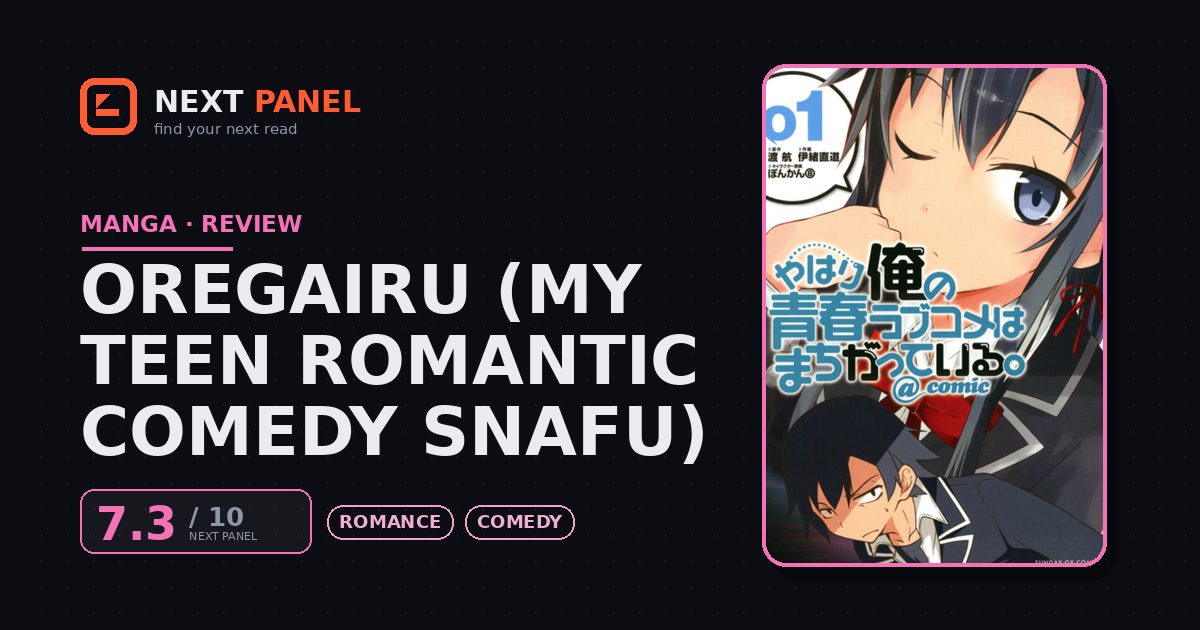
Hachiman Hikigaya has decided that friendship, romance, and most forms of social effort are a waste of time — a conclusion he defends with real conviction in a school essay that gets him drafted straight into the Service Club, a two-person operation whose entire purpose is to help other students with their problems. Naomichi Io's manga adaptation of Wataru Watari's My Teen Romantic Comedy SNAFU (Oregairu) picks up from there, running 22 volumes as Hachiman, the icy overachiever Yukino Yukinoshita, and the eager-to-please Yui Yuigahama tackle one thorny request after another, usually by solving the actual problem rather than the one anyone asked them to.
What it does well
The manga's biggest asset is carrying over Hachiman's narration intact — cutting, self-aware, and frequently very funny, but never just a joke delivery system. It does real work explaining why he's built his particular brand of defensive cynicism, which keeps the comedy from feeling hollow. The Service Club's approach to 'helping' — often blunt, sometimes at real personal cost to Hachiman — gives each arc a specific shape instead of falling back on generic school-comedy beats.
What elevates it further is that Yukino and Yui aren't simply love-interest slots. Both are given their own defenses, blind spots, and reasons for the roles they've settled into, which makes the slow unraveling of all three characters' self-deceptions feel earned rather than mechanical. The manga does a genuinely good job translating a novel built on dense internal monologue into something that reads visually, without losing the introspective quality that made the source material distinct from a standard rom-com.
Where it falls short
This is a patient story, and it asks patience of its reader — the early volumes spend real time establishing the club's dynamic before the emotional stakes start compounding, which can feel slow if you're expecting a faster rom-com rhythm. Hachiman's cynicism, while well-drawn, is also the engine the whole story runs on, and there are stretches where the joke of his worldview outlasts its welcome before the narrative lets him be genuinely wrong about something. Some of the more comedic supporting cast members stay fairly thin, mostly there to lighten the tone between heavier beats.
Verdict
Oregairu's manga adaptation is a slow-burn character study wearing a romantic comedy's clothes, and it earns that disguise through genuinely sharp narration and a cast that's allowed to be wrong about themselves for a long time before anything resolves. If you want a rom-com that takes its characters' loneliness seriously, it delivers. If you want something lighter and faster, this isn't it.
Strengths & Weaknesses
Strengths
- Hachiman's caustic internal narration is genuinely funny while also doing real work establishing why he's built the walls he has, rather than just being a gimmick voice.
- The Service Club's 'fix problems the hard way' premise gives every arc a concrete, specific conflict instead of generic school-rom-com filler.
- Yukino and Yui are drawn as people with their own defenses and blind spots, not just points on a love-triangle chart.
- The manga translates the light novel's dense internal monologue into visual beats without losing what made the prose version work.
Weaknesses
- The pace is deliberately slow, and readers expecting quick rom-com payoffs may find the early volumes frustrating.
- Hachiman's cynicism is the whole engine of the story, and it can wear thin in stretches before the manga lets him be wrong about something.
- Some of the broader comedic side characters get less depth than the core trio, existing mostly for tonal relief.
Similar Titles
A different setup, but a similar interest in prickly characters slowly admitting what they actually want.
Rascal Does Not Dream of Bunny Girl Senpai
Shares the introspective, narration-heavy approach to a teenage romance that takes its characters' insecurities seriously.
Frequently Asked Questions
Is the Oregairu manga finished?
Yes, the manga adaptation ('...@comic' by Naomichi Io) is complete at 22 volumes, running from 2012 to 2023.
Is the Oregairu manga the same story as the light novel?
It adapts the same story as Wataru Watari's original light novels, condensing the prose's heavy internal monologue into manga form.
Where can I read Oregairu in English?
Yen Press has released the full manga in English print and digital editions.