Is Persona 3 (Manga) Worth Reading? Review & Where to Read
Quick Answer
If you've played Persona 3 and want to revisit its story and cast in comic form, yes — Sogabe's art suits the SEES team well. If you haven't played the game, it's still a solid dark-fantasy school story on its own.
Quick Verdict
“Faithful to a fault, and best appreciated as a companion to the game rather than a reinvention of it.”
Best for: Fans of the Persona 3 game who want to revisit its story and characters in comic form.
Not for: Readers who want a story that diverges from or expands meaningfully on its source material.
- Type
- Manga
- Genres
- School Life, Supernatural
- Status
- Completed
- This review
- Minor Spoilers
- Author
- Shuji Sogabe
- Publisher
- ASCII Media Works
- Platform
- UDON Entertainment
| Quick facts | |
|---|---|
| Format | Manga (shōnen), 50 chapters, 11 volumes |
| Run | 2007–2017 · completed |
| Community score | AniList 7.5 · MangaUpdates 7.3 |
| Content | Violence, themes of death |
| Where to read | UDON Entertainment — official |
Overview
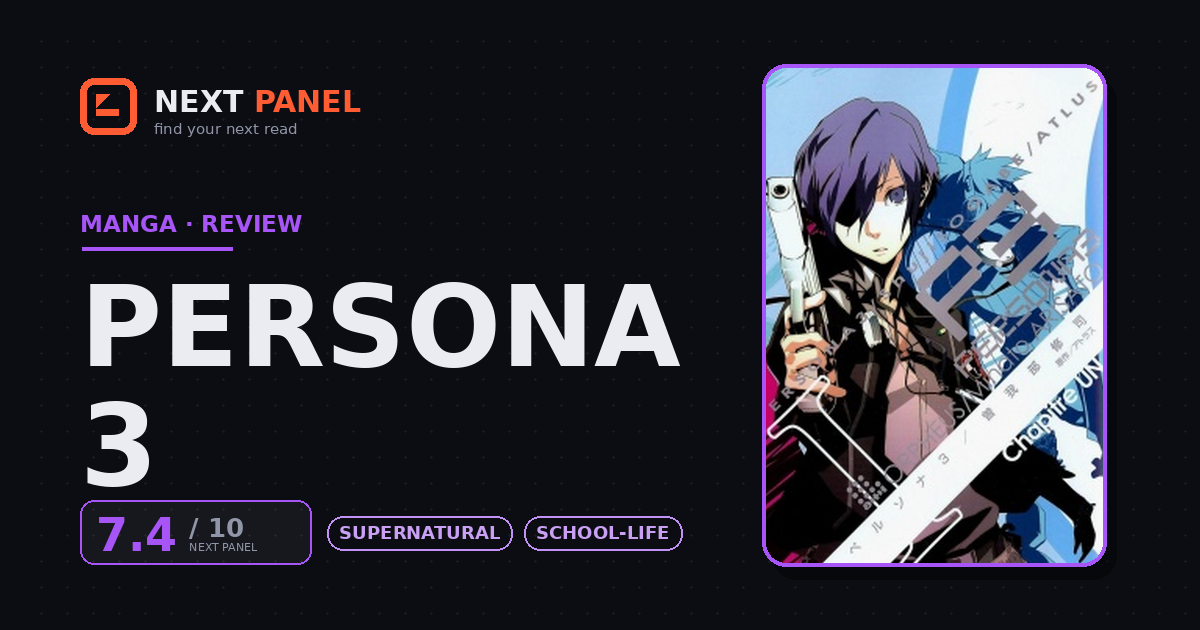
Persona 3's manga does what most good game adaptations try to do: it takes a story you might already know — a transfer student who discovers the hidden Dark Hour and joins a team of Persona users fighting Shadows from within a mysterious tower — and gives it room to breathe as a straightforward comic. Shuji Sogabe handles both story and art, following the SEES team from their first Tartarus climb through to the game's ending, and the choice to put one person in charge of both writing and drawing gives the whole run a consistent feel that some multi-creator adaptations lack.
The plot beats will be familiar to anyone who's played the game: the protagonist moves into the dorm, awakens their Persona, and slowly pulls Yukari, Junpei, Mitsuru, and the rest of SEES into the fight against the Dark Hour and the Shadows that come with it. What's different here is pacing and focus — a comic can linger on a facial expression or a quiet hallway conversation in a way a JRPG's dialogue boxes usually can't.
What it does well
Sogabe draws the cast with clear, expressive character work, and the Personas themselves come through with real visual punch when they're summoned — the Evoker-to-Persona reveal panels in particular land with more weight than you'd expect from a fairly simple visual gimmick. The Dark Hour setting carries genuine atmosphere here, too. Tartarus especially benefits from a slower, more deliberate page-by-page pace than a video game dungeon crawl usually allows, letting the dread build floor by floor instead of compressing it into a loading screen.
The manga also uses its format well to slow down for character beats between missions, giving names like Yukari, Junpei, and Mitsuru a bit more room to just exist as people rather than combat roles waiting for their next fight. A few small scenes — dorm conversations, throwaway jokes between missions — get more space than the game ever gave them, and they add up to a cast that feels a little more lived-in on the page.
Where it falls short
Because it's such a faithful adaptation, the manga rarely deviates from the game's story or pacing, which means anyone who's already played Persona 3 won't find many surprises here. If you know the game beat for beat, you'll know exactly where this is going scene by scene, and the comic doesn't do much to complicate or reinterpret what you already know.
Some of the game's social-link side stories get trimmed or skipped entirely, and a few supporting characters end up thinner as a result — several Social Link partners who got whole arcs in the game are reduced to a cameo or two here. It also only covers the base game, stopping before the FES/Portable epilogue The Answer, so anyone hoping for that material won't find it in these pages. Readers coming in cold, without game familiarity, may also find some of the mechanics-derived worldbuilding (Personas, Arcana, the Dark Hour's rules) explained a little quickly.
Verdict
This is a well-crafted, faithful companion piece for people who already love Persona 3, and a perfectly solid dark-fantasy school story even if you haven't played it. Sogabe's art suits the SEES cast and gives Tartarus real atmosphere, but don't expect the manga to reinvent anything the game already did — it's a comic made to sit alongside the source material, not replace or reimagine it.
Strengths & Weaknesses
Strengths
- Sogabe's art gives the SEES cast real personality, and the Personas themselves look sharp translated to the page.
- The Dark Hour setting still generates real dread, with Tartarus feeling appropriately oppressive across the volumes.
- Quieter character moments between missions get room to breathe, which helps the cast feel like actual people rather than combat roles.
- It's a complete, self-contained adaptation that doesn't require any familiarity with the game to follow.
Weaknesses
- The manga sticks closely to the game's plot and pacing, so anyone who's already played it will find few surprises.
- Some of the game's social-link relationships get compressed or cut, thinning out a few side characters.
- It ends where the base game does, so if you're looking for The Answer's epilogue story, it isn't here.
Similar Titles
Digimon
Another faithful comic adaptation of a beloved game/anime property aimed at existing fans.
Beet the Vandel Buster
A different flavor of supernatural-tinged shōnen fantasy with a young ensemble cast.
Franken Fran
A darker, more horror-leaning read for fans of Persona's Dark Hour atmosphere.
Where to Read Officially
| Platform | Format | Pricing | Region notes | Link |
|---|---|---|---|---|
| UDON Entertainment | Print & digital volumes | Paid | Region availability varies | Open |
Frequently Asked Questions
Do I need to have played Persona 3 to read the manga?
No — it's a self-contained retelling of the game's story that works fine without any prior knowledge, though fans of the game will get the most out of recognizing the cast and Personas.
Does the Persona 3 manga include The Answer?
No, it only adapts the base game's story and ends where that does, so the FES/Portable epilogue content isn't covered.
Is the Persona 3 manga finished?
Yes — it ran from 2007 to 2017 and is a complete 11-volume adaptation.