Is Phoenix Worth Reading? Review & Where to Read
Quick Answer
Yes, if you want ambition over neatness. Phoenix is Tezuka reaching for the biggest questions there are, told as twelve linked stories across thousands of years. It's uneven and was never fully finished, but the best volumes are among the finest comics ever drawn.
Quick Verdict
“Tezuka spent thirty years swinging at life, death, and the whole universe across twelve stories — and he connects far more often than anyone had a right to.”
Best for: Readers who want big, philosophical stories and don't mind an anthology that jumps around in time.
Not for: Readers who want one continuous plot and a tidy, finished ending.
- Type
- Manga
- Genres
- Drama, Sci-Fi
- Status
- Completed
- This review
- Minor Spoilers
- Author
- Osamu Tezuka
- Publisher
- VIZ Media
- Platform
- Kodansha (Spring 2027)
| Quick facts | |
|---|---|
| Format | Manga, 134 chapters, 16 volumes |
| Run | 1966–1988 · completed |
| Community score | AniList 8.4 · MAL 8.6 |
| Where to read | VIZ — official |
Overview
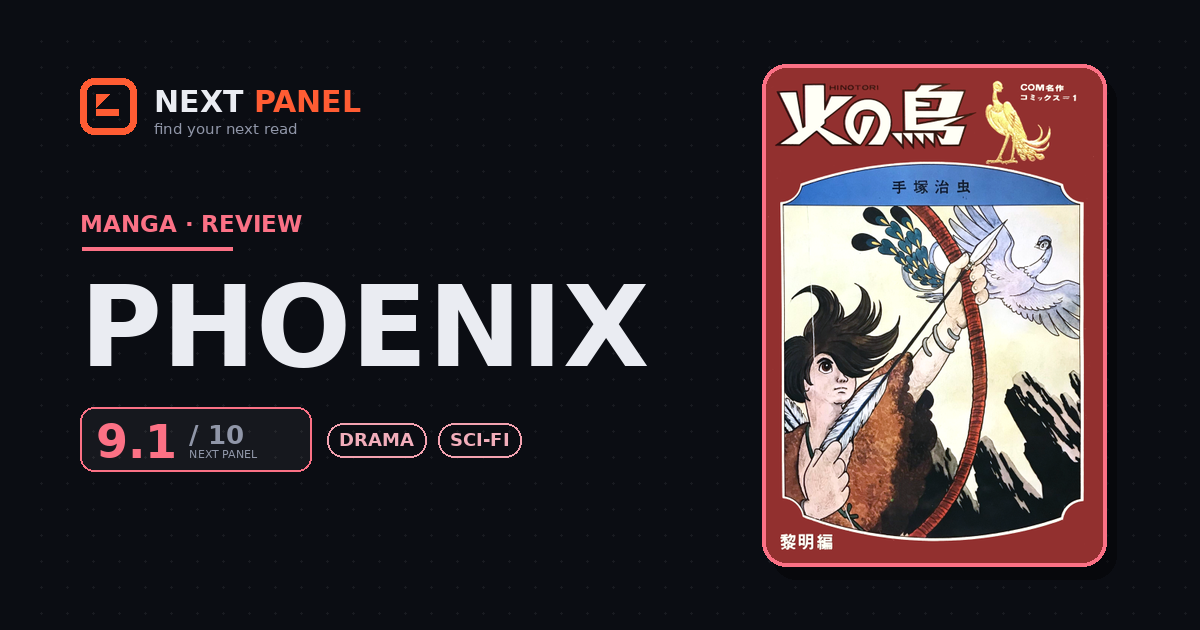
Phoenix (Hi no Tori) was Osamu Tezuka's life's work. He started it in the 1950s and was still drawing it when he died in 1989, and you can feel that across the twelve volumes. It isn't one story. It's a set of self-contained tales, each set in a different time period, alternating between the distant past and the far future and slowly working toward the present. The one thread connecting them is the phoenix itself — a bird whose blood grants immortality, which is exactly what most of the human characters think they want.
If you've only read Tezuka's lighter stuff, this is the serious end of what he could do. It's ambitious in a way very few comics even attempt.
What it does well
The big draw is the scope. Each volume hands you a complete story — a king chasing eternal life, a lone survivor on a dead Earth, a sculptor, a scientist — and then the next volume jumps centuries in the other direction. On their own they're strong. Stacked together, they start arguing with each other about the same handful of ideas: death, rebirth, greed, what a single life is actually worth. By the time you've read a few, you stop reading them as separate stories and start feeling the shape of the whole thing.
The art is the other reason to pick this up. Tezuka was experimenting constantly, and the page layouts here were years ahead of his peers. He breaks the panel grid for the big cosmic moments, plays with scale, and switches registers from cartoony to genuinely awe-inspiring without it feeling jarring. For a series this old, it almost never looks creaky on the page.
The reincarnation structure also pays off the more you read. Characters get reused, ideas echo, and small details in one era turn up transformed in another. It rewards attention and rereading in a way most long series don't.
Where it falls short
It's an anthology, and anthologies are uneven. A couple of the volumes simply aren't as gripping as the best ones, and which ones land will depend on your taste — some readers love the historical arcs, others only click with the science-fiction ones. The momentum stops and restarts with each new era, so it doesn't build the way a single continuous story does.
The bigger catch is that Phoenix is unfinished. Tezuka planned a final arc set in the present day that would tie the past and future strands together, and he died before drawing it. The published volumes are complete and satisfying on their own, but the grand design never gets its capstone.
A few of Tezuka's older habits also show their age — the slapstick humor and his trick of reusing the same character designs like a troupe of actors can throw new readers.
Verdict
Phoenix is a flawed masterpiece, and it's worth reading precisely because of how big it swings. No single volume is perfect, the tone wanders, and the ending you'd want was never drawn. But the ambition — one artist spending three decades trying to say something true about living and dying — comes through on nearly every page. If you care about comics as an art form, this is essential, uneven edges and all.
Strengths & Weaknesses
Strengths
- The scope is enormous. Each volume is its own self-contained story in a different era, and read together they build one long argument about life, death, and what we do with the time in between.
- Tezuka's page design was decades ahead of everyone else. The panel layouts, the way he breaks the grid for big moments, the cosmic splash pages — it still reads as inventive now.
- The reincarnation structure ties everything together. Faces, names, and ideas recur across volumes, so the more you read the more the whole thing rhymes.
Weaknesses
- It's an anthology, so the quality swings. A couple of volumes drag next to the strongest ones, and which is which depends on your taste.
- Tezuka died in 1989 before drawing the planned final present-day arc, so the saga stops rather than truly lands.
- Some of the older humor and Tezuka's habit of reusing his characters as a 'cast of actors' can feel dated if you're new to his work.
Similar Titles
Another humane, big-idea Tezuka story (via Urasawa) about what makes us human.
Tezuka's other sprawling philosophical epic about life and death.
A long, serious epic wrestling with violence and the meaning of a life.
Where to Read Officially
| Platform | Format | Pricing | Region notes | Link |
|---|---|---|---|---|
| Kodansha (Spring 2027) | Deluxe hardcover (preorder; ships Spring 2027) | Free + Paid | VIZ's 2002-2008 English edition is out of print. Kodansha's new Deluxe Edition debuts Spring 2027 (announced at Anime Expo 2026; preorder stage, not yet available to read or buy). | Open |
Frequently Asked Questions
Do I need to read Phoenix in order?
Not strictly — each volume stands alone. But reading in publication order lets you feel the past arcs and future arcs slowly converge, which is the point of the whole structure.
Is Phoenix finished?
The 12 published volumes are complete stories, but Tezuka died in 1989 before drawing the final present-day arc he planned. So the books are readable and whole, while the overall saga is technically unfinished.
Where can I read Phoenix in English?
VIZ Media published all 12 volumes in English. They're available digitally on viz.com and the VIZ Manga app, with a free preview of Volume 1.